
Hanwha QNV-6082R1 vs i-PRO S35302-F2L1: Specification Comparison
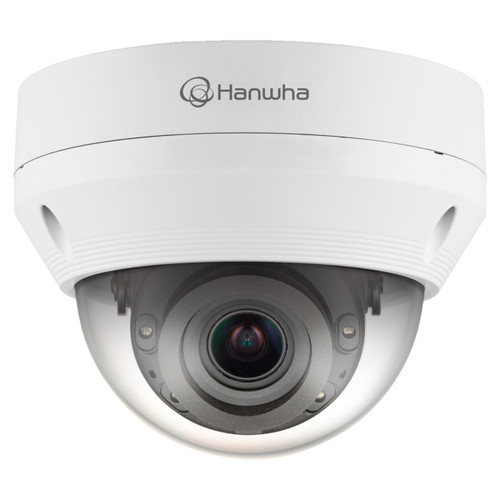
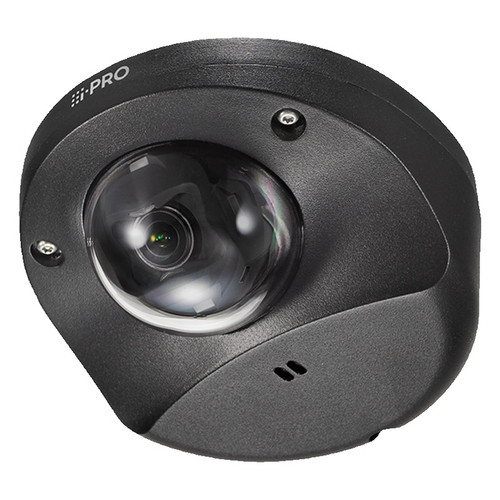
Both the Hanwha QNV-6082R1 and i-PRO WV-S35302-F2L1 are 2MP outdoor vandal-resistant dome cameras aimed at the same general market segment of perimeter and facility surveillance. The Hanwha unit pairs a motorized varifocal lens with 30m IR and 120dB WDR, while the i-PRO model delivers a fixed wide-angle lens, 144dB Super Dynamic WDR, on-camera AI classification, and a 5-year warranty. This comparison examines how their imaging, installation, and integration profiles differ to help installers and IT buyers match the right unit to their deployment.
In This Guide
How do the imaging specs compare?
The QNV-6082R1 uses a 1/2.8-inch 2MP CMOS sensor outputting 1920×1080 at 30fps. Its 3.2–10mm motorized varifocal lens (3.1× zoom, F1.6 wide) provides a horizontal field of view of 109° at wide end, giving installers flexible framing at commissioning without manual lens changes. Minimum illumination is 0.03 Lux color / 0 Lux IR, with built-in IR illuminators rated to 30m. WDR is specified at 120dB. The WV-S35302-F2L1 also uses a 1/2.8-inch 2MP CMOS but resolves to 2048×1536 (the spec sheet lists this native resolution, though a card bullet references 1920×1080 at 60fps—the datasheet figure is used here). Its fixed 2.4mm lens delivers a 132° horizontal field of view and F2.1 aperture. Minimum illumination is 0.02 Lux color / 0 Lux IR, and the Super Dynamic WDR is rated at 144dB—24dB above the Hanwha.
IR range favors the Hanwha at 30m vs. the i-PRO's 21m (both at 30IRE). The Hanwha's motorized zoom also produces substantially greater detection/identification reach in the DORI table: at tele, it detects to 128.8m vs. the i-PRO's fixed-lens 17.1m detect distance, reflecting the varifocal advantage for longer-range scene coverage. The i-PRO counters with its wider native FOV (132° vs. 109°), better suited to large open-area coverage from a single mount point. Frame rate is 30fps fixed for the Hanwha; the i-PRO spec lists 'variable' with no maximum fps stated for the primary stream.
What about installation and environment?
Both cameras carry IP66 and IK10 ratings and are PoE-powered. The Hanwha accepts PoE (IEEE 802.3af, Class 3) or 12VDC, drawing up to 7.7W. The i-PRO is PoE-only (802.3af, Class 0 per spec), drawing up to 8.6W—slightly higher, which matters on switch port budgets. Operating temperature for the Hanwha is –30°C to +55°C; the i-PRO extends cold-end performance significantly to –40°C to +50°C (noting the spec also states PoE operation limited to –20°C to +50°C), making it better suited for harsh-cold environments. The i-PRO additionally carries NEMA 4X and Type 4X (UL50E) ratings alongside its IP66, adding corrosion-resistance certification relevant to coastal or industrial sites.
Physically, the i-PRO is lighter and more compact (approx. 475g / 1.05 lb, 109×53×119mm) compared to the Hanwha (710g / 1.57 lb, Ø137×106.1mm). The Hanwha lists a CVBS analog output for installer-mode alignment. The i-PRO specifies wind resistance up to 40 m/s (~89 mph). The Hanwha lists compatible accessories including a hanging mount (SBP-301HMW2) and backbox (SBV-136BW); the i-PRO lists no specific accessory part numbers in the provided spec.
Which fits your VMS and analytics better?
Both cameras support ONVIF Profiles G, M, S, and T, covering the primary VMS integration bases. The Hanwha supports Wisenet SUNAPI (HTTP API) and the Wisenet open platform in addition to ONVIF. Analytics on the Hanwha include defocus detection, directional detection, virtual line, enter/exit, and tampering—all processed on-camera. The i-PRO adds AI-grade face, people, and vehicle detection, plus AI Sound Classification (gunshot, yell, vehicle horn, glass break) using the Ambarella CV25M SoC—capabilities not listed for the Hanwha. The i-PRO also provides Scene Change Detection and up to 14 simultaneous users vs. the Hanwha's 6 unicast users.
Edge storage tops out at 128GB microSD on the Hanwha; the i-PRO supports up to 512GB SDXC. For audio, the Hanwha lists 'Audio In: None / Audio Out: None' in its primary spec fields, though a separate field references 'Audio input'—no audio compression codec is listed; the i-PRO explicitly supports G.726, G.711, and audio detection. Security posture differs: the i-PRO carries FIPS 140-2 Level 3 certification and signed firmware, relevant for government and critical-infrastructure deployments; the Hanwha lists 802.1X (EAP-TLS, EAP-LEAP), HTTPS/SSL, and digest authentication but no FIPS listing. Alarm inputs/outputs are 1-in/1-out on the Hanwha; the i-PRO spec does not list discrete alarm I/O terminals.
Which should you choose: the QNV-6082R1 or the S35302-F2L1?
Our take: The WV-S35302-F2L1 is the stronger choice when AI analytics, wider environmental certification, or long-term warranty are primary requirements; the QNV-6082R1 is the stronger choice when motorized varifocal reach, dual-power flexibility, or Wisenet VMS ecosystem integration drives the decision. Key spec deltas: (1) WDR—i-PRO's Super Dynamic measures 144dB vs. Hanwha's 120dB, a meaningful 24dB advantage in high-contrast scenes; (2) IR range—Hanwha reaches 30m vs. i-PRO's 21m, and varifocal tele detection extends to 128.8m vs. i-PRO's fixed-lens 17.1m; (3) Edge storage—i-PRO supports up to 512GB microSD vs. Hanwha's 128GB cap; (4) Warranty—i-PRO carries a 5-year warranty vs. Hanwha's 3-year. For cold-climate or NEMA 4X-required sites the i-PRO's –40°C rating and UL50E certification provide clear regulatory compliance that the Hanwha does not match.
Side-by-Side Comparison
Spec-for-spec, from manufacturer data.
| Specification | Hanwha QNV-6082R1 | i-PRO S35302-F2L1 |
|---|---|---|
| Resolution | 1920×1080 | 2048×1536 |
| Image Sensor | 1/2.8" 2MP CMOS | 1/2.8" 2MP CMOS |
| Lens / Focal Length | 3.2–10mm motorized varifocal (3.1×) | 2.4mm fixed |
| Horizontal FOV | 109.0° (wide) | 132° (16:9) |
| Min. Illumination (Color) | 0.03 Lux | 0.02 Lux |
| IR Range | 30m (98.4ft) | 21m (68.9ft) |
| WDR | 120dB | 144dB (Super Dynamic) |
| Max Frame Rate | 30fps | Variable (max not specified) |
| Video Compression | H.265, H.264, MJPEG | H.265, H.264, JPEG |
| IP Rating | IP66 | IP66, NEMA 4X, Type 4X (UL50E) |
| IK / Impact Rating | IK10 | IK10 |
| Operating Temperature | −30°C to +55°C | −40°C to +50°C (PoE: −20°C to +50°C) |
| Power Input / PoE Class | PoE 802.3af Class 3 or 12VDC | PoE 802.3af Class 0 |
| Max Power Draw | 7.7W | 8.6W |
| Edge Storage | microSD up to 128GB | microSD/SDXC up to 512GB |
| Audio | Not specified (no codec listed) | G.726, G.711; audio detection; AI sound classification |
| AI Analytics | Defocus, directional, enter/exit, virtual line, tampering | AI VMD, face, people, vehicle detection; AI sound classification |
| Simultaneous Users | 6 (unicast) | Up to 14 |
| ONVIF Profiles | G, M, S, T | G, M, S, T |
| Security Certification | 802.1X EAP-TLS/LEAP, HTTPS | FIPS 140-2 Level 3, HTTPS, 802.1X, signed firmware |
| Alarm I/O | 1 input / 1 output | Not specified |
| Dimensions | Ø137.0 × 106.1mm | 109 × 53 × 119mm |
| Weight | 710g (1.57 lb) | 475g (1.05 lb) |
| Warranty | 3 years | 5 years |
Frequently Asked Questions
Which should you choose: the QNV-6082R1 or the S35302-F2L1?
The WV-S35302-F2L1 is the stronger choice when AI analytics, wider environmental certification, or long-term warranty are primary requirements; the QNV-6082R1 is the stronger choice when motorized varifocal reach, dual-power flexibility, or Wisenet VMS ecosystem integration drives the decision. Key spec deltas: (1) WDR—i-PRO's Super Dynamic measures 144dB vs. Hanwha's 120dB, a meaningful 24dB advantage in high-contrast scenes; (2) IR range—Hanwha reaches 30m vs. i-PRO's 21m, and varifocal tele detection extends to 128.8m vs. i-PRO's fixed-lens 17.1m; (3) Edge storage—i-PRO supports up to 512GB microSD vs. Hanwha's 128GB cap; (4) Warranty—i-PRO carries a 5-year warranty vs. Hanwha's 3-year. For cold-climate or NEMA 4X-required sites the i-PRO's –40°C rating and UL50E certification provide clear regulatory compliance that the Hanwha does not match.
Is the QNV-6082R1 or WV-S35302-F2L1 better for low-light performance?
Both cameras reach 0 Lux with IR active. In ambient-light conditions the i-PRO specifies 0.02 Lux color minimum illumination vs. the Hanwha's 0.03 Lux—a marginal advantage for the i-PRO. However, the Hanwha's IR illuminators are rated to 30m vs. the i-PRO's 21m, so the Hanwha covers more distance in complete darkness.
Which camera handles high-contrast scenes better—parking lots with headlights, for example?
The i-PRO WV-S35302-F2L1 specifies 144dB Wide Dynamic Range (Super Dynamic), compared to 120dB on the Hanwha QNV-6082R1. In high-contrast environments such as entry points or parking areas with vehicle headlights, the i-PRO's 24dB higher WDR rating provides greater latitude to retain detail in both bright and shadowed zones simultaneously.
Can either camera work without a VMS for on-camera analytics?
Yes, but their on-board analytics differ significantly. The Hanwha QNV-6082R1 provides defocus detection, directional detection, virtual line, enter/exit, and tampering analysis on-camera via its WiseStream II engine. The i-PRO WV-S35302-F2L1 goes further with AI-based face, people, and vehicle detection plus AI Sound Classification (gunshot, yell, vehicle horn, glass break) using its Ambarella CV25M SoC—making it the stronger standalone analytics platform of the two.
Get a Second Opinion on Your Camera Choice
Share your site layout, coverage goals, and budget. Our team will validate the camera selection, flag anything we would change, and recommend products that match the use case.