
Hanwha QNV-6012R1 vs Hanwha QNV-6082R1: Specification Comparison
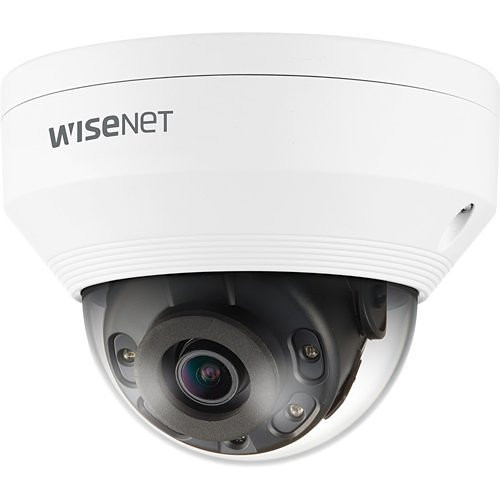
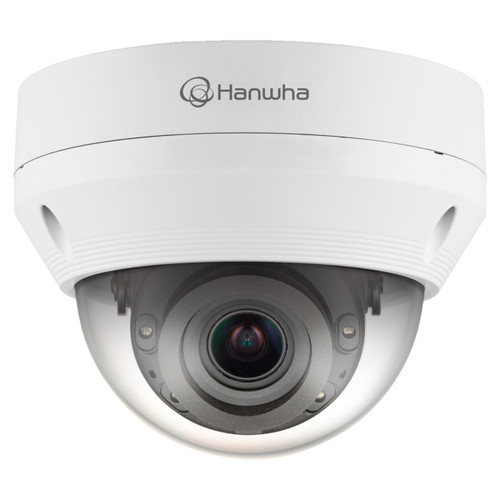
Both the Hanwha QNV-6012R1 and QNV-6082R1 are 2MP (1920×1080) vandal-resistant outdoor IR dome cameras sharing the same sensor class, resolution, frame rate, and PoE power standard. The core differentiator is the lens system: the QNV-6012R1 uses a fixed 2.8mm wide-angle lens, while the QNV-6082R1 offers a 3.2–10mm motorized varifocal lens with DC auto iris. Installers choosing between these two models are trading field-of-view flexibility and IR throw distance against a simpler, lighter, lower-cost fixed-lens deployment.
In This Guide
How do the imaging specs compare?
Both cameras share a 1/2.8" 2MP CMOS sensor, 1920×1080 resolution at 30fps, 120dB WDR, SSNR digital noise reduction, WiseStream II smart codec, and a minimum illumination of 0.03 Lux color / 0 Lux IR. The QNV-6012R1 uses a fixed 2.8mm lens at F2.0 with a horizontal FOV of 113.7°, making it well-suited for wide-area coverage at close to medium range. The QNV-6082R1 uses a 3.2–10mm motorized varifocal lens with DC auto iris ranging from F1.6 (wide) to F2.9 (tele), delivering a horizontal FOV of 109.0° at the wide end and significantly tighter framing at tele. The wider aperture at the varifocal's wide end (F1.6 vs F2.0) provides marginally better light gathering in ambient-light conditions.
IR throw distance differs meaningfully: the QNV-6012R1 is rated at 20m (65.62ft), while the QNV-6082R1 reaches 30m (98.42ft). DORI performance reflects this gap — in tele mode, the QNV-6082R1 achieves a detection distance of 128.8m versus the QNV-6012R1's 25.1m, and an identification distance of 12.9m (tele) versus 2.5m. In wide mode, DORI figures are comparable between the two models. Focus control is fixed on the QNV-6012R1 and "simple focus" (motorized, remotely adjustable) on the QNV-6082R1, which also supports DC auto iris for improved exposure control in varying lighting.
What about installation and environment?
Both cameras are IP66-rated and IK10-rated (the QNV-6082R1 lists these explicitly under Certification; the QNV-6012R1 lists them under product attributes). Both accept PoE IEEE 802.3af Class 3 or 12VDC. The QNV-6012R1 draws a maximum of 7.40W versus 7.70W for the QNV-6082R1 — a negligible difference on a Class 3 budget. Operating temperature for the QNV-6012R1 is specified at -10°C to +55°C in the primary spec field (a separate attribute field lists -30°C, which appears inconsistent — installers should verify against the datasheet). The QNV-6082R1 specifies -30°C to +55°C, giving it a confirmed wider cold-weather operating range.
Form factor and mounting options diverge significantly. The QNV-6012R1 is a compact plastic housing measuring Ø110.0×86.0mm and weighing 255g (0.56 lb), with no listed conduit/gangbox compatibility or accessory mounts in the spec data. The QNV-6082R1 uses an aluminum housing at Ø137.0×106.1mm, weighing 710g (1.57 lb), and supports single, double, and 4" octagon conduit/gangbox knockouts, a hanging mount (SBP-301HMW2), and a backbox (SBV-136BW). The aluminum construction and broader mounting ecosystem make the QNV-6082R1 more suited for conduit-fed commercial installations.
Which fits your VMS and analytics better?
Both cameras support ONVIF Profile S/G/T, SUNAPI (HTTP API), and Wisenet open platform, making them compatible with the same range of VMS platforms. The analytics feature set is identical across both models: defocus detection, directional detection, motion detection (4 polygonal zones), Enter/Exit, tampering, and virtual line. Privacy masking supports 6 rectangular zones on both. Neither model lists audio input or output in the primary spec fields, though the QNV-6082R1 has an attribute entry noting "Audio input" — installers should confirm against the datasheet before designing in audio recording.
Edge storage is identical: Micro SD/SDHC/SDXC, single slot, up to 128GB, on both models. RAM and flash are the same (512MB RAM / 256MB Flash). Protocol support is equivalent, including SNMPv1/v2c/v3, 802.1X (EAP-TLS, EAP-LEAP), HTTPS/SSL, and digest authentication. Both carry a 3-year warranty. Neither model lists a serial interface, audio output, or coaxial protocol. For VMS integrators standardizing on SUNAPI or ONVIF, both cameras present an equivalent integration profile; the choice reduces to physical deployment requirements rather than software compatibility.
Which should you choose: the QNV-6012R1 or the QNV-6082R1?
Our take: The QNV-6082R1 is the stronger choice when the installation requires field-adjustable framing, longer IR throw, or conduit-compatible mounting in a permanent commercial installation. Its 3.2–10mm motorized varifocal lens allows remote focus adjustment post-mount, avoiding return visits — a practical advantage in high-ceiling or difficult-access locations. IR range extends to 30m versus the QNV-6012R1's 20m, a 50% increase that matters on longer parking aisles or building perimeters. The aluminum housing and listed gangbox/conduit compatibility (single, double, 4" octagon) suit conduit-fed commercial work. Conversely, the QNV-6012R1 is the appropriate choice for budget-sensitive, high-density deployments where wide-angle coverage at close range is sufficient: it is substantially lighter (255g vs 710g), draws marginally less power (7.40W vs 7.70W), and its 113.7° fixed FOV covers lobbies, corridors, and small retail areas without adjustment. Both cameras are ONVIF-compatible with identical analytics and edge storage.
Side-by-Side Comparison
Spec-for-spec, from manufacturer data.
| Specification | Hanwha QNV-6012R1 | Hanwha QNV-6082R1 |
|---|---|---|
| Resolution | 1920×1080 | 1920×1080 |
| Image Sensor | 1/2.8" 2MP CMOS | 1/2.8" 2MP CMOS |
| Max Frame Rate | 30fps | 30fps |
| Lens / Focal Length | 2.8mm fixed | 3.2–10mm (3.1×) motorized varifocal |
| Max Aperture | F2.0 | F1.6 (Wide) – F2.9 (Tele) |
| Horizontal FOV | 113.7° | 109.0° (Wide end) |
| Focus Control | Fixed | Simple focus (motorized, remote) |
| Min Illumination | 0.03 Lux color / 0 Lux IR | 0.03 Lux color / 0 Lux IR |
| IR Range | 20m (65.62ft) | 30m (98.42ft) |
| Wide Dynamic Range | 120dB | 120dB |
| IP / IK Rating | IP66 / IK10 | IP66 / IK10 |
| Operating Temperature | -10°C ~ +55°C (primary spec field) | -30°C ~ +55°C |
| Power Input / PoE Class | PoE IEEE802.3af Class 3 / 12VDC | PoE IEEE802.3af Class 3 / 12VDC |
| Max Power Draw | 7.40W | 7.70W |
| Housing Material | Plastic | Aluminum |
| Dimensions | Ø110.0×86.0mm | Ø137.0×106.1mm |
| Weight | 255g (0.56 lb) | 710g (1.57 lb) |
| Conduit / Gangbox Compatibility | — | Single, Double, 4" Octagon |
| Edge Storage | Micro SD/SDHC/SDXC, 1 slot, 128GB | Micro SD/SDHC/SDXC, 1 slot, 128GB |
| Video Compression | H.265 / H.264 / MJPEG | H.265 / H.264 / MJPEG |
| ONVIF | Profile S/G/T | Profile S/G/T |
| Audio In / Out | — / — | Audio input listed in attributes / — |
| Warranty | 3-year | 3-year |
Frequently Asked Questions
Which should you choose: the QNV-6012R1 or the QNV-6082R1?
The QNV-6082R1 is the stronger choice when the installation requires field-adjustable framing, longer IR throw, or conduit-compatible mounting in a permanent commercial installation. Its 3.2–10mm motorized varifocal lens allows remote focus adjustment post-mount, avoiding return visits — a practical advantage in high-ceiling or difficult-access locations. IR range extends to 30m versus the QNV-6012R1's 20m, a 50% increase that matters on longer parking aisles or building perimeters. The aluminum housing and listed gangbox/conduit compatibility (single, double, 4" octagon) suit conduit-fed commercial work. Conversely, the QNV-6012R1 is the appropriate choice for budget-sensitive, high-density deployments where wide-angle coverage at close range is sufficient: it is substantially lighter (255g vs 710g), draws marginally less power (7.40W vs 7.70W), and its 113.7° fixed FOV covers lobbies, corridors, and small retail areas without adjustment. Both cameras are ONVIF-compatible with identical analytics and edge storage.
Is the QNV-6012R1 or QNV-6082R1 better for low-light and nighttime use?
Both cameras share the same minimum illumination spec (0.03 Lux color / 0 Lux IR) and 120dB WDR. However, the QNV-6082R1 has a longer IR range (30m vs 20m) and a wider maximum aperture at its wide-end setting (F1.6 vs F2.0 fixed), which can improve light-gathering in ambient-lit scenes. For pure IR darkness at longer distances, the QNV-6082R1 holds an advantage.
Can I adjust the QNV-6082R1 lens remotely after mounting, and can I do the same with the QNV-6012R1?
Yes — the QNV-6082R1 uses a 3.2–10mm motorized varifocal lens with 'simple focus' control, meaning zoom and focus can be adjusted remotely via the web interface or VMS after installation. The QNV-6012R1 has a fixed 2.8mm lens with no remote focus or zoom capability; its field of view is set permanently at the factory.
Which camera is easier to install in a conduit-fed commercial environment?
The QNV-6082R1 is better suited for conduit-fed installations. Its spec sheet lists compatibility with single, double, and 4-inch octagon gangboxes, a hanging mount accessory (SBP-301HMW2), and a backbox (SBV-136BW). The QNV-6012R1 lists no conduit hole or gangbox compatibility in its specifications, and its plastic housing and lighter weight (255g vs 710g) are more typical of surface-mount retrofit scenarios.
Get a Second Opinion on Your Camera Choice
Share your site layout, coverage goals, and budget. Our team will validate the camera selection, flag anything we would change, and recommend products that match the use case.