
Hanwha QNV-6012R1 vs i-PRO X25300-V3LN: Specification Comparison
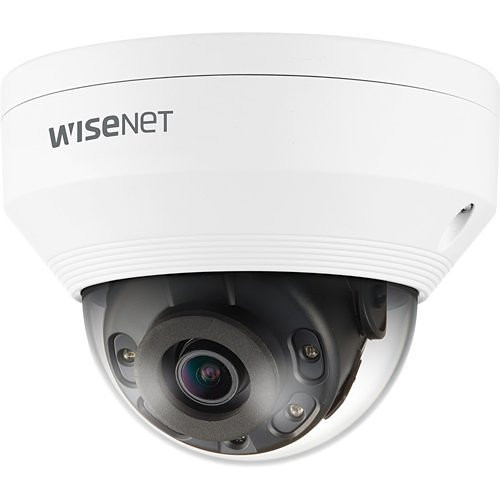
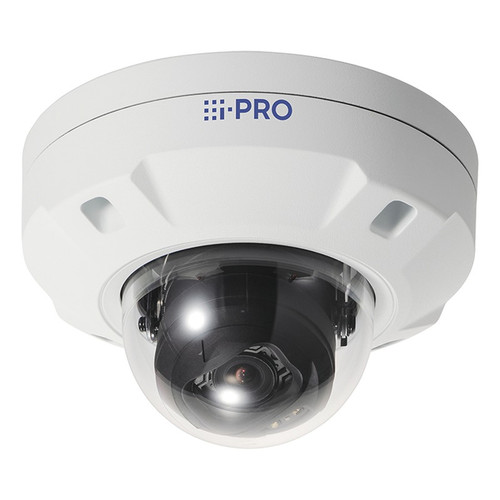
Both the Hanwha QNV-6012R1 and the i-PRO WV-X25300-V3LN are wired, outdoor, vandal-resistant IP dome cameras operating at 1920×1080 (2MP) resolution with built-in IR illumination, day/night ICR, H.265/H.264/MJPEG compression, ONVIF compatibility, and IK10 impact ratings. A buyer evaluating outdoor perimeter or entry-point surveillance in the 2MP dome category would legitimately cross-shop these two models, though they differ substantially in lens type, IR range, AI depth, PoE class, and construction materials.
In This Guide
How do the imaging specs compare?
Both cameras use an approximate 1/2.8-inch 2MP CMOS sensor delivering 1920×1080 at 30 fps. The QNV-6012R1 features a fixed 2.8mm lens with a wide 113.7° horizontal field of view, a maximum aperture of F2.0, and a minimum illumination of 0.03 lux color / 0 lux with IR active. Its IR illuminator reaches 20m (65.6 ft). The WV-X25300-V3LN carries a 3.1x motorized zoom lens (2.9–9mm, F1.3–F2.5 at wide), providing an adjustable horizontal FOV of 36°–113°, a minimum illumination of 0.005 lux (B&W, 50IRE, F1.5, 1/30s), and a substantially longer IR illuminator rated to 70m (230 ft). On DORI metrics at TELE, the i-PRO reaches a detect distance of 118.2m vs. 25.1m for the Hanwha.
Wide dynamic range also diverges: the QNV-6012R1 is specified at 120dB WDR via Hanwha's SSDR/BLC processing, while the WV-X25300-V3LN delivers up to 144dB with its Super Dynamic system (level 0–31 adjustable) plus an active fog compensation filter (range 0–8). The i-PRO also includes a built-in gyro-based image stabilizer active in 30fps mode, adaptive black stretch, and HLC with adjustable range; none of these features are listed in the Hanwha spec set. The Hanwha supports Hallway View (90°/270° rotation) which is absent from the i-PRO spec sheet.
What about installation and environment?
Both cameras carry IP66 ingress protection and IK10 impact resistance. The i-PRO WV-X25300-V3LN adds IP67 and full NEMA 4X / UL50E compliance, plus a tested wind resistance rating of up to 40 m/s (~89 mph) and 50J shock resistance per IEC 60068-2-75—specs not listed for the QNV-6012R1. The i-PRO housing is aluminum, stainless steel, and PC resin; the Hanwha housing is plastic (RAL9003 white).
On power: the QNV-6012R1 accepts PoE IEEE 802.3af (Class 3) or 12VDC, drawing a maximum of 7.4W—compatible with standard PoE switches. The WV-X25300-V3LN requires PoE+ (802.3at, Class 4) or DC12V at 1.2A, consuming up to 14W, which demands a PoE+ capable switch or injector and must be verified against switch port budgets. Operating temperature is -10°C to +55°C for the Hanwha (storage to -30°C) versus -40°C to +55°C (power-on from -30°C) for the i-PRO, giving the i-PRO a meaningful cold-start advantage in harsh climates. The i-PRO is significantly heavier at 1.1 kg (2.43 lbs) with a larger footprint (ø154×105mm) versus the Hanwha at 255g (0.56 lb) and ø110×86mm.
Which fits your VMS and analytics better?
Both cameras support ONVIF Profile S/G/T. The i-PRO WV-X25300-V3LN additionally supports ONVIF Profile M, which is relevant for metadata streaming used in AI analytics pipelines. The Hanwha QNV-6012R1 exposes Wisenet SUNAPI (HTTP API) and the Wisenet open platform; the i-PRO does not list a proprietary SDK equivalent in the provided specs. On concurrent streams, the Hanwha supports unicast up to 6 users and multicast with up to 3 profiles; the i-PRO supports up to 14 simultaneous users.
Analytics depth differs considerably. The QNV-6012R1 provides defocus detection, directional detection, motion detection (4 polygonal zones), enter/exit, tampering, and virtual line—standard rule-based edge analytics. The WV-X25300-V3LN adds AI-powered motion, face, people, and vehicle detection, scene change detection (SCD), audio detection, and AI sound classification (gunshot, yell, vehicle horn, glass break) via its Ambarella CV52 SoC—none of which are listed for the Hanwha. Audio: the i-PRO provides both a 3.5mm stereo mic input and mono audio output supporting G.726/G.711/AAC-LC, plus 2-in/2-out alarm I/O; the Hanwha has no audio input or output listed and 1-in/1-out alarm I/O. Edge storage: the Hanwha supports microSD/SDHC/SDXC up to 128GB; the i-PRO supports microSDXC up to 512GB. Security posture: the i-PRO lists FIPS 140-2 Level 3, secure boot, and signed firmware; these are not listed in the Hanwha spec sheet.
Which should you choose: the QNV-6012R1 or the X25300-V3LN?
Our take: The WV-X25300-V3LN is the stronger choice when long-range identification, AI-driven classification, and hardened environmental compliance are required. Its IR illuminator reaches 70m versus 20m, pushing TELE detect range to 118.2m against the Hanwha's 25.1m; its minimum illumination of 0.005 lux significantly undercuts the Hanwha's 0.03 lux in near-darkness; and its 144dB Super Dynamic WDR exceeds the QNV-6012R1's 120dB. It further adds AI sound classification, face/people/vehicle detection, FIPS 140-2 Level 3 security, IP67/NEMA 4X sealing, and a 5-year warranty versus the Hanwha's 3-year. The QNV-6012R1 is the practical choice when budget, switch infrastructure (standard PoE 802.3af), or weight constraints are the primary concern—its 7.4W draw, 113.7° wide fixed FOV, and Hallway View mode suit tight corridors or standard dome deployments where the i-PRO's PoE+ requirement, larger size, and premium price tier are not justified.
Side-by-Side Comparison
Spec-for-spec, from manufacturer data.
| Specification | Hanwha QNV-6012R1 | i-PRO X25300-V3LN |
|---|---|---|
| Resolution | 1920×1080 (2MP) | 1920×1080 (2MP) |
| Image Sensor | 1/2.8" 2MP CMOS | Approx. 1/2.8" CMOS |
| Lens / Focal Length | 2.8mm fixed, F2.0 | 2.9–9mm motorized zoom (3.1x), F1.3–F2.5 |
| Horizontal FOV | 113.7° | 36°–113° (zoom-dependent) |
| Min. Illumination | 0.03 lux color / 0 lux (IR) | 0.005 lux B&W (F1.5, 1/30s) |
| IR Range | 20m (65.6 ft) | 70m (230 ft) |
| WDR | 120 dB | 144 dB (Super Dynamic, level 0–31) |
| Max Frame Rate | 30 fps | 30 fps |
| Video Compression | H.265, H.264, MJPEG | H.265, H.264, MJPEG |
| IP Rating | IP66 | IP66 / IP67 / NEMA 4X |
| IK / Impact Rating | IK10 | IK10 (50J, IEC 60068-2-75) |
| Operating Temperature | -10°C to +55°C | -40°C to +55°C (power-on: -30°C to +55°C) |
| Power Input / PoE Class | PoE 802.3af (Class 3) / 12VDC, max 7.4W | PoE+ 802.3at (Class 4) / DC12V 1.2A, max 14W |
| Edge Storage | microSD/SDHC/SDXC up to 128GB | microSDXC up to 512GB |
| Audio | — | 3.5mm mic in + mono out; G.726/G.711/AAC-LC |
| Alarm I/O | 1 input / 1 output | 2 inputs / 2 outputs |
| AI Analytics | Rule-based (motion, enter/exit, virtual line, defocus, tampering) | AI face, people, vehicle detection; sound classification (gunshot, yell, horn, glass break) |
| ONVIF Profiles | S / G / T | S / G / T / M |
| Dimensions | ø110.0 × 86.0mm | ø154 × 105mm |
| Weight | 255g (0.56 lb) | 1.1 kg (2.43 lbs) |
| Housing Material | Plastic (RAL9003 white) | Aluminum, stainless steel, PC resin |
| Warranty | 3 years | 5 years |
Frequently Asked Questions
Which should you choose: the QNV-6012R1 or the X25300-V3LN?
The WV-X25300-V3LN is the stronger choice when long-range identification, AI-driven classification, and hardened environmental compliance are required. Its IR illuminator reaches 70m versus 20m, pushing TELE detect range to 118.2m against the Hanwha's 25.1m; its minimum illumination of 0.005 lux significantly undercuts the Hanwha's 0.03 lux in near-darkness; and its 144dB Super Dynamic WDR exceeds the QNV-6012R1's 120dB. It further adds AI sound classification, face/people/vehicle detection, FIPS 140-2 Level 3 security, IP67/NEMA 4X sealing, and a 5-year warranty versus the Hanwha's 3-year. The QNV-6012R1 is the practical choice when budget, switch infrastructure (standard PoE 802.3af), or weight constraints are the primary concern—its 7.4W draw, 113.7° wide fixed FOV, and Hallway View mode suit tight corridors or standard dome deployments where the i-PRO's PoE+ requirement, larger size, and premium price tier are not justified.
Is the QNV-6012R1 or WV-X25300-V3LN better for low-light performance?
Based on the provided specs, the WV-X25300-V3LN has a significant advantage: its minimum illumination is 0.005 lux (B&W, F1.5, 1/30s) versus 0.03 lux color for the QNV-6012R1. Its IR illuminator also reaches 70m compared to 20m on the Hanwha, making it the stronger performer for low-light or long-range night-time applications.
Will both cameras work with my existing PoE switch?
The QNV-6012R1 draws up to 7.4W and is powered by standard PoE (IEEE 802.3af, Class 3), which is supported by most modern managed and unmanaged PoE switches. The WV-X25300-V3LN requires PoE+ (802.3at, Class 4) at up to 14W; you must confirm your switch ports support PoE+ before deploying the i-PRO model, or use a compatible PoE+ injector.
Which camera offers better built-in AI analytics?
The WV-X25300-V3LN provides substantially deeper AI analytics per its spec sheet: AI-powered detection of faces, people, and vehicles, scene change detection, audio detection, and AI sound classification (gunshot, yell, vehicle horn, glass break) via its Ambarella CV52 SoC, plus ONVIF Profile M for metadata streaming. The QNV-6012R1 offers rule-based analytics—motion detection (4 polygonal zones), directional detection, enter/exit, virtual line, defocus, and tampering—but does not list AI object classification.
Get a Second Opinion on Your Camera Choice
Share your site layout, coverage goals, and budget. Our team will validate the camera selection, flag anything we would change, and recommend products that match the use case.