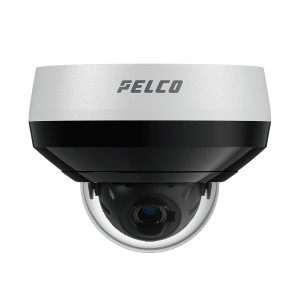
Pelco SRXP4-3V10-IMD-IR 2MP Mini Dome IR Camera
The Pelco SRXP4-3V10-IMD-IR is a compact 2MP indoor mini dome designed for low-light and dark environments where supplemental lighting is impractical or unavailable. Built on the Sarix Professional 4 platform, this camera pairs integrated IR illumination with a motorized 4.4–9.3 mm varifocal lens to deliver flexible coverage across corridors, lobbies, and reception areas without manual lens swaps or external IR emitters.
Key Features
- 2MP 1/2.8" progressive scan CMOS sensor (1920×1080): Sufficient resolution for facial recognition and detail recovery in confined spaces—typical for office buildings and secure corridors where 4MP or higher would waste bandwidth on scenes with limited subjects.
- Motorized varifocal lens, 4.4–9.3 mm (32–109° HFOV): Remote zoom and focus from the NVR eliminate on-site lens changes and reduce installation labor. The wide field at 32° covers entire rooms; the narrow 109° setting captures detail at distance. No need to stock multiple fixed-lens models.
- Integrated 850 nm IR illumination with 0 lux operation: Delivers usable monochrome video in complete darkness without external lighting infrastructure. Color video remains possible at 0.01 lux, and the camera retains 0.003 lux sensitivity in monochrome mode—practical for night-shift monitoring in unlit storage areas or server rooms.
- 130 dB SureVision WDR: Handles doorways and windows where bright exterior light bleeds into indoor scenes. High WDR values preserve shadow detail and face capture when subjects move between lit and dark zones—a common pain point in lobbies and access corridors.
- Edge-based Smart Analytics: Person and vehicle detection, directional violation, loitering, beam crossing, and crowd detection run on the camera itself. Reduces NVR CPU load and delivers faster alerting—meaningful for facilities monitoring dozens of indoor zones.
- H.265 and Smart Compression codecs: H.265 cuts storage and bandwidth roughly 40–60% versus H.264 at equivalent quality. Smart Compression adapts bitrate to scene complexity (static hallway = lower bitrate; busy entrance = higher bitrate). Reduces storage costs on 24/7 recording across multiple cameras.
- ONVIF Profile S, T, G, and M certification: Integrates with any ONVIF-compliant NVR, VMS platform, or third-party analytics engine. No vendor lock-in; you can migrate to a different recorder or software layer without replacing cameras.
- PoE Class 3 (up to ~13W): Standard 802.3af switches and injectors supply power; no separate PSU needed. Low power draw means you won't strain your switch's budget on dense deployments.
- IK09 vandal rating: Withstands impact and casual tampering in public-facing areas. Not a replacement for cages in high-abuse environments, but sufficient for offices and retail.
- HTTPS encryption and microSD local storage: Edge recording to microSD card (up to capacity) provides failsafe video if network connectivity drops. Encrypted traffic prevents interception over the network.
- 60 fps maximum frame rate: Supports smooth motion capture for behavior analysis and detailed incident review. Most indoor deployments use 24–30 fps for bandwidth efficiency; 60 fps is optional for high-motion areas.
- 5-year warranty: Standard Sarix Professional 4 warranty covers defects in materials and workmanship.
Integration and Compatibility
The SRXP4-3V10-IMD-IR (often searched as SRXP4 3V10 IMD IR) works with any ONVIF-compliant network video recorder, including Milestone XProtect, Genetec, Axis Camera Station, Pelco VMS platforms, and open-source systems like Frigate or ZoneMinder. Edge analytics fire ONVIF events that trigger NVR alarms, email notifications, or third-party integrations. Verify your NVR firmware supports ONVIF Profiles T and G if you plan to use edge analytics or two-way audio; older implementations may support only Profile S (basic streaming).
Deployment Considerations
Bandwidth and storage: A single 2MP stream at 30 fps H.265 consumes roughly 2–4 Mbps depending on scene detail. Multiply by camera count and 24/7 recording hours to size your NVR storage. A busy retail entrance at 60 fps will consume more; a static hallway at 24 fps will consume less. Use your VMS's bitrate calculator before ordering.
Power and cabling: Confirm PoE injectors or switch ports match Class 3 capacity. Run Cat6 or better for 100+ meter runs to minimize voltage drop. Test power delivery to the camera before final installation.
Lens focus: After physical installation, use the NVR or camera's web interface to adjust zoom and focus remotely. Do not expect perfect focus immediately; motorized varifocal lenses require tuning, especially in low-light conditions where autofocus may struggle.
IR performance: IR range is approximately 15–20 meters in clear air, but reflective surfaces (glass, mirrors, light walls) can cause bloom and washout. Test IR coverage in your actual environment before finalizing placement. In spaces with consistent ambient lighting (>20 lux), consider the non-IR variant (SRXP4-3V10-IMD) to save power and reduce heat.
When to Choose a Different Model
If you need outdoor weathering, select a turret or bullet camera rated IP67 or higher. If scenes demand very wide coverage (e.g., large warehouses), consider a higher-megapixel variant (4MP or 5MP) in the same Sarix family, though storage costs will rise. If your facility has excellent lighting and IR is unnecessary, the non-IR SRXP4-3V10-IMD variant saves roughly 1–2W and generates less heat. If you require PTZ, look to Pelco's Sarix PTZ line; this dome is fixed-mount only.
Marty AllisonPerspective based on aggregated IP Security Depot and affiliated engineering team experience.
The SRXP4-3V10-IMD-IR is a workhorse for indoor spaces where darkness or mixed lighting would otherwise require external IR emitters or costly HPS fixtures. The motorized varifocal lens and 130 dB WDR are the two features that justify this camera over cheaper fixed-lens 2MP domes: you get remote zoom and robust handling of backlit scenes, which together cut re-installation labor and reduce false alerts from exposure swings.
Technical Highlights:
- H.265 codec + Smart Compression: A 2MP stream at 30 fps H.265 typically occupies 2–4 Mbps; H.264 would require 5–8 Mbps for the same quality. On a 12-camera lobby installation recording 24/7, that's a 40–50% storage savings—meaningful on a 48TB NVR running 30 days retention.
- Motorized 4.4–9.3 mm varifocal lens: The 32° wide view captures the whole room; the 109° narrow view isolates individuals at distance. No field technician needed to unscrew and swap lenses. Focus adjustments are also remote, eliminating a common failure point in manual varifocal setups.
- 130 dB SureVision WDR + 0.01 lux color sensitivity: Handles the classic lobby scenario—sunlight streaming through the front doors while the interior is dim. WDR preserves face detail both in the bright entrance and shadowed interior. At night, 0.01 lux color keeps faces visible under emergency lighting; IR kicks in for total darkness.
- Edge-based person/vehicle detection and directional violation: Analytics run on the camera, not the NVR, so a busy multi-camera system doesn't bog down a single server. Loitering alerts trigger within seconds, not minutes.
Deployment Considerations:
- PoE power at ~13W is Class 3 only: If your switch is maxed out, a dedicated injector for this camera costs $50–150 but buys you room to grow. Do not daisy-chain injectors; verify switch capacity before deployment.
- IR range realistic limits: Expect usable IR coverage to ~15–20 meters in typical air. Dust, fog, or reflective surfaces (glass partitions, white walls) reduce effective range and can cause blooming. Test in your actual environment; a 20-meter IR range spec means best-case, not average-case.
- Motorized focus quirks in low light: Autofocus can hunt (refocus repeatedly) in scenes with very low contrast and dim lighting. Manual focus via NVR web interface is often faster and more reliable. Budget 10–15 minutes per camera for focus tuning at night.
Deploy this model in office buildings, retail lobbies, hospital corridors, and educational facilities where interior lighting is adequate most of the day but can drop sharply at night or in interior rooms. The motorized lens, WDR, and edge analytics make it a strong fit for facility managers who want flexibility and don't want to revisit the camera mounting for focus adjustments. Skip it if you need outdoor weathering or if IR is purely optional—those scenarios point toward other form factors in the Sarix line.
Frequently Asked Questions
Q: Does the SRXP4-3V10-IMD-IR work with Milestone XProtect or Genetec?
A: Yes. The camera is ONVIF Profile S, T, G, and M certified, so it integrates with any VMS platform that supports ONVIF. Milestone XProtect and Genetec both support ONVIF; confirm your NVR firmware version supports Profile T and G if you plan to use edge analytics or two-way audio.
Q: What is the typical infrared range, and does it work through glass?
A: Integrated 850 nm IR illumination provides usable coverage to approximately 15–20 meters in clear air. IR does not penetrate glass; install the camera inside the monitored space, not outside looking in. Reflective surfaces and dust reduce effective range.
Q: Can I use the SRXP4-3V10-IMD-IR outdoors or in high-humidity areas?
A: No. The SRXP4-3V10-IMD-IR is indoor-only (no IP rating). For outdoor or wet environments, select a turret or bullet variant rated IP67. High humidity indoors is generally tolerable, but avoid direct water spray or condensation buildup.
Q: What is the power consumption, and will a standard PoE switch power it?
A: The camera draws up to approximately 13W at maximum (full IR + motorized lens adjustment + analytics active). This falls within PoE Class 3 (15.4W available), so any standard 802.3af PoE switch or injector rated for Class 3 will power it. Verify switch documentation for per-port PoE budget if you're deploying many cameras on one switch.
Q: Does the SRXP4-3V10-IMD-IR support local storage or failsafe recording?
A: Yes. The camera includes a microSD card slot supporting cards up to the manufacturer's stated capacity. If network connectivity drops, video records to the card; when the network recovers, buffered video syncs to the NVR. This does not replace NVR storage but provides a backup for brief outages.
Q: Is the warranty included, and what does it cover?
A: The SRXP4-3V10-IMD-IR includes a 5-year warranty covering defects in materials and workmanship. It does not cover physical damage, misuse, or unauthorized repair. Contact the retailer or manufacturer for warranty claim procedures.