
Pelco SRXP4-2V10-IMD vs Pelco SRXP4-8V9-EMD-IR: Specification Comparison
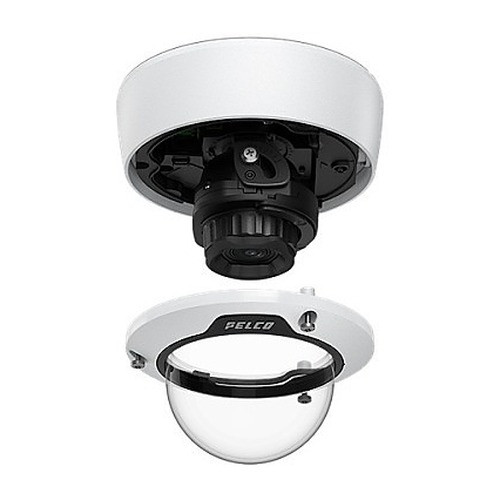
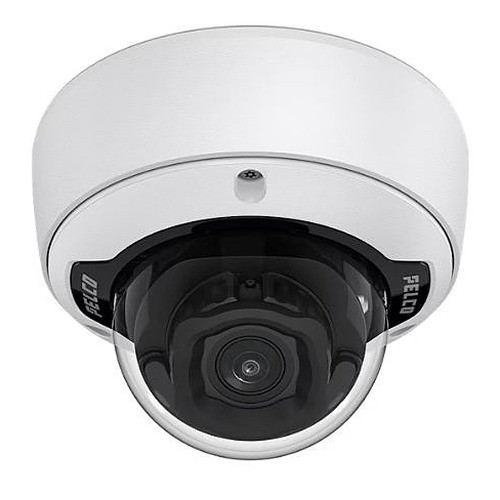
Both the Pelco SRXP4-2V10-IMD and SRXP4-8V9-EMD-IR belong to the Sarix Professional 4 Series and share the same 2MP resolution class, 1/2.8-inch progressive-scan CMOS sensor, IK09 vandal rating, PoE Class 3 power, and ONVIF Profile S/T/G/M compliance. The meaningful split is deployment environment: the SRXP4-2V10-IMD is an indoor dome with a wider zoom range, while the SRXP4-8V9-EMD-IR is an outdoor dome with integrated IR illumination and a ruggedized enclosure rated for outdoor exposure.
In This Guide
How do the imaging specs compare?
Both cameras deliver 1920×1080 at up to 60 fps from a 1/2.8-inch CMOS sensor. The SRXP4-2V10-IMD offers a broader motorized varifocal range of 3.4–10.5 mm with a horizontal field of view spanning 101° to 31°, maximum aperture F1.6, and a WDR rating of 126 dB. Minimum illumination in color is 0.01 lux (at 33 ms) and 0.005 lux in monochrome. Dynamic range without WDR is specified at 83 dB, and signal-to-noise ratio is listed as greater than 50 dB.
The SRXP4-8V9-EMD-IR uses a narrower 4.4–9.3 mm motorized varifocal lens covering 32°–109° HFOV and carries a higher WDR rating of 130 dB (branded SureVision). Its minimum illumination is 0.01 lux in color and 0 lux in IR mode, the latter enabled by integrated IR illumination that allows operation in complete darkness. Maximum aperture for the SRXP4-8V9-EMD-IR is listed as F1.4 versus F1.6 on the IMD model. IR wavelength is specified as 850 nm for the EMD-IR; the IMD lists IR cut filter and day/night capability but no active IR emitter, making it passive-only for low-light performance.
What about installation and environment?
The SRXP4-2V10-IMD is rated for indoor use only; no outdoor IP ingress rating is confirmed in its specifications despite IP66 appearing in some spec fields — its primary environment classification is Indoor. It carries an IK09 vandal resistance rating. Mounting options listed include wall, ceiling, pole, pendant, and corner. PoE Class 3 (802.3af) is the primary power source, with 12 VDC also listed. No operating temperature range is provided in the supplied specifications.
The SRXP4-8V9-EMD-IR is rated for outdoor deployment with an IP66/IP67 environmental rating and IK09 vandal resistance (one spec field lists IK10; the primary product spec states IK09). Storage temperature is specified as -10°C to +70°C (14°F to 158°F); operating temperature range is not separately broken out in the provided specs. Mounting options are wall, ceiling, and pendant — fewer than the IMD. Power is PoE Class 3 (802.3af). The outdoor-rated enclosure and active IR emitter make the EMD-IR self-contained for 24/7 perimeter coverage without supplemental lighting.
Which fits your VMS and analytics better?
Both cameras are ONVIF Profile S, T, G, and M compliant and support H.264, H.265, and Pelco Smart Compression with Idle Scene Mode for bandwidth management. Both include onboard microSD/SDHC/SDXC storage up to 1.5 TB (IMD spec confirmed; EMD-IR lists microSD support but does not confirm the 1.5 TB ceiling in the provided specs). Memory is 1 GB RAM / 512 MB Flash on both. The SRXP4-2V10-IMD explicitly lists audio I/O as line-level in/out and supports G.711 PCM 8 kHz and Opus codecs. The SRXP4-8V9-EMD-IR lists microphone support only; line-level output is not confirmed in the provided specs.
Analytics differentiate the two models significantly. The SRXP4-8V9-EMD-IR lists Smart Analytics including Person/Vehicle Detection, Directional Violation, Loitering, Beam Crossing, Crowd Detection, and Tamper Alert. The SRXP4-2V10-IMD lists Pixel Motion Detection and Classified Object Detection but does not enumerate the behavioral analytics available on the EMD-IR. Both cameras list external alarm I/O. The SRXP4-2V10-IMD additionally documents USB 2.0, IPv4/IPv6 protocol support, three distinct stream tiers, and electronic shutter range (1/7.5 to 1/30000 sec); equivalent detail is absent from the EMD-IR's provided specification set.
Which should you choose: the SRXP4-2V10-IMD or the SRXP4-8V9-EMD-IR?
Our take: The SRXP4-2V10-IMD is the stronger choice when deploying indoors where active IR is unnecessary and a wider zoom range, bidirectional line-level audio, or a broader mounting envelope is required. Key spec deltas: the IMD's motorized lens spans 3.4–10.5 mm (101°–31° HFOV) versus the EMD-IR's 4.4–9.3 mm (32°–109°), giving installers more optical reach in large atriums or corridors; the IMD lists a 126 dB WDR rating versus 130 dB SureVision on the EMD-IR; and the IMD confirms line-level audio I/O while the EMD-IR specifies microphone input only. Conversely, the SRXP4-8V9-EMD-IR is the correct selection for any outdoor or zero-lux-capable deployment: it integrates an IR illuminator rated to 0 lux operation, carries an IP66/IP67 outdoor enclosure rating, and offers a richer edge-analytics suite. Both cameras carry a 5-year warranty and identical ONVIF compliance. Choose the IMD for indoor versatility; choose the EMD-IR for outdoor 24/7 coverage.
Side-by-Side Comparison
Spec-for-spec, from manufacturer data.
| Specification | Pelco SRXP4-2V10-IMD | Pelco SRXP4-8V9-EMD-IR |
|---|---|---|
| Series | Sarix Professional 4 | Sarix Professional 4 |
| Resolution | 2MP (1920×1080) | 2MP (1920×1080) |
| Image Sensor | 1/2.8" progressive scan CMOS | 1/2.8" progressive scan CMOS |
| Lens / Focal Length | 3.4–10.5 mm motorized varifocal | 4.4–9.3 mm motorized varifocal |
| Horizontal Field of View | 101° – 31° | 109° – 32° |
| Maximum Aperture | F1.6 | F1.4 |
| WDR | 126 dB (WDR On) | 130 dB SureVision |
| Min. Illumination (Color) | 0.01 lux at 33 ms | 0.01 lux |
| Min. Illumination (IR / Mono) | 0.005 lux monochrome at 33 ms | 0 lux (IR active) |
| IR Illumination | — | Integrated 850 nm IR |
| Max Frame Rate | 60 fps | 60 fps |
| Video Compression | H.264; H.265; Motion JPEG; Smart Compression | H.264; H.265; Smart Compression |
| IP Rating | Indoor (IP66 listed but environment rated Indoor) | IP66 / IP67 |
| IK / Impact Rating | IK09 | IK09 (IK10 noted in one spec field) |
| Operating Temperature | Not specified | Storage: -10°C to +70°C (operating not specified) |
| Power / PoE Class | PoE Class 3 (802.3af); 12 VDC | PoE Class 3 (802.3af) |
| Onboard Storage | microSD/SDHC/SDXC up to 1.5 TB | microSD (max capacity not confirmed in specs) |
| Audio | Line-level I/O; G.711 PCM 8 kHz; Opus | Microphone supported (line-level out not confirmed) |
| Edge Analytics | Pixel Motion; Classified Object Detection | Person/Vehicle Detection; Directional Violation; Loitering; Beam Crossing; Crowd Detection; Tamper Alert |
| ONVIF Compliance | Profile S; T; G; M | Profile S; T; G; M |
| Environment Rating | Indoor | Outdoor |
| Warranty | 5-year | 5-year |
Frequently Asked Questions
Which should you choose: the SRXP4-2V10-IMD or the SRXP4-8V9-EMD-IR?
The SRXP4-2V10-IMD is the stronger choice when deploying indoors where active IR is unnecessary and a wider zoom range, bidirectional line-level audio, or a broader mounting envelope is required. Key spec deltas: the IMD's motorized lens spans 3.4–10.5 mm (101°–31° HFOV) versus the EMD-IR's 4.4–9.3 mm (32°–109°), giving installers more optical reach in large atriums or corridors; the IMD lists a 126 dB WDR rating versus 130 dB SureVision on the EMD-IR; and the IMD confirms line-level audio I/O while the EMD-IR specifies microphone input only. Conversely, the SRXP4-8V9-EMD-IR is the correct selection for any outdoor or zero-lux-capable deployment: it integrates an IR illuminator rated to 0 lux operation, carries an IP66/IP67 outdoor enclosure rating, and offers a richer edge-analytics suite. Both cameras carry a 5-year warranty and identical ONVIF compliance. Choose the IMD for indoor versatility; choose the EMD-IR for outdoor 24/7 coverage.
Is the SRXP4-2V10-IMD or SRXP4-8V9-EMD-IR better for low-light performance?
For scenes with ambient lighting, the SRXP4-2V10-IMD reaches 0.005 lux in monochrome mode. However, for zero-light environments the SRXP4-8V9-EMD-IR is the clear choice: its integrated 850 nm IR illuminator enables 0 lux operation, whereas the IMD has no active IR emitter and relies entirely on ambient light.
Can the SRXP4-8V9-EMD-IR be used outdoors and is it rated for weather exposure?
Yes. The SRXP4-8V9-EMD-IR is specifically classified as an outdoor dome and carries an IP66/IP67 environmental rating for dust and water ingress protection. The SRXP4-2V10-IMD is classified as an indoor dome; its provided specifications do not confirm a validated outdoor IP rating for that deployment context.
Do both cameras support edge analytics, and how do the capabilities compare?
Both cameras support on-camera analytics, but the EMD-IR's specification is more detailed: it explicitly lists Smart Analytics including Person/Vehicle Detection, Directional Violation, Loitering, Beam Crossing, Crowd Detection, and Tamper Alert. The IMD lists Pixel Motion Detection and Classified Object Detection. The EMD-IR's analytics suite as documented is broader; however, the IMD's full analytics capability list is not fully enumerated in the provided specifications, so direct parity cannot be confirmed.
Get a Second Opinion on Your Camera Choice
Share your site layout, coverage goals, and budget. Our team will validate the camera selection, flag anything we would change, and recommend products that match the use case.