
Pelco SRXE4-4V9-EBT-IR1 vs Pelco SRXE4P-4V9-EBT-IR1: Specification Comparison
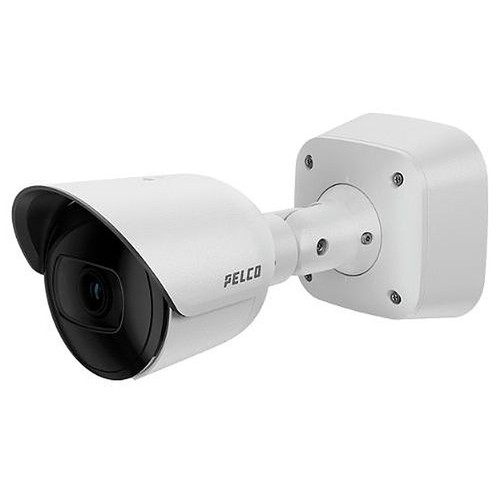
Both the Pelco SRXE4-4V9-EBT-IR1 and SRXE4P-4V9-EBT-IR1 are outdoor fixed bullet cameras from the Sarix Enhanced 4 Series, each delivering 4MP resolution at up to 60 fps with motorized varifocal lenses and 850 nm IR illumination. They share the same sensor, compression stack, ingress protection, and cybersecurity posture, making them direct cross-shop candidates for enterprise perimeter deployments. The primary differentiator surfaced in the provided specs is the IR range figure stated for the SRXE4P variant and minor metadata differences; all other published specs are identical.
In This Guide
How do the imaging specs compare?
Both cameras use a 1/1.8-inch progressive-scan CMOS sensor resolving 2560 × 1440 (4MP) at a maximum of 60 fps. The lens is identical on both: a motorized varifocal covering 4.4–9.3 mm with a horizontal field of view of 32–109 degrees and an F1.4 aperture. Minimum illumination is listed at 0.003 lux color and 0 lux with IR active on both models. Wide dynamic range is 130 dB SureVision on both units.
The one imaging-layer distinction present in the provided specs is IR range: the SRXE4P-4V9-EBT-IR1 spec sheet explicitly states 70 meters (229 ft) at 850 nm, while the SRXE4-4V9-EBT-IR1 documentation confirms 850 nm illumination and 0-lux capability but does not publish a rated IR throw distance. Buyers requiring a contractually specified illumination range should note this gap.
What about installation and environment?
Ingress protection and mechanical resilience are identical: both carry IP66, IP67, IP68 (2 m for 2 hr), IPX9K, and NEMA 4X ratings alongside an IK11 impact rating. Operating temperature range is the same on both: -50 °C to +65 °C when powered via PoE+ or external supply. Both are rated for outdoor use and share a white bullet housing.
Power input is PoE+ (802.3at) or 12/24 Vdc external on both models. The PoE class field in the shared metadata is listed as Class 3 for both, though PoE+ (802.3at) is the stated standard in the enrichment data; installers should verify actual draw against switch budgets. Mounting options noted in the SRXE4-4V9-EBT-IR1 data include wall, pole, and corner; mounting data for the SRXE4P-4V9-EBT-IR1 is not specified in the provided documentation. Physical dimensions (309 mm × 133 mm × 133 mm) are listed only for the SRXE4-4V9-EBT-IR1; dimensions for the SRXE4P variant are not provided in the supplied specs.
Which fits your VMS and analytics better?
ONVIF compliance is identical across both: Profile S, Profile T, Profile G, and Profile M are all supported, ensuring broad VMS compatibility. Edge analytics are the same on both: Smart Analytics covers person and vehicle detection, direction violation, loitering, beam crossing, crowd detection, audio analytics, and tamper alert. Cybersecurity features are equally matched — FIPS 140-3 Level 3, TPM, Secure Boot, HTTPS, and 802.1X are present on both.
Both models list microSD as on-board storage support and note audio microphone support. NDAA Section 889 and TAA compliance are confirmed on both, which is a non-negotiable qualification criterion for U.S. federal and many state/local government deployments. No VMS-specific certifications beyond ONVIF are listed in the provided specs for either model.
Which should you choose: the SRXE4-4V9-EBT-IR1 or the SRXE4P-4V9-EBT-IR1?
Our take: The SRXE4P-4V9-EBT-IR1 is the stronger choice when a contractually specified IR illumination distance is required, as its datasheet explicitly rates throw at 70 meters (229 ft) at 850 nm — a figure absent from the SRXE4-4V9-EBT-IR1 documentation. Beyond that single published delta, the two cameras are spec-for-spec identical across every other decision-relevant dimension: both resolve 4MP at 60 fps on a 1/1.8-inch CMOS, both carry IP66/IP67/IP68/IK11 ratings, and both operate from -50 °C to +65 °C. The SRXE4-4V9-EBT-IR1 provides an explicit mounting-option list (wall, pole, corner) and physical dimensions not published for the SRXE4P in the supplied specs. If IR range documentation is immaterial to the project scope and mounting data matters more, the SRXE4-4V9-EBT-IR1 documentation is more complete. Both are appropriate for NDAA/TAA-restricted government sites.
Side-by-Side Comparison
Spec-for-spec, from manufacturer data.
| Specification | Pelco SRXE4-4V9-EBT-IR1 | Pelco SRXE4P-4V9-EBT-IR1 |
|---|---|---|
| Series | Sarix Enhanced 4 Series | Sarix Enhanced 4 Series |
| Resolution | 4MP (2560 × 1440) | 4MP (2560 × 1440) |
| Image Sensor | 1/1.8" progressive scan CMOS | 1/1.8" progressive scan CMOS |
| Max Frame Rate | 60 fps | 60 fps |
| Lens / Focal Length | 4.4–9.3 mm motorized varifocal | 4.4–9.3 mm motorized varifocal |
| HFOV | 32–109 degrees | 32–109 degrees |
| Aperture | F1.4 | F1.4 |
| Min Illumination | 0.003 lux color / 0 lux IR | 0.003 lux color / 0 lux IR |
| IR Range | — | ~70 m (229 ft) @ 850 nm |
| WDR | 130 dB SureVision | 130 dB SureVision |
| Video Compression | H.265; H.264; Motion JPEG | H.265; H.264; Motion JPEG |
| IP Rating | IP66 / IP67 / IP68 (2m/2hr) / IPX9K / NEMA 4X | IP66 / IP67 / IP68 (2m/2hr) / IPX9K / NEMA 4X |
| Impact Rating | IK11 | IK11 |
| Operating Temperature | -50°C to +65°C | -50°C to +65°C |
| Power Input | PoE+ (802.3at) or 12/24 Vdc | PoE+ (802.3at) or 12/24 Vdc |
| Edge Storage | microSD | microSD |
| Audio | Microphone supported | Microphone supported |
| ONVIF Compliance | Profile S; T; G; M | Profile S; T; G; M |
| Cybersecurity | FIPS 140-3 Level 3; TPM; Secure Boot; HTTPS; 802.1X | FIPS 140-3 Level 3; TPM; Secure Boot; HTTPS; 802.1X |
| Regulatory Approvals | NDAA Section 889; TAA Compliant | NDAA Section 889; TAA Compliant |
| Dimensions (L×W×H) | 309 mm × 133 mm × 133 mm | — |
| Warranty | 5-year | 5-year |
Frequently Asked Questions
Which should you choose: the SRXE4-4V9-EBT-IR1 or the SRXE4P-4V9-EBT-IR1?
The SRXE4P-4V9-EBT-IR1 is the stronger choice when a contractually specified IR illumination distance is required, as its datasheet explicitly rates throw at 70 meters (229 ft) at 850 nm — a figure absent from the SRXE4-4V9-EBT-IR1 documentation. Beyond that single published delta, the two cameras are spec-for-spec identical across every other decision-relevant dimension: both resolve 4MP at 60 fps on a 1/1.8-inch CMOS, both carry IP66/IP67/IP68/IK11 ratings, and both operate from -50 °C to +65 °C. The SRXE4-4V9-EBT-IR1 provides an explicit mounting-option list (wall, pole, corner) and physical dimensions not published for the SRXE4P in the supplied specs. If IR range documentation is immaterial to the project scope and mounting data matters more, the SRXE4-4V9-EBT-IR1 documentation is more complete. Both are appropriate for NDAA/TAA-restricted government sites.
Is the SRXE4-4V9-EBT-IR1 or SRXE4P-4V9-EBT-IR1 better for low-light performance?
Both cameras reach 0 lux with IR active and share 0.003 lux minimum illumination in color mode. The SRXE4P-4V9-EBT-IR1 spec sheet explicitly states a 70-meter (229 ft) IR range at 850 nm; the SRXE4-4V9-EBT-IR1 confirms 850 nm IR but does not publish a rated throw distance in the provided specs. If a documented illumination range is required for design sign-off, the SRXE4P data is more complete.
Can either camera be used on a federal or government project with NDAA restrictions?
Yes. Both the SRXE4-4V9-EBT-IR1 and SRXE4P-4V9-EBT-IR1 are listed as NDAA Section 889 compliant and TAA compliant in the provided specifications, making both eligible for U.S. federal procurement under those requirements.
Are the SRXE4-4V9-EBT-IR1 and SRXE4P-4V9-EBT-IR1 compatible with the same VMS platforms?
Based on the provided specs, yes. Both cameras support ONVIF Profile S, T, G, and M, which covers the major enterprise VMS platforms. No VMS-specific certifications beyond ONVIF are listed in the supplied documentation for either model; buyers should verify certification status directly with their VMS vendor for edge-case compatibility.
Get a Second Opinion on Your Camera Choice
Share your site layout, coverage goals, and budget. Our team will validate the camera selection, flag anything we would change, and recommend products that match the use case.