
Hanwha L7022R vs Pelco SRXE4-2X33-EBT-IR1: Specification Comparison
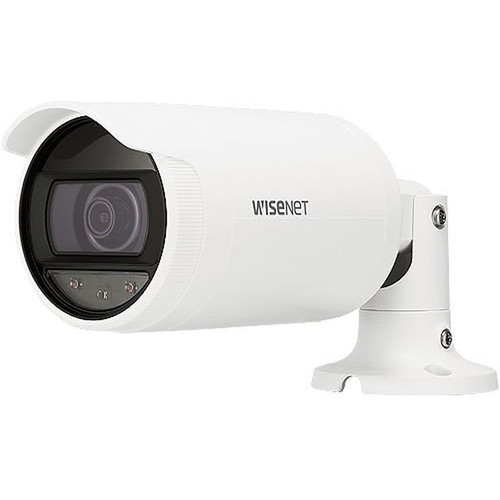
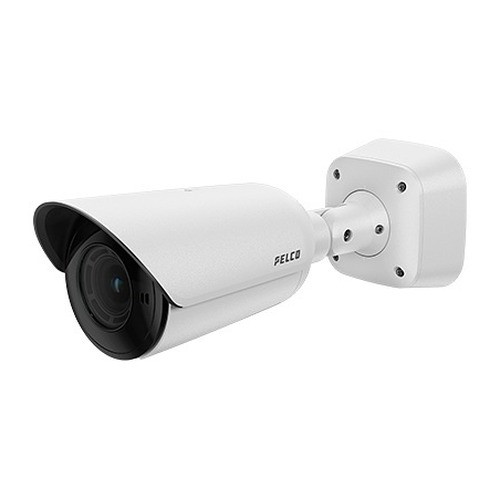
Both the Hanwha ANO-L7022R and the Pelco SRXE4-2X33-EBT-IR1 are 4MP (2560×1440) outdoor bullet IP cameras targeting perimeter and general surveillance applications. The comparison covers sensor size, lens flexibility, IR performance, ingress and impact protection, PoE class, analytics depth, and cybersecurity posture — the factors that most often drive specification decisions for installers and IT procurement teams evaluating fixed-lens versus motorized-varifocal options in this resolution class.
In This Guide
How do the imaging specs compare?
The Hanwha ANO-L7022R uses a 1/3" CMOS sensor with a fixed 4mm lens (F1.6, 79° HFOV) and delivers up to 30 fps at 4MP with 120 dB WDR. Minimum illumination is 0.13 lux color / 0 lux with IR (850 nm LEDs, 25 m range). The Pelco SRXE4-2X33-EBT-IR1 specifies a 1/1.8" CMOS sensor — a significantly larger format that collects more light — paired with a motorized varifocal lens covering 4.4–9.3 mm (32–109° HFOV). It supports up to 60 fps at 4MP, 130 dB WDR (branded SureVision), and reaches 0.003 lux color / 0 lux IR, roughly 43× more sensitive in color mode than the Hanwha. Note: the Pelco spec sheet also contains a conflicting sensor size entry of '1/2.8"' and a conflicting lens entry of '2.8–12 mm'; buyers should verify against Pelco's current datasheet before final specification.
IR reach favors the Pelco at approximately 70 m (per the product card) versus 25 m on the Hanwha — a critical delta for long-corridor or large-perimeter deployments. The Hanwha's fixed 4mm lens locks field of view at installation; the Pelco's motorized varifocal allows remote optical zoom adjustment from 32° to 109° HFOV without a technician climbing the mount. Both cameras support H.265, H.264, and Motion JPEG compression with CBR/VBR controls, and both implement smart codec bandwidth reduction — Hanwha via WiseStream II, Pelco via its SmartCompression technology.
What about installation and environment?
The Hanwha ANO-L7022R is rated IP66 (dust-tight, high-pressure jet water) and operates from -30°C to +55°C on standard PoE (IEEE 802.3af, Class 3, max 7.5 W). It weighs 390 g and measures ø78 × 262 mm. The Pelco SRXE4-2X33-EBT-IR1 carries IP66, IP67, IP68 (2 m submersion for 2 hr), and IPX9K (high-temperature, high-pressure wash-down) ratings, plus NEMA 4X, and an IK11 impact rating. Its operating temperature spans -50°C to +65°C — a 95°C total range versus the Hanwha's 85°C range — making it suitable for extreme-cold or high-heat environments where the Hanwha would be out of spec. The Pelco is powered by PoE+ (802.3at, Class 3 per spec), which requires a PoE+ capable switch port or midspan injector; the Hanwha operates on the more widely available 802.3af standard. Dimensions and weight for the Pelco are not provided in the supplied specifications. Note: the Pelco spec sheet lists an IK09 vandal rating in one field and IK11 in another; buyers should confirm the correct impact rating with Pelco before specifying for high-vandalism environments.
Which fits your VMS and analytics better?
Both cameras conform to ONVIF Profile S, Profile T, and Profile G. The Pelco additionally claims ONVIF Profile M (metadata/analytics), which is relevant for VMS platforms that consume structured analytics metadata. The Hanwha's native API is SUNAPI (HTTP API) and supports WiseStream II; the Pelco uses its own PelcoSmartCompression and is designed for integration into Pelco's Endura and VideoXpert ecosystems, though ONVIF ensures baseline third-party VMS compatibility on both units.
On-camera analytics differ in scope and branding. The Hanwha provides motion detection, tampering, defocus detection, and virtual line/area rules (intrusion, enter, exit, crossing, direction) across polygonal zones. The Pelco spec lists Smart Analytics including Person/Vehicle Detection, Direction Violation, Loitering, Beam Crossing, Crowd Detection, Audio Analytics, and Tamper Alert — a broader declared analytics set, including audio analytics and object classification that the Hanwha spec does not list. Audio input/output support is not specified for the Hanwha; the Pelco spec references microphone support. Edge storage is available on both: the Hanwha supports a single Micro SD/SDHC/SDXC slot up to 128 GB; the Pelco lists microSD support but does not specify a maximum card capacity in the provided specs. Cybersecurity posture differs substantially: the Hanwha provides firmware encryption, 802.1X (EAP-TLS/LEAP/PEAP), HTTPS/SRTP, digest authentication, IP-based access control, and SD card partition encryption. The Pelco adds FIPS 140-3 Level 3 cryptographic validation, a hardware TPM, and Secure Boot — a meaningfully higher security baseline for government, critical-infrastructure, or NDAA-sensitive deployments, where the Pelco also carries TAA compliance per its spec.
Which should you choose: the L7022R or the SRXE4-2X33-EBT-IR1?
Our take: The SRXE4-2X33-EBT-IR1 is the stronger choice when optical flexibility, extreme-environment durability, low-light performance, or government procurement compliance are primary requirements; the ANO-L7022R is the stronger choice when 802.3af PoE infrastructure is fixed, budget is constrained, or the site is already Hanwha/SUNAPI-standardized. On the three most decision-relevant deltas: the Pelco's larger 1/1.8" sensor and 0.003 lux color sensitivity versus the Hanwha's 0.13 lux represent roughly a 43× low-light advantage, and its IR range of approximately 70 m is 2.8× the Hanwha's 25 m; the Pelco's -50°C to +65°C operating range covers environments well outside the Hanwha's -30°C to +55°C window; and the Pelco's FIPS 140-3 Level 3 / TPM / Secure Boot / NDAA-compliant security stack exceeds the Hanwha's firmware-encryption baseline. Buyers on standard 802.3af switch infrastructure should verify that their switch supports PoE+ before specifying the Pelco.
Side-by-Side Comparison
Spec-for-spec, from manufacturer data.
| Specification | Hanwha L7022R | Pelco SRXE4-2X33-EBT-IR1 |
|---|---|---|
| Resolution | 4MP (2560×1440) | 4MP (2560×1440) |
| Image Sensor | 1/3" CMOS | 1/1.8" CMOS (conflicting entry: 1/2.8" also listed) |
| Lens / Focal Length | 4mm fixed (F1.6) | 4.4–9.3mm motorized varifocal (F1.4) [conflicting entry: 2.8–12mm also listed] |
| Horizontal FOV | 79° | 32°–109° |
| Min. Illumination (Color) | 0.13 lux | 0.003 lux |
| Min. Illumination (IR on) | 0 lux | 0 lux |
| IR Range | 25m (82ft) | ~70m (per product card; datasheet value not provided) |
| Max Frame Rate | 30 fps @ 4MP | 60 fps @ 4MP |
| WDR | 120dB | 130dB SureVision |
| Video Compression | H.265, H.264 (Main/High), MJPEG | H.265, H.264, Motion JPEG |
| ONVIF Profiles | Profile S, G, T | Profile S, T, G, M |
| IP Rating | IP66 | IP66, IP67, IP68 (2m/2hr), IPX9K, NEMA 4X |
| Impact Rating | — | IK11 (conflicting entry: IK09/IK10 also listed) |
| Operating Temperature | -30°C to +55°C | -50°C to +65°C |
| Power Input / PoE Class | PoE IEEE 802.3af, Class 3 (max 7.5W) | PoE+ 802.3at, Class 3 |
| Edge Storage | Micro SD/SDHC/SDXC, 1 slot, up to 128GB | microSD (max capacity not specified) |
| Audio | — | Microphone supported |
| Cybersecurity | Firmware encryption, 802.1X, HTTPS/SRTP, SD partition encryption | FIPS 140-3 Level 3, TPM, Secure Boot, HTTPS, 802.1X |
| NDAA / TAA Compliance | — | NDAA Section 889; TAA Compliant |
| Weight | 390g (0.86lb) | — |
| Warranty | 3 years | 5 years |
Frequently Asked Questions
Which should you choose: the L7022R or the SRXE4-2X33-EBT-IR1?
The SRXE4-2X33-EBT-IR1 is the stronger choice when optical flexibility, extreme-environment durability, low-light performance, or government procurement compliance are primary requirements; the ANO-L7022R is the stronger choice when 802.3af PoE infrastructure is fixed, budget is constrained, or the site is already Hanwha/SUNAPI-standardized. On the three most decision-relevant deltas: the Pelco's larger 1/1.8" sensor and 0.003 lux color sensitivity versus the Hanwha's 0.13 lux represent roughly a 43× low-light advantage, and its IR range of approximately 70 m is 2.8× the Hanwha's 25 m; the Pelco's -50°C to +65°C operating range covers environments well outside the Hanwha's -30°C to +55°C window; and the Pelco's FIPS 140-3 Level 3 / TPM / Secure Boot / NDAA-compliant security stack exceeds the Hanwha's firmware-encryption baseline. Buyers on standard 802.3af switch infrastructure should verify that their switch supports PoE+ before specifying the Pelco.
Is the ANO-L7022R or the SRXE4-2X33-EBT-IR1 better for low-light and night performance?
Based on the provided specifications, the Pelco SRXE4-2X33-EBT-IR1 has a significant low-light advantage. Its minimum illumination is rated at 0.003 lux color / 0 lux IR, compared to the Hanwha ANO-L7022R's 0.13 lux color / 0 lux IR — roughly 43× more sensitive in color mode. The Pelco also specifies an IR range of approximately 70 m versus the Hanwha's 25 m, which is the more relevant figure for wide-area perimeter monitoring.
Can I power either camera from a standard 802.3af PoE switch?
The Hanwha ANO-L7022R is specified for IEEE 802.3af (Class 3, max 7.5 W) and will operate on any standard PoE switch. The Pelco SRXE4-2X33-EBT-IR1 is specified as PoE+ (802.3at) in the product card, which requires a PoE+ capable switch port or a PoE+ midspan injector. Using a standard 802.3af port with the Pelco may result in insufficient power delivery; confirm power requirements with Pelco before installation.
Which camera is better suited for government or critical-infrastructure projects requiring NDAA compliance?
The Pelco SRXE4-2X33-EBT-IR1 is the specified choice for those environments. Its spec sheet explicitly lists NDAA Section 889 compliance and TAA Compliance, along with FIPS 140-3 Level 3 cryptographic validation, a hardware TPM, and Secure Boot. The Hanwha ANO-L7022R spec does not list NDAA or TAA compliance, nor FIPS-validated cryptography, in the provided specifications.
Get a Second Opinion on Your Camera Choice
Share your site layout, coverage goals, and budget. Our team will validate the camera selection, flag anything we would change, and recommend products that match the use case.