
ACTi A422 vs Hanwha L7022R: Specification Comparison
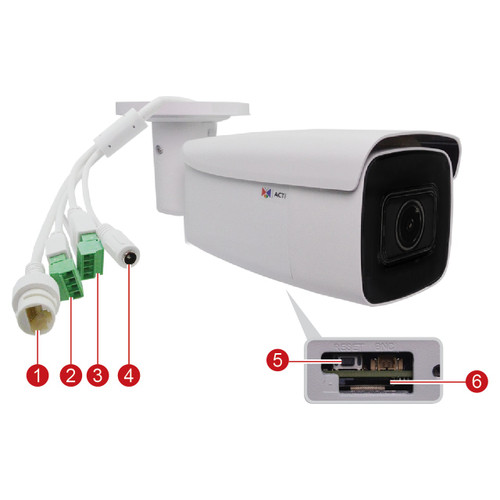
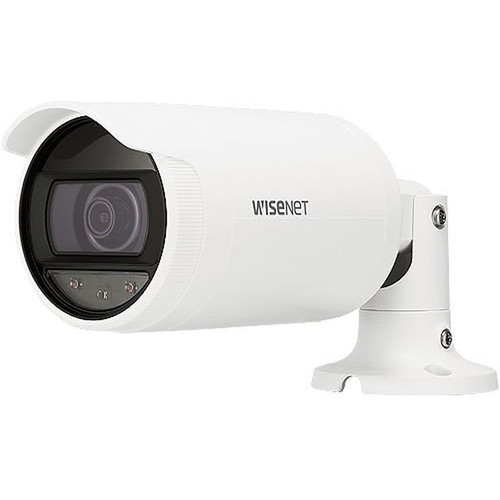
Both the ACTi A422 and the Hanwha ANO-L7022R are 4MP outdoor bullet IP cameras aimed at perimeter and general surveillance applications. The comparison covers two meaningfully different designs within the same resolution class: the A422 brings a 5x motorized varifocal lens and hardened IP68/IK10 construction, while the ANO-L7022R offers a fixed 4mm lens in a lighter, lower-power package. Buyers evaluating these two will weigh optical flexibility and environmental toughness against simplicity, cost of power infrastructure, and Hanwha-native analytics depth.
In This Guide
How do the imaging specs compare?
The A422 captures at 2688×1520 on a 1/2.7" sensor with a 2.7–13.5mm (5x optical zoom) motorized lens, delivering 30 fps at full resolution. Its minimum illumination is 0.003 lux in color and 0 lux with IR active, and its IR LEDs reach 85m at 850nm. WDR is specified at 150dB (Extreme WDR). The motorized zoom enables remote focal-length adjustment without a technician on a ladder, which is significant for final scene framing after installation.
The ANO-L7022R resolves 2560×1440 on a 1/3" CMOS sensor with a fixed 4mm lens (F1.6, 79° horizontal FOV). Its color minimum illumination is 0.13 lux, dropping to 0 lux with IR. IR range is 25m at 850nm — 60m shorter than the A422. WDR is rated at 120dB via BLC/WDR/SSDR. The wider F1.6 aperture helps low-light color performance relative to aperture, but the 0.13 lux floor is still 43× higher than the A422's 0.003 lux. The fixed lens means scene coverage is locked at installation.
What about installation and environment?
The A422 carries IP68 and IK10 ratings, meaning it is rated for continuous submersion and resists 20-joule impacts — the highest standard vandal resistance available. Its operating temperature spans −40°C to +60°C, making it suitable for extreme cold-storage, arctic, or desert-heat deployments. Weight is 1,410g (3.11 lb). Mounting options listed in the specs include pole and corner mounts. Power is PoE++ (802.3bt) Class 3, which requires a PoE++ capable switch or injector; a DC 12V input is also listed.
The ANO-L7022R is rated IP66 (dust-tight and protected against powerful water jets, but not submersion) and carries no IK impact rating in the provided specs. Its operating temperature range is −30°C to +55°C — narrower by 10°C on the cold end and 5°C on the warm end versus the A422. The camera weighs 390g (0.86 lb) and measures ø78×262mm, making it considerably smaller and lighter. Power is standard PoE (802.3af, Class 3, max 7.5W), compatible with any 802.3af-capable switch — no PoE++ infrastructure required.
Which fits your VMS and analytics better?
The A422 supports ONVIF Profile S, G, T, and M — the broadest profile set of the two — and includes Deep Learning (DLPU) on-board analytics alongside Video Motion Detection. Two-way audio is supported with line-in and line-out. Edge storage capability is not specified in the provided specs for the A422. VMS compatibility is documented via ONVIF Profile S/G/T/M.
The ANO-L7022R supports ONVIF Profile S, G, and T (Profile M is not listed) and adds Hanwha's SUNAPI (HTTP API) for native integration with Hanwha Wisenet VMS. Its analytics suite is broader in variety as specified: motion detection with 4 polygonal zones, tampering, defocus detection, and virtual line/area events (intrusion, enter, exit, crossing, direction). Cybersecurity features are more extensively documented: 802.1X network authentication (EAP-TLS/LEAP/PEAP), HTTPS/SRTP/WSS, SD card partition encryption, device certificate, and firmware encryption. Edge storage supports Micro SD/SDHC/SDXC up to 128GB. No audio capability is listed in the provided specs for this model.
Which should you choose: the A422 or the L7022R?
Our take: The A422 is the stronger choice when the deployment demands optical flexibility, extreme environmental hardening, or very low-light color performance. Its 5x motorized zoom (2.7–13.5mm) eliminates lens-swap site visits, its 85m IR range is 3.4× the ANO-L7022R's 25m, its 150dB WDR exceeds the Hanwha's 120dB, and its IP68/IK10 ratings outclass the ANO-L7022R's IP66/no-IK rating for high-vandalism or submersion-risk sites. Its −40°C cold-floor also extends deployment options by 10°C. The trade-offs are real: the A422 requires PoE++ infrastructure, weighs 3.6× more, and its edge storage and cybersecurity depth are not documented in the provided specs. The ANO-L7022R is the pragmatic pick for standard PoE infrastructure, Hanwha Wisenet VMS environments, or projects where richer documented analytics, SD card storage, and a lighter, lower-power form factor are the governing criteria.
Side-by-Side Comparison
Spec-for-spec, from manufacturer data.
| Specification | ACTi A422 | Hanwha L7022R |
|---|---|---|
| Resolution | 4MP (2688×1520) | 4MP (2560×1440) |
| Image Sensor | 1/2.7" | 1/3" CMOS |
| Lens / Focal Length | 2.7–13.5mm (5x motorized optical zoom) | 4mm fixed focal (F1.6) |
| Min Illumination (Color) | 0.003 lux | 0.13 lux (F1.6, 1/30 sec) |
| Min Illumination (B/W / IR on) | 0 lux | 0 lux |
| IR Range | 85m | 25m |
| WDR | 150dB (Extreme WDR) | 120dB |
| Max Frame Rate | 30 fps @ 2688×1520 | 30 fps @ 4MP (H.265/H.264); 15 fps MJPEG @ 4MP |
| Video Compression | H.265; H.264; MJPEG | H.265; H.264; MJPEG |
| IP Rating | IP68 | IP66 |
| IK / Impact Rating | IK10 | — |
| Operating Temperature | −40°C to +60°C | −30°C to +55°C |
| Power Input / PoE Class | PoE++ 802.3bt Class 3; DC 12V | PoE 802.3af Class 3; max 7.5W |
| ONVIF Profiles | Profile S, G, T, M | Profile S, G, T |
| Edge Storage | — (not specified) | Micro SD/SDHC/SDXC up to 128GB |
| Audio | Two-way (line-in, line-out) | — (not specified) |
| Weight | 1,410g (3.11 lb) | 390g (0.86 lb) |
| Warranty | 3 years | 3 years |
Frequently Asked Questions
Which should you choose: the A422 or the L7022R?
The A422 is the stronger choice when the deployment demands optical flexibility, extreme environmental hardening, or very low-light color performance. Its 5x motorized zoom (2.7–13.5mm) eliminates lens-swap site visits, its 85m IR range is 3.4× the ANO-L7022R's 25m, its 150dB WDR exceeds the Hanwha's 120dB, and its IP68/IK10 ratings outclass the ANO-L7022R's IP66/no-IK rating for high-vandalism or submersion-risk sites. Its −40°C cold-floor also extends deployment options by 10°C. The trade-offs are real: the A422 requires PoE++ infrastructure, weighs 3.6× more, and its edge storage and cybersecurity depth are not documented in the provided specs. The ANO-L7022R is the pragmatic pick for standard PoE infrastructure, Hanwha Wisenet VMS environments, or projects where richer documented analytics, SD card storage, and a lighter, lower-power form factor are the governing criteria.
Is the A422 or ANO-L7022R better for low-light performance?
Based on the provided specs, the A422 has a significantly lower minimum illumination — 0.003 lux in color versus the ANO-L7022R's 0.13 lux in color — making it the stronger performer in near-dark conditions. Both cameras reach 0 lux with IR active, but the A422's IR range extends to 85m versus the ANO-L7022R's 25m, covering a much larger area in total darkness.
Do I need a special switch to power either of these cameras?
The ANO-L7022R runs on standard PoE (802.3af, Class 3, max 7.5W), so any 802.3af-capable switch or injector will power it. The A422 is specified as PoE++ (802.3bt) Class 3 and also lists DC 12V input; verify your switch supports 802.3bt or use a dedicated PoE++ injector, as a standard 802.3af switch may not supply sufficient power.
Which camera has better analytics for intrusion detection?
The ANO-L7022R's spec sheet lists a broader set of analytics including virtual line crossing, directional detection, and virtual area intrusion/enter/exit events in addition to motion detection and tampering. The A422 specifies Deep Learning (DLPU) and Video Motion Detection. The ANO-L7022R's documented analytics variety is more extensive based on the provided specs, and it also supports SUNAPI for native Hanwha VMS integration.
Get a Second Opinion on Your Camera Choice
Share your site layout, coverage goals, and budget. Our team will validate the camera selection, flag anything we would change, and recommend products that match the use case.