
Hanwha L7022R vs i-PRO U1542LA: Specification Comparison
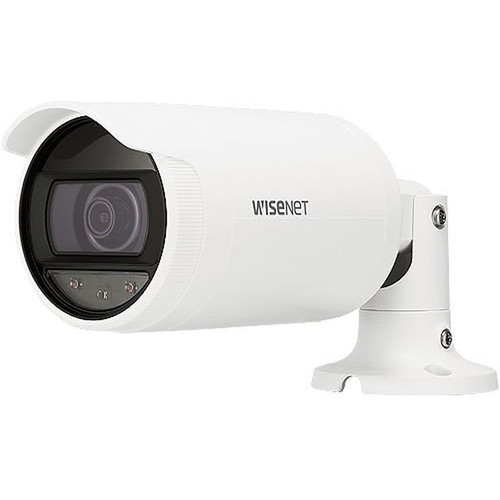
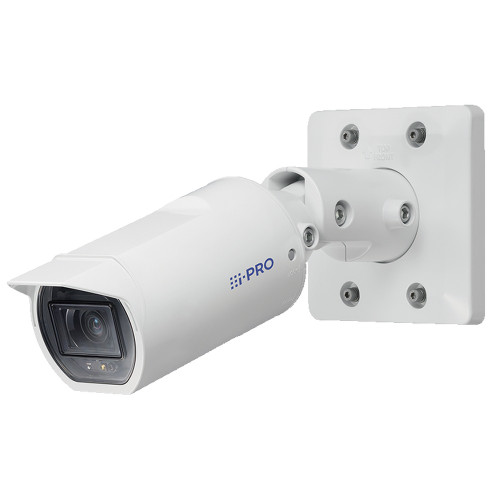
Both the Hanwha ANO-L7022R and the i-PRO WV-U1542LA are 4MP wired outdoor bullet IP cameras designed for perimeter and general surveillance, powered via PoE and rated IP66. They occupy the same resolution class and share the bullet form factor, making them direct cross-shop candidates for installers evaluating fixed-lens economy versus motorized-varifocal flexibility at the 4MP tier. This comparison is driven entirely by published specifications for each model.
In This Guide
How do the imaging specs compare?
The ANO-L7022R uses a 1/3" CMOS sensor with a fixed 4mm lens (F1.6 aperture), delivering a horizontal field of view of 79° and a detection range of 62.9m (206ft) at 25PPM. Its minimum illumination is 0.13 lux color / 0 lux with IR (850nm LEDs, 25m range), and its Wide Dynamic Range is rated at 120dB. The WV-U1542LA uses a larger approx. 1/2.7" CMOS sensor with a motorized varifocal lens spanning 2.9–7.3mm (2.5x optical zoom), providing a horizontal field of view of 44–103°. In telephoto mode it achieves a detection range of 126.7m (415.8ft) at 25PPM, far exceeding the fixed-lens model. Its minimum illumination is 0.3 lux color / 0.12 lux B&W, with IR LEDs rated at 20m.
On WDR, the ANO-L7022R specifies 120dB, while the WV-U1542LA specifies a maximum of 102dB (Super Dynamic level 31). The Hanwha also provides SSNR digital noise reduction without a stated level range, whereas the i-PRO's DNR level is adjustable from 0 to 255. The i-PRO adds fog compensation (adjustable 0–8) and Adaptive Black Stretch is listed as not available in its spec sheet. The Hanwha's larger WDR headroom and lower color lux rating (0.13 vs 0.3) favor it in high-contrast or dimly lit wide-angle scenes; the i-PRO's varifocal reach and larger sensor format favor it where variable standoff distance is required.
What about installation and environment?
Both cameras carry an IP66 ingress rating and are powered by PoE IEEE 802.3af. The ANO-L7022R draws a maximum of 7.5W (typical 5.7W) and operates from -30°C to +55°C. The WV-U1542LA draws 7.2W and operates from -30°C to +50°C, giving the Hanwha a 5°C advantage at the high-temperature end. The i-PRO additionally carries NEMA 4X and IK10 (impact resistance per IEC 62262) ratings, specifies wind resistance up to 40 m/s (~89 mph), and includes an anti-condensation Temish element — none of these supplemental certifications appear in the Hanwha's published specs.
Physically, the ANO-L7022R measures ø78.0 × 262.0mm and weighs 390g, with a plastic housing. The WV-U1542LA is larger at 112.5 × 112.5 × 262mm and heavier at 860g, constructed from aluminum die cast, PC resin, and stainless steel. The i-PRO's motorized lens requires no physical adjustment at the camera head, enabling remote focus and zoom from the VMS or browser; the Hanwha's fixed lens is set at installation. Mounting adjustment ranges are specified for the i-PRO (±180° pan, 0–100° tilt for ceiling; ±100° horizontal/vertical for wall); the Hanwha lists 0–360° pan, 0–100° tilt, and 0–360° rotate.
Which fits your VMS and analytics better?
Both cameras support ONVIF Profiles G, S, and T and H.265/H.264/MJPEG compression with CBR/VBR bitrate control. The ANO-L7022R additionally supports Hanwha's SUNAPI (HTTP API) and WiseStream II smart codec (manual, up to 5 areas), and streams up to 3 simultaneous profiles for up to 6 unicast users. The WV-U1542LA supports up to 14 simultaneous users and includes GOP control and frame-rate control (H.265) as its smart-coding mechanisms. The i-PRO lists MQTT in its protocol stack; the Hanwha does not.
Edge analytics differ materially. The ANO-L7022R specifies motion detection, tampering, defocus detection, virtual area (intrusion/enter/exit), and virtual line (crossing/direction) — all on-camera. The WV-U1542LA lists VMD (4 areas) and Scene Change Detection (1 area); no additional on-camera video analytics are specified. Audio is not supported on either camera per their published specifications — the i-PRO's spec sheet lists audio input/output as dashes (—), and the ANO-L7022R lists no audio capability. On-board storage differs: the Hanwha supports microSD/SDHC/SDXC up to 128GB; the i-PRO supports microSDXC up to 512GB and microSDHC up to 32GB. Security features are broadly comparable: both support 802.1X, HTTPS, and device certificates; the Hanwha adds firmware encryption, SD card partition encryption, brute-force prevention, and ZIP-encrypted data protection per its spec sheet.
Which should you choose: the L7022R or the U1542LA?
Our take: The ANO-L7022R is the stronger choice when a fixed wide-angle view, richer on-camera analytics, higher WDR tolerance (120dB vs 102dB), and lower color minimum illumination (0.13 lux vs 0.3 lux) matter more than lens flexibility. The WV-U1542LA is the stronger choice when standoff distance varies or is unknown at install time — its 2.5x motorized varifocal lens enables remote focus adjustment and extends telephoto detection range to 126.7m (vs 62.9m for the Hanwha at 25PPM). The i-PRO also adds IK10 vandal resistance, NEMA 4X certification, wind resistance to 40 m/s, and 512GB edge storage capacity — none of which appear in the Hanwha's published specs. The Hanwha operates 5°C higher (+55°C vs +50°C) and carries a 3-year warranty versus the i-PRO's 5-year warranty. Choose the ANO-L7022R for analytics-rich fixed installations; choose the WV-U1542LA for ruggedized deployments or sites requiring field-adjustable zoom.
Side-by-Side Comparison
Spec-for-spec, from manufacturer data.
| Specification | Hanwha L7022R | i-PRO U1542LA |
|---|---|---|
| Resolution | 4MP (2560×1440) | 4MP (2688×1520) |
| Image Sensor | 1/3" CMOS | Approx. 1/2.7" CMOS |
| Lens / Focal Length | 4mm fixed (F1.6) | 2.9–7.3mm motorized varifocal (F2.0–F3.0) |
| Optical Zoom | — | 2.5x motorized |
| Min. Illumination (Color) | 0.13 lux | 0.3 lux |
| Min. Illumination (B&W / IR) | 0 lux (IR on) | 0.12 lux (B&W) |
| IR Range | 25m (82ft) | 20m (66ft) |
| Wide Dynamic Range | 120dB | Max. 102dB (Super Dynamic On, Level 31) |
| Max Frame Rate | 30fps @ 4MP | 30fps @ 4MP |
| Video Compression | H.265, H.264, MJPEG | H.265, H.264, MJPEG |
| IP Rating | IP66 | IP66, NEMA 4X |
| IK / Impact Rating | — | IK10 |
| Operating Temperature | -30°C to +55°C | -30°C to +50°C |
| Power Input / PoE Class | PoE IEEE 802.3af, Class 3, max 7.5W | PoE IEEE 802.3af, 7.2W |
| Edge Storage | microSD/SDHC/SDXC up to 128GB | microSDXC up to 512GB |
| On-Camera Analytics | Motion, tamper, defocus, virtual area, virtual line | VMD (4 areas), Scene Change Detection (1 area) |
| ONVIF Profiles | G / S / T | G / S / T |
| Simultaneous Users | 6 (unicast) | Up to 14 |
| Dimensions | ø78.0 × 262.0mm (ø3.07 × 10.31") | 112.5 × 112.5 × 262mm (4-7/16 × 4-7/16 × 10-5/16") |
| Weight | 390g (0.86 lb) | 860g (1.90 lb) |
| Housing Material | Plastic | Aluminum die cast, PC resin, stainless steel |
| Warranty | 3 years | 5 years |
Frequently Asked Questions
Which should you choose: the L7022R or the U1542LA?
The ANO-L7022R is the stronger choice when a fixed wide-angle view, richer on-camera analytics, higher WDR tolerance (120dB vs 102dB), and lower color minimum illumination (0.13 lux vs 0.3 lux) matter more than lens flexibility. The WV-U1542LA is the stronger choice when standoff distance varies or is unknown at install time — its 2.5x motorized varifocal lens enables remote focus adjustment and extends telephoto detection range to 126.7m (vs 62.9m for the Hanwha at 25PPM). The i-PRO also adds IK10 vandal resistance, NEMA 4X certification, wind resistance to 40 m/s, and 512GB edge storage capacity — none of which appear in the Hanwha's published specs. The Hanwha operates 5°C higher (+55°C vs +50°C) and carries a 3-year warranty versus the i-PRO's 5-year warranty. Choose the ANO-L7022R for analytics-rich fixed installations; choose the WV-U1542LA for ruggedized deployments or sites requiring field-adjustable zoom.
Is the ANO-L7022R or WV-U1542LA better for low-light performance?
The ANO-L7022R specifies a lower color minimum illumination (0.13 lux vs 0.3 lux for the WV-U1542LA) and a longer IR range (25m vs 20m). The i-PRO reaches 0 lux in B&W mode at 0.12 lux, which is not directly specified in the Hanwha's B&W figure — only 0 lux with IR on is stated. Based on published specs, the Hanwha has an advantage in color low-light sensitivity and IR reach; the i-PRO's 1/2.7" sensor is physically larger, which may influence real-world low-light behavior but is not quantified beyond the listed lux figures.
Which camera is easier to install if I don't know the exact mounting distance yet?
The WV-U1542LA's 2.5x motorized varifocal lens (2.9–7.3mm) allows the field of view to be adjusted remotely after mounting, covering 44–103° horizontal. The ANO-L7022R has a fixed 4mm lens set at 79° horizontal — no optical adjustment is possible post-installation. For sites where standoff distance may change or is uncertain, the WV-U1542LA provides significantly more flexibility without requiring physical access to the camera head.
Does either camera support on-board video analytics beyond basic motion detection?
Yes — the ANO-L7022R specifies tampering detection, defocus detection, virtual area analytics (intrusion, enter, exit), and virtual line analytics (crossing, direction) in addition to motion detection, all on-camera per its published spec sheet. The WV-U1542LA specifies VMD (4 areas) and Scene Change Detection (1 area); no additional on-camera analytics are listed in its published specifications. If edge analytics are required without a VMS license, the ANO-L7022R has a more comprehensive on-camera feature set per spec.
Get a Second Opinion on Your Camera Choice
Share your site layout, coverage goals, and budget. Our team will validate the camera selection, flag anything we would change, and recommend products that match the use case.