
Hanwha L7082R vs i-PRO U1542LA: Specification Comparison
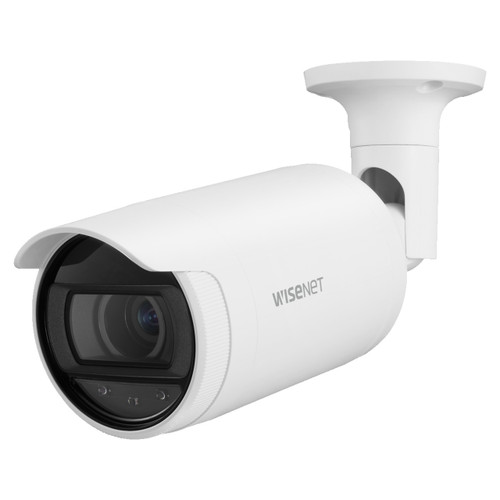
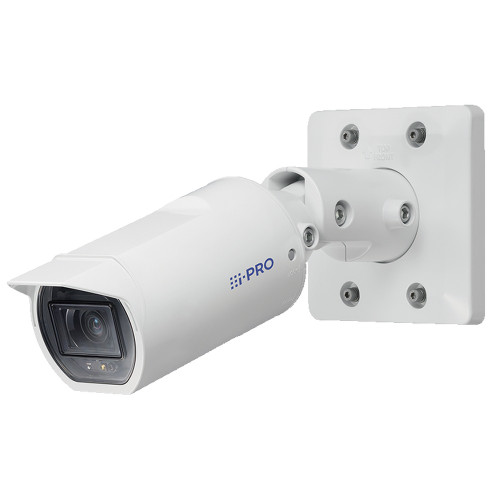
Both the Hanwha ANO-L7082R and the i-PRO WV-U1542LA are wired, PoE-powered, 4MP outdoor bullet cameras with motorized varifocal lenses and IR night vision, placing them squarely in the same cross-shop category for perimeter and general outdoor surveillance. The comparison covers imaging performance, environmental and installation characteristics, and VMS/analytics integration—areas where the two models diverge meaningfully despite sharing a common form factor and resolution class.
In This Guide
How do the imaging specs compare?
The ANO-L7082R uses a 1/2.8" CMOS sensor with a 3.3–10.3mm (3.1x) motorized varifocal lens, F1.6 (wide) to F3.3 (tele), achieving a minimum illumination of 0.1 lux in color and 0 lux in IR mode using an 850nm IR LED with a rated range of 30m (98.4ft). Its WDR is specified at 120dB. At tele, the DORI detect range is 204.6m and identify range is 20.5m. The WV-U1542LA uses an approximately 1/2.7" CMOS sensor with a 2.9–7.3mm (2.5x) motorized varifocal lens, F2.0 (wide) to F3.0 (tele), and a minimum illumination of 0.3 lux color / 0.12 lux B&W. Its IR LED reaches 20m and its Super Dynamic WDR tops out at 102dB (level 31). At tele, the DORI detect range is 126.7m and identify range is 12.7m.
On pure imaging metrics, the L7082R holds advantages in WDR (120dB vs. 102dB), IR range (30m vs. 20m), and low-light sensitivity (0.1 lux color vs. 0.3 lux color). The L7082R's longer focal length and wider zoom ratio (3.1x, up to 10.3mm) deliver significantly greater DORI reach at tele versus the U1542LA's 2.5x/7.3mm lens. The U1542LA offers extra optical zoom (up to 3.3x) when resolution is set to 1080p, and its native horizontal FOV at wide (103°) is slightly broader than the L7082R (95°). Both cameras output 4MP at 30fps using H.265, H.264, and MJPEG compression.
What about installation and environment?
Both cameras are rated IP66 for dust and water ingress. The U1542LA adds NEMA 4X (UL50E) compliance and IK10 impact resistance (IEC 62262), along with a rated wind resistance of up to 40 m/s (approx. 89 mph) and an anti-condensation Temish element—none of these supplementary ratings are specified for the L7082R. The L7082R is constructed from plastic, while the U1542LA uses aluminum die cast, PC resin, and stainless steel.
The L7082R operates from -30°C to +55°C, giving it a 5°C upper-temperature advantage over the U1542LA's -30°C to +50°C range. Both are PoE IEEE 802.3af powered; the L7082R draws a maximum of 8.0W (typical 6.0W), while the U1542LA draws 7.2W. The L7082R weighs 390g vs. the U1542LA's 860g, a significant difference for bracket and conduit loading. Both support ceiling and wall mounting with full pan/tilt/rotate adjustment ranges.
Which fits your VMS and analytics better?
Both cameras support ONVIF Profile S, G, and T, ensuring broad VMS compatibility. The L7082R supports SUNAPI (HTTP API) in addition to ONVIF and is compatible with Hanwha's own VMS ecosystem. The U1542LA supports MQTT and LLDP protocols not listed for the L7082R, and specifies up to 14 simultaneous users versus the L7082R's 6 unicast users. The L7082R's edge analytics suite includes tampering, defocus detection, directional detection, and enter/exit in addition to VMD—the U1542LA's listed analytics are limited to VMD (4 areas) and Scene Change Detection (1 area).
On-board storage differs notably: the L7082R supports microSD/SDHC/SDXC up to 128GB (1 slot), while the U1542LA supports microSDXC up to 512GB. Audio support is not specified in the L7082R's provided specs; the U1542LA lists audio input/output fields, though those fields show '—' in the provided spec data, indicating no built-in audio terminals. Privacy masking on the L7082R supports 6 rectangular zones; the U1542LA supports up to 8 zones. The L7082R includes SD card partition encryption; the U1542LA spec lists device certificate, HTTPS, 802.1X, and encryption but does not specify SD card encryption.
Which should you choose: the L7082R or the U1542LA?
Our take: The ANO-L7082R is the stronger choice when imaging reach, low-light performance, and on-camera analytics depth are the primary decision factors. Its 30m IR range versus the U1542LA's 20m, 120dB WDR versus 102dB, and 0.1 lux color minimum illumination versus 0.3 lux give it a measurable edge in challenging light conditions. The 3.1x zoom ratio and 10.3mm tele end extend DORI detect range to 204.6m compared to the U1542LA's 126.7m, a critical gap for perimeter monitoring. The L7082R also supports a richer edge analytics set (defocus, directional, enter/exit) and a higher operating ceiling (+55°C vs. +50°C). However, the U1542LA is the better fit where physical hardening matters: its IK10 impact rating, NEMA 4X certification, aluminum housing, anti-condensation element, and 5-year warranty (versus the L7082R's 3-year) make it the preferred choice for exposed or vandal-risk installations.
Side-by-Side Comparison
Spec-for-spec, from manufacturer data.
| Specification | Hanwha L7082R | i-PRO U1542LA |
|---|---|---|
| Resolution | 4MP (2560×1440) | 4MP (2688×1520) |
| Image Sensor | 1/2.8" CMOS | Approx. 1/2.7" CMOS |
| Lens / Focal Length | 3.3–10.3mm motorized varifocal (3.1x) | 2.9–7.3mm motorized varifocal (2.5x) |
| Max Aperture | F1.6 (Wide) / F3.3 (Tele) | F2.0 (Wide) / F3.0 (Tele) |
| Min Illumination (Color) | 0.1 lux | 0.3 lux |
| Min Illumination (B&W / IR) | 0 lux (IR on) | 0.12 lux (B&W) |
| IR Range | 30m (98.4ft) | 20m (65.6ft) |
| WDR | 120dB | 102dB (Super Dynamic, Level 31) |
| Max Frame Rate | 30fps @ 4MP | 30fps @ 4MP |
| Video Compression | H.265, H.264, MJPEG | H.265, H.264, MJPEG |
| IP Rating | IP66 | IP66, NEMA 4X |
| IK / Impact Rating | — | IK10 |
| Operating Temperature | -30°C to +55°C | -30°C to +50°C |
| Power Input / PoE Class | PoE IEEE 802.3af, Class 3, max 8.0W | PoE IEEE 802.3af, 7.2W |
| Edge Storage | microSD/SDHC/SDXC up to 128GB | microSDXC up to 512GB |
| ONVIF Profile | S, G, T | S, G, T |
| Dimensions | ø78.0×262.0mm | 112.5×112.5×262mm |
| Weight | 390g (0.86lb) | 860g (1.90lb) |
| Warranty | 3 years | 5 years |
Frequently Asked Questions
Which should you choose: the L7082R or the U1542LA?
The ANO-L7082R is the stronger choice when imaging reach, low-light performance, and on-camera analytics depth are the primary decision factors. Its 30m IR range versus the U1542LA's 20m, 120dB WDR versus 102dB, and 0.1 lux color minimum illumination versus 0.3 lux give it a measurable edge in challenging light conditions. The 3.1x zoom ratio and 10.3mm tele end extend DORI detect range to 204.6m compared to the U1542LA's 126.7m, a critical gap for perimeter monitoring. The L7082R also supports a richer edge analytics set (defocus, directional, enter/exit) and a higher operating ceiling (+55°C vs. +50°C). However, the U1542LA is the better fit where physical hardening matters: its IK10 impact rating, NEMA 4X certification, aluminum housing, anti-condensation element, and 5-year warranty (versus the L7082R's 3-year) make it the preferred choice for exposed or vandal-risk installations.
Is the ANO-L7082R or WV-U1542LA better for low-light performance?
Based on the provided specs, the ANO-L7082R has a lower minimum illumination in color (0.1 lux vs. 0.3 lux) and achieves 0 lux in IR mode, while the U1542LA achieves 0.12 lux in B&W mode. The L7082R also has a longer IR range (30m vs. 20m). On the available spec data, the L7082R has the advantage in low-light and IR scenarios.
Which camera is better for vandal-prone or high-impact outdoor locations?
The WV-U1542LA is the specified choice for impact resistance: it carries an IK10 rating (IEC 62262) and NEMA 4X certification with an aluminum die-cast and stainless steel housing. The ANO-L7082R has an IP66 rating and plastic housing but no IK impact rating is listed in its provided specifications.
Can both cameras store video locally on an SD card?
Yes. The ANO-L7082R supports a single microSD/SDHC/SDXC slot up to 128GB with SD card partition encryption. The WV-U1542LA supports microSDXC up to 512GB and microSDHC up to 32GB, giving it a substantially higher local storage ceiling. Both support NAS recording via alarm triggers per their listed specs.
Get a Second Opinion on Your Camera Choice
Share your site layout, coverage goals, and budget. Our team will validate the camera selection, flag anything we would change, and recommend products that match the use case.