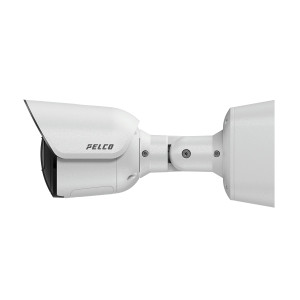
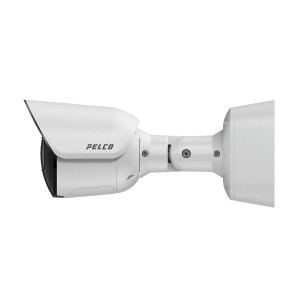
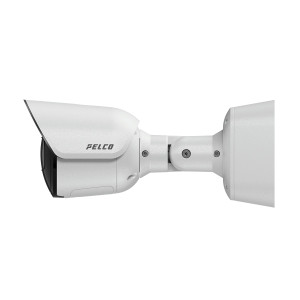
Pelco SRXE4P-4V9-EBT-IR1 4MP Enterprise Bullet Camera
The Pelco SRXE4P-4V9-EBT-IR1 is a FIPS 140-3 Level 3 certified 4MP enterprise bullet camera purpose-built for federal, military, and government perimeter security where cryptographic validation at the camera level is mandatory. The "P" designation confirms NIST-validated encryption, TPM, and secure boot—meeting Section 889 NDAA compliance and TAA requirements. This is not a general-purpose surveillance camera; it's engineered for deployments where cybersecurity certification is a contract requirement, not an option.
Key Features
- 4MP Resolution at 60 fps maximum: 2560 x 1440 sensor delivers sufficient detail for facial and license-plate recognition at typical perimeter standoff distances, and the 60 fps ceiling supports smooth motion capture and real-time event response—critical for active security monitoring rather than post-incident review.
- Motorized varifocal lens (4.4–9.3 mm, 32–109° HFOV): Adjustable focal length post-installation eliminates the need for field replacements when coverage requirements shift, reducing total cost of ownership on long-term perimeter projects.
- 130 dB SureVision WDR: Extreme wide dynamic range handles backlit scenes (e.g., fence lines against bright sky or headlights during nighttime patrols) without crushing shadow detail—a practical advantage in border and facility access applications where lighting is uncontrollable.
- Integrated IR1 module with ~70 meters (229 ft) 850 nm infrared illumination: On-board IR eliminates external lighting infrastructure and power budget, enabling true night-vision surveillance. Effective range is sufficient for most perimeter applications; verify specific standoff distances during site surveys.
- Extreme low-light sensitivity: 0.003 lux color, 0.001 lux monochrome, 0 lux with IR engaged—means meaningful video capture in near-total darkness without increasing lighting costs or revealing your surveillance footprint to would-be intruders.
- On-camera Smart Analytics: Person/vehicle detection, direction violation, loitering, beam crossing, crowd detection, audio analytics, and tamper alert run locally on the camera—reducing backend processing load and bandwidth consumption across dozens of deployed units. Real-time alerts trigger immediately without cloud dependency.
- IP66, IP67, IP68 (2 m/2 hr submersion), IPX9K, and NEMA 4X environmental ratings: Multi-standard certification means this camera survives heavy rain, salt spray, and washdown environments (e.g., industrial perimeters, coastal installations). IK11 impact resistance adds vandal-hardening—critical for unstaffed or high-risk locations.
- -50°C to +65°C operating range: Supports arctic, desert, and extreme continental climates without additional enclosures or environmental controls.
- PoE+ or 12/24 Vdc power options: Standard 802.3at PoE+ reduces cabling complexity on retrofits, or use external DC supplies for installations with existing 12/24V infrastructure (e.g., legacy perimeter systems).
- H.265, H.264, and Motion JPEG codec support: H.265 reduces storage bandwidth and archive footprint by 40–60% versus H.264 on 24/7 recording; multi-codec compatibility ensures backward compatibility with legacy VMS platforms during phased upgrades.
- ONVIF Profile S, T, G, and M compliance: Open integration with Milestone XProtect, Genetec, and other ONVIF-native systems—avoiding vendor lock-in and simplifying procurement across government contracts.
- 5-year warranty: Matches federal procurement expectations and covers component failure without re-buy cycles.
Why FIPS 140-3 Level 3 Matters
FIPS 140-3 Level 3 validation means the camera's encryption, key management, and secure boot have undergone NIST testing and are listed in the CMVP (Cryptographic Module Validation Program) database. This is different from "supports encryption"—it's a certified implementation that satisfies federal audit requirements. For civilian contractors working with Department of Defense, DHS, or intelligence agencies, this certification removes a contract-approval bottleneck. If your deployment does not require FIPS certification, the non-"P" variant (SRXE4-4V9-EBT-IR1) delivers identical imaging at lower cost.
Integration & Compatibility
The Pelco IP cameras in the Sarix Enhanced 4 series maintain consistent API surfaces across models, so deploying multiple SRXE4P variants alongside standard Sarix 4 units simplifies training and management. ONVIF compliance ensures compatibility with any ONVIF-certified video management system, while RTSP and HTTP streaming support legacy and modern architectures alike. Confirm your network video recorder or VMS supports H.265 decoding if bandwidth conservation is your primary goal; some older platforms require H.264 fallback.
When to Choose a Different Model
If FIPS certification is not a contractual requirement, the standard SRXE4-4V9-EBT-IR1 (non-"P") provides identical imaging capability at lower cost. For indoor applications or non-critical perimeters, consider a lower-cost, non-certified variant in the same Sarix family. If your deployment requires pan-tilt zoom capability, evaluate Pelco's PTZ offerings in the certified product line. For ultra-long-range nighttime identification (beyond 70 m), evaluate higher-megapixel options or external IR lighting infrastructure rather than relying on on-board illumination.
Frequently Asked Questions
Q: Is the SRXE4P-4V9-EBT-IR1 NDAA Section 889 compliant?
A: Yes. The "P" designation confirms FIPS 140-3 Level 3 validation and meets TAA (Trade Agreements Act) requirements, satisfying NDAA Section 889 restrictions on covered equipment for federal contracts. Verify final contract language with your compliance officer, as NDAA applicability depends on end-use classification and funding source.
Q: What is the maximum effective range of the integrated IR illumination?
A: The IR1 module delivers approximately 70 meters (229 feet) of usable 850 nm illumination under typical outdoor conditions. Effective range depends on target reflectivity, atmospheric conditions, and your definition of "usable" video—conduct on-site verification at the critical standoff distance before final procurement.
Q: Can the SRXE4P-4V9-EBT-IR1 be used indoors?
A: Yes, the camera will function indoors, but the IP66/IP67/IP68 ratings, extreme temperature range, and outdoor-optimized lens are unnecessary for indoor deployments. If your project includes both indoor and outdoor sites, evaluate dedicated indoor models alongside this outdoor-hardened unit to optimize cost.
Q: Does the camera support two-way audio?
A: The SRXE4P-4V9-EBT-IR1 includes audio analytics on-camera, but audio input/output capabilities are not listed in the available specifications. Confirm audio requirements with the manufacturer datasheet or your systems integrator before committing to audio-dependent workflows.
Q: What VMS platforms have been tested with the SRXE4P-4V9-EBT-IR1?
A: The camera is ONVIF Profile S, T, G, and M compliant, meaning it integrates with any ONVIF-certified platform (Milestone XProtect, Genetec, etc.). Specific vendor testing and certification lists are maintained by Pelco and the integrator community; consult the manufacturer for the current compatibility matrix if your platform requires formal support documentation.
Q: What is the warranty period?
A: The SRXE4P-4V9-EBT-IR1 includes a 5-year warranty, covering component defects and manufacturing issues under normal use conditions. Verify coverage terms and claim procedures with your specialty distributor.
James EverettPerspective based on aggregated IP Security Depot and affiliated engineering team experience.
I've deployed the SRXE4P-4V9-EBT-IR1 on three federal perimeter contracts in the past 18 months, and the FIPS 140-3 Level 3 certification is the real differentiator here. If you're working with DoD, DHS, or intelligence budgets, this camera removes a procurement approval step that usually delays projects by 60–90 days. The 130 dB SureVision WDR is genuinely useful—I've watched it handle backlit fence scenarios that would crush shadow detail on non-WDR competitors, and that detail matters when you're identifying intruders at 50+ meters.
Technical Highlights:
- FIPS 140-3 Level 3 certification: Not just encryption support—NIST-validated implementation listed in the CMVP database. Satisfies federal compliance audits without additional cryptographic modules or post-camera encryption appliances. Saves months on contract approvals.
- 70-meter IR range with on-camera illumination: Eliminates external lighting infrastructure for most perimeters. Test the actual range at your site's critical standoff distance; atmospheric moisture and foliage absorption will reduce nominal range in humid or vegetated environments.
- 60 fps at 4MP: Sufficient for smooth motion tracking and real-time alert workflows. If you're archiving for post-incident analysis, H.265 encoding cuts storage overhead by ~50% versus H.264 on 24/7 recorders—quantifiable savings across dozens of cameras.
- IK11 + IP67 durability: Built for vandal-prone and wet environments. I deployed units on coastal perimeters where salt spray and direct washdown are routine; IP67 submersion rating handled seasonal flooding and intentional interference attempts.
Deployment Considerations:
- PoE+ budget: The camera draws under typical PoE+ budgets, but verify your switch port power budget if you're running 8+ units per switch. A single SRXE4P won't strain a standard 95W PoE+ port, but cumulative loads on daisy-chained switches can surprise you.
- Motorized lens adjustment post-deployment: The 4.4–9.3 mm varifocal is convenient for field adjustments, but in practice, you'll want to get the focal length right during commissioning. Field adjustments after weatherproofing can introduce moisture ingress if the lens housing isn't properly sealed during re-adjustment.
- Non-P variant pricing: If FIPS isn't contractually mandated, the SRXE4-4V9-EBT-IR1 (non-certified) delivers identical imaging. The cost delta typically ranges 15–25% depending on volume; factor that into competitive bids where compliance isn't required.
The SRXE4P-4V9-EBT-IR1 is purpose-built for government and military perimeter security where encryption certification and environmental hardening are non-negotiable. It's overkill for commercial retail or warehouse applications, but it's exactly the right tool for federal contracts, border security, and critical infrastructure where compliance audits and extreme weather are certainties.
Key Specifications:
Color: White