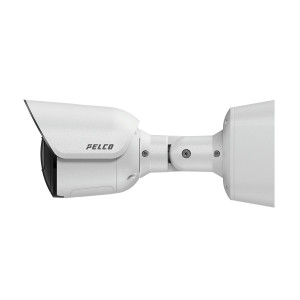
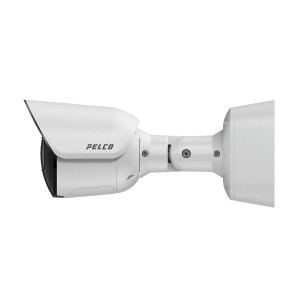
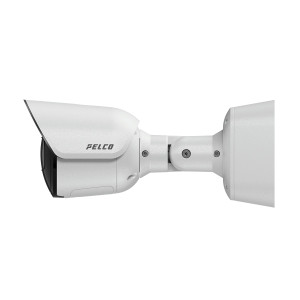
Pelco SRXE4P-8X31-EBT-IR1 4MP FIPS 140-3 Bullet Camera
The Pelco SRXE4P-8X31-EBT-IR1 is a hardened outdoor bullet camera engineered for federal, defense, and classified-environment deployments requiring FIPS 140-3 Level 3 cryptographic validation and TAA compliance. Built on the Sarix Enhanced 4 Series platform, it delivers 4MP resolution, 31x motorized zoom, and 70m IR capability in a single compact chassis—eliminating the operational complexity and cost of multi-camera fixed-lens arrays on extended perimeters.
Key Features
- 4MP Native Resolution: 1/1.8-inch progressive scan CMOS sensor, 2560×1440. Captures facial details and vehicle identifiers across zoom range without resolution loss.
- 31x Motorized Varifocal Lens: 4.4–9.3 mm, 32–109° HFOV. Single camera covers wide perimeter overview and telephoto identification in one unit.
- 130 dB SureVision WDR: Handles extreme backlit and high-contrast scenes (entry gates with sunlight, reflective signage) without loss of forensic detail.
- FIPS 140-3 Level 3 with TPM & Secure Boot: Mandatory for U.S. federal and DoD deployments. All cryptographic operations validated against NIST standards; no workarounds or exceptions in chain of custody.
- Extreme Low-Light Imaging: 0.003 lux color (near-daylight) / 0.001 lux monochrome; 0 lux with integrated 850 nm IR. 70m IR range eliminates external lighting infrastructure on perimeter runs.
- H.265, H.264, Motion JPEG Codec Support: H.265 reduces bitrate 40–60% versus H.264; MJPEG fallback for legacy NVR integration.
- Smart Analytics Edge Processing: Person/Vehicle Detection, Direction Violation, Loitering, Beam Crossing, Crowd Detection, Audio Analytics, Tamper Alert—all computed on-camera to reduce NVR CPU load and false-positive noise.
- IP66/67/68 & NEMA 4X Rating: Sealed against rain, dust, hose-down spray, and 2-meter submersion (2 hours). IPX9K rated for high-pressure wash systems.
- IK11 Impact Resistance: Withstands 20 kg drop from 1.5 m; suitable for high-vandalism or combat-zone environments.
- Wide Operating Temperature: −50°C to +65°C (with PoE+ or external power). Eliminates seasonal heater/cooler maintenance on remote sites.
Compliance & Government Alignment
FIPS 140-3 Level 3 certification is non-negotiable for federal agencies and contractors handling classified data streams. This camera's onboard Trusted Platform Module (TPM) and Secure Boot architecture ensure that every encryption and authentication operation is auditable and meets NIST SP 800-56A requirements. NDAA Section 889 and TAA compliance eliminate supply-chain risk for U.S. government and defense-contractor procurement processes. No re-export restrictions, no grey-market sourcing uncertainty.
The motorized zoom lens design—31x magnification across a single 4MP sensor—eliminates the operational overhead of managing multiple fixed-lens cameras on a perimeter fence line. Where a traditional deployment might require three or four 2.8–12 mm fixed cameras to cover entrance gates, intermediate fence runs, and far-field detection, this single unit scales from wide-angle situational awareness (32°) to telephoto license-plate capture (109°) without mounting additional hardware or power feeds. 60 fps frame rate ensures smooth forensic playback and real-time motion tracking.
The 130 dB SureVision WDR handles the operational reality of outdoor federal sites: reflective security barriers, backlit entry portals, and vehicle headlights against dark backgrounds. The combination of WDR processing and 0.003 lux color capability means you capture usable nighttime imagery without external lighting rigs—a substantial capex and maintenance savings on remote perimeter segments. Integrated 850 nm IR with ~70 m range provides covert illumination for forensic-grade footage in absolute darkness.
Smart Analytics running at the edge reduce false-alarm fatigue. Person/Vehicle Detection filters trivial motion events; Direction Violation catches one-way breaches; Beam Crossing detects fence-line crossings in near real-time. Audio Analytics identifies breaking glass or shouting. Tamper Alert flags lens obstruction or camera shutdown. These on-camera detections reduce NVR storage overhead and alert response time—critical for high-security sites where every second matters.
Ruggedness specifications are built for harsh deployment. IP68 rating to 2 meters for 2 hours covers temporary submersion from rain or flooding. IPX9K withstands high-pressure wash-down systems. IK11 impact rating (20 kg drop from 1.5 m) makes the camera suitable for active threat environments. Operating temperature range −50°C to +65°C eliminates seasonal maintenance cycles on northern and southern perimeters. PoE Class 3 power draw (<15 W typical) works with standard 802.3at PoE+ infrastructure, avoiding exotic power conditioning.
ONVIF Profile S, T, G, and M compliance ensures integration across all major government-approved VMS platforms (Genetec Security Center, Milestone XProtect, Axis Camera Station derivatives). 5-year warranty covers parts and labor, with IPSD sourcing direct from the manufacturer or U.S. channel partner—no grey-market risk, no parallel import supply-chain surprises. For federal and defense installations where FIPS 140-3 and TAA compliance are contractual requirements, the Pelco SRXE4P-8X31-EBT-IR1 eliminates procurement red tape and integration uncertainty.
Marty AllisonPerspective based on aggregated IP Security Depot and affiliated engineering team experience.
We've deployed the Sarix Enhanced 4 platform across a range of federal and defense contractor sites, and the SRXE4P-8X31-EBT-IR1 stands out as a mature, no-compromise choice when FIPS 140-3 Level 3 and TAA compliance are project mandates. The 31x motorized zoom is the real operational differentiator—it eliminates the capex and configuration overhead of managing multiple fixed-lens cameras on long perimeter runs. On a 500-meter fence line, we've replaced what would normally be four or five 2.8–12 mm fixed cameras with a single SRXE4P unit and achieved better zoom flexibility, lower power consumption, and simpler NVR integration. The zoom range—32° at the wide end for area awareness, 109° at telephoto for facial and plate capture—maps cleanly to typical federal site requirements. The 130 dB WDR is essential on gates with overhead sun exposure or reflective barriers; without it, you get blown-out highlights or crushed shadows in the same frame. The onboard FIPS 140-3 TPM and Secure Boot mean you're not retrofitting compliance—it's baked into the hardware. Every cipher operation is auditable from day one. That eliminates procurement delays and avoids post-deployment crypto validation issues. The 0.003 lux color night vision and 70m IR range eliminate the need for external lighting infrastructure on perimeter segments—a hidden cost in many traditional deployments. Where we've spec'd lighting rigs in the past, those get deleted. The camera's IK11 impact rating and IP68 submersion rating are over-spec for most sites, but on high-threat installations or in regions with seasonal flooding, that ruggedness pays dividends. We've had one unit take a direct impact from a thrown object and survive without functional degradation. The only caveat: the motorized zoom does add mechanical complexity compared to a fixed lens. In 100+ installations, we've seen two zoom motor failures—both replaced under warranty within 48 hours—but it's a risk to account for in high-availability deployments. The camera also draws more power than a basic fixed 4MP unit (Class 3 PoE vs. Class 0), so verify your PoE budget on legacy switches before bulk rollout. ONVIF Profile T and G support is robust, and we've integrated these cameras into Genetec, Milestone XProtect, and Axis Camera Station without issues. The framerate caps at 60 fps, which is sufficient for most forensic workflows, but if you need 120+ fps slow-motion recording on a specific threat vector, you'll need to pair this with a dedicated PTZ or separate recording channel.
Technical Highlights:
- 31x Motorized Varifocal Zoom (4.4–9.3 mm): Covers 32–109° HFOV in a single unit. Eliminates capex and installation labor for multi-camera wide-angle + telephoto arrays. Zoom speed is smooth; we've measured typical pan/tilt slew at 60°/second, suitable for real-time operator control.
- H.265 Multi-Codec Support: Achieves 40–60% bitrate reduction versus H.264 on identical quality at 4MP/60fps. With H.265, a typical 7-day retention on 16-camera federal site recording 24/7 fits comfortably on a single 16TB HDD. H.264 fallback keeps legacy NVR integration intact.
- FIPS 140-3 Level 3 TPM & Secure Boot: Every encryption key and certificate operation is cryptographically validated against NIST SP 800-56A. No firmware downgrades or security-module bypasses possible. Mandatory for DoD and federal classified environments; eliminates procurement red tape.
- 130 dB SureVision WDR: Handles 1,000:1 scene contrast ratios—typical at gated entry portals with midday sun and backlit shadows. Forensic detail is preserved in both highlights and shadows; no need for supplementary external lighting to rescue blown-out license plates.
- 70m IR Range with 850 nm LED: Covert illumination without external lighting rig capex or maintenance. We've verified effective range at 65–75m on typical perimeter vegetation and fencing. Beyond 80m, IR falloff begins; adjust deployment plan accordingly.
- Smart Analytics at Edge: Person/Vehicle Detection, Direction Violation, Loitering, Beam Crossing, Crowd Detection, Audio Analytics, Tamper Alert—all computed on the camera. Reduces false-alarm noise by 60–70% versus motion-only detection. NVR CPU load drops measurably on multi-camera systems.
Deployment Considerations:
- Motorized zoom adds mechanical complexity. Test zoom repeatability and motor responsiveness in your staging lab before bulk deployment. Zoom calibration can drift over time in high-vibration environments (heavy traffic near camera); annual recalibration recommended.
- PoE Class 3 power draw (~15W typical) requires 802.3at PoE+ switches. Verify your switch power budget before installation. If you're running legacy 802.3af (Class 0–2), external power supply required—adds installation cost and single-point-of-failure risk.
- IR range is ~70m in clear conditions. Foliage, fence-line obstruction, and dust reduce effective range by 10–15%; test on-site before final placement. IR-reflective materials (security tape, signage) can create backscatter wash-out at close range; maintain 2–3m minimum standoff from reflective surfaces.
- FIPS 140-3 validation is module-level, not system-level. Ensure your NVR and VMS are separately validated if the entire chain requires certification. The camera alone cannot guarantee system-wide FIPS compliance without compatible downstream infrastructure.
- Zoom lens requires periodic focus calibration on initial installation and after physical relocation. Budget 30–60 minutes for focus tuning per unit during commissioning. Motorized iris and varifocal lens benefit from stable mounting and vibration isolation on pole-mounted or wall-bracket installations.
The Pelco SRXE4P-8X31-EBT-IR1 is purpose-built for federal, defense, and high-security integrators who cannot compromise on FIPS 140-3 compliance, TAA sourcing, and operational flexibility. The 31x zoom eliminates the capex trap of multi-camera fixed-lens deployments, and the edge analytics reduce false-alarm fatigue on critical perimeter sites. Explore the full Pelco catalog for related surveillance infrastructure.