
Honeywell 8675I200FR-2-N vs Honeywell 8690IB601-2: Specification Comparison
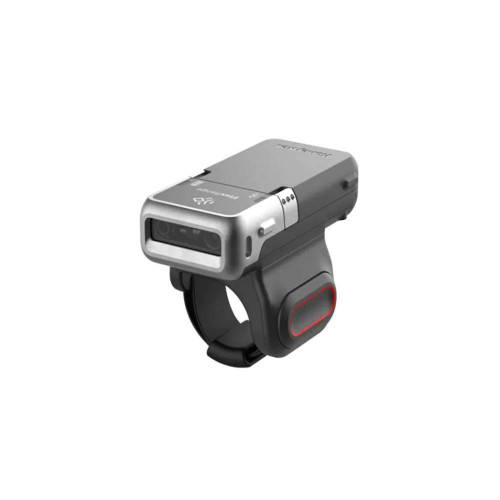
Both the Honeywell 8675I200FR-2-N and the 8690IB601-2 are wearable Bluetooth ring scanners capable of reading 1D and 2D barcodes, rated IP55 for dust and moisture resistance, and targeted at hands-free warehouse, logistics, and retail workflows. This comparison evaluates the two units across battery and shift endurance, physical and environmental durability, and scan pattern and connectivity specifications — the axes that most directly affect purchasing decisions for wearable ring scanner deployments.
In This Guide
- Which scanner delivers longer shift endurance and how do their battery capacities compare?
- How do the two scanners compare on environmental ruggedness and operating temperature range?
- What are the differences in scan pattern, imager technology, and Bluetooth connectivity between the two units?
- Which should you choose: the 8675I200FR-2-N or the 8690IB601-2?
- Side-by-Side Specs
- FAQ
Which scanner delivers longer shift endurance and how do their battery capacities compare?
The 8690IB601-2 carries a 420 mAh battery, 40 mAh (approximately 11%) more capacity than the 380 mAh cell in the 8675I200FR-2-N. Both manufacturers describe their respective units as capable of all-shift operation, but only the 8690IB601-2 spec explicitly frames the 420 mAh rating as 'all-shift capability.' The 8675I200FR-2-N spec does not include a stated runtime figure in hours.
For high-throughput environments where devices must run continuously across 8–10 hour shifts without battery swaps, the 40 mAh advantage of the 8690IB601-2 is a factual differentiator, though neither datasheet provides a scan-cycle or runtime figure to quantify the real-world delta. Both units carry a 3-year warranty, so post-purchase battery support terms are equivalent.
How do the two scanners compare on environmental ruggedness and operating temperature range?
Both units share an IP55 rating, providing equivalent protection against dust ingress and low-pressure water jets — neither is rated for immersion. The 8675I200FR-2-N is marked 'Outdoor Ready' in its spec set and is described as suitable for warehouse and harsh environments, but no operating temperature range is specified in the provided data.
The 8690IB601-2 explicitly lists an operating temperature range of -20°C to 50°C, covering cold-storage and outdoor field-service scenarios. Because no temperature specification is provided for the 8675I200FR-2-N, buyers deploying in environments below 0°C or above ambient warehouse temperatures cannot confirm suitability from available data. The 8690IB601-2's documented cold-storage rating is a concrete, verifiable advantage for temperature-variable deployments.
What are the differences in scan pattern, imager technology, and Bluetooth connectivity between the two units?
The 8675I200FR-2-N uses an area imager with an 844 × 640 pixel array, as noted in the spec data, enabling structured 2D capture across its field of view. Its scan pattern classification is listed as Area Imager. The 8690IB601-2 is listed with an omni-directional scan pattern and Bluetooth operating in the 2.4 GHz to 2.5 GHz ISM band, with a stated decode range of 44 mm to 552 mm (1.7 in to 21.7 in). No pixel array resolution or decode range is specified for the 8675I200FR-2-N in the provided data.
Both units connect via Bluetooth wireless. The 8690IB601-2 spec explicitly states the ISM frequency band (2.4–2.5 GHz); the 8675I200FR-2-N spec does not include a Bluetooth frequency or range figure. For deployments requiring documented RF band compliance or specific decode-distance guarantees, the 8690IB601-2 provides more verifiable data.
Which should you choose: the 8675I200FR-2-N or the 8690IB601-2?
Our take: The 8690IB601-2 is the stronger choice when operating temperature range, documented decode distance, and shift-length battery endurance are primary decision criteria. It carries a 420 mAh battery versus the 8675I200FR-2-N's 380 mAh — a 40 mAh (≈11%) advantage — specifies a -20°C to 50°C operating range absent from the 8675I200FR-2-N data, and documents a 44–552 mm decode range with explicit 2.4–2.5 GHz Bluetooth band confirmation. The 8675I200FR-2-N, by contrast, specifies a higher-resolution area imager (844 × 640 pixels) and is listed as outdoor-ready, but no temperature floor or decode-distance figure is provided in available specs to substantiate cold or extended-range claims. Both units weigh under 30 g, carry IP55 ratings, and include 3-year warranties. The 8675I200FR-2-N may suit structured-light 2D imaging tasks where pixel resolution matters; the 8690IB601-2 is better documented for cold-chain, outdoor, and extended-shift deployments.
Side-by-Side Comparison
Spec-for-spec, from manufacturer data.
| Specification | Honeywell 8675I200FR-2-N | Honeywell 8690IB601-2 |
|---|---|---|
| Part Number | 8675I200FR-2-N | 8690IB601-2 |
| Series / Family | 8675i | 8680i |
| Scan Type | 1D/2D Wearable Ring | 1D/2D Wearable Ring |
| Scan Pattern | Area Imager (844 × 640 px) | Omni-directional |
| IP Rating | IP55 | IP55 |
| Connectivity | Bluetooth Wireless | Bluetooth Wireless (2.4–2.5 GHz ISM) |
| Battery Capacity | 380 mAh | 420 mAh |
| Weight | 28 g (1.0 oz) | 26 g |
| Operating Temperature | — | -20°C to 50°C |
| Decode Range | — | 44 mm to 552 mm (1.7–21.7 in) |
| Outdoor Ready | Yes | — |
| Warranty | 3-Year | 3-Year |
| Form Factor | Ring / Wearable | Ring / Wearable |
| Device Category | Scanner | Scanner |
Frequently Asked Questions
Which should you choose: the 8675I200FR-2-N or the 8690IB601-2?
The 8690IB601-2 is the stronger choice when operating temperature range, documented decode distance, and shift-length battery endurance are primary decision criteria. It carries a 420 mAh battery versus the 8675I200FR-2-N's 380 mAh — a 40 mAh (≈11%) advantage — specifies a -20°C to 50°C operating range absent from the 8675I200FR-2-N data, and documents a 44–552 mm decode range with explicit 2.4–2.5 GHz Bluetooth band confirmation. The 8675I200FR-2-N, by contrast, specifies a higher-resolution area imager (844 × 640 pixels) and is listed as outdoor-ready, but no temperature floor or decode-distance figure is provided in available specs to substantiate cold or extended-range claims. Both units weigh under 30 g, carry IP55 ratings, and include 3-year warranties. The 8675I200FR-2-N may suit structured-light 2D imaging tasks where pixel resolution matters; the 8690IB601-2 is better documented for cold-chain, outdoor, and extended-shift deployments.
Is the 8675I200FR-2-N or 8690IB601-2 better suited for cold-storage or freezer warehouse environments?
Based on available specifications, only the 8690IB601-2 provides a documented operating temperature range of -20°C to 50°C, which covers freezer and cold-chain environments. The 8675I200FR-2-N does not include an operating temperature specification in the provided data, so its suitability for sub-zero conditions cannot be confirmed from specs alone.
Which scanner is lighter and easier to wear for full-shift use?
The 8690IB601-2 weighs 26 g versus 28 g for the 8675I200FR-2-N — a 2 g difference. Both are wearable ring form factors rated for extended use. The 8690IB601-2 is also the heavier-battery unit (420 mAh vs 380 mAh), meaning it achieves lower weight despite greater battery capacity.
Does either scanner offer a longer decode range for scanning items on high shelves or conveyor belts?
Only the 8690IB601-2 specifies a decode range in the provided data: 44 mm to 552 mm (1.7 in to 21.7 in). No decode distance or read range is listed for the 8675I200FR-2-N in the available specifications. Buyers with documented range requirements should verify the 8675I200FR-2-N's decode distance directly against the manufacturer's datasheet before selecting that unit.
More Barcode Scanner Comparisons
- Unitech HT730-LJ6122BG vs Datalogic HS7500SR
- Unitech HT730-LJ6122BG vs Honeywell 8690IB601-2
- Unitech HT730-LJ6122BG vs Honeywell 8690IB201-2-N
- Unitech HT730-LJ6122BG vs Honeywell 8680I400-2
- Unitech HT730-LJ6122BG vs Unitech HT730-LJ6142BG
- Unitech HT730-LJ6142BG vs Datalogic HS7500SR
Barcode Scanner Buying Guides
Get a Second Opinion on Your Camera Choice
Share your site layout, coverage goals, and budget. Our team will validate the camera selection, flag anything we would change, and recommend products that match the use case.