
Honeywell 1962HSR-5USB-WC-N vs CipherLab A2500SCBSU0T1: Specification Comparison
Both the Honeywell 1962HSR-5USB-WC-N and the CipherLab A2500SCBSU0T1 are cordless handheld barcode scanners with USB connectivity, placing them in the same general device class a buyer could reasonably cross-shop. However, they diverge sharply on scan engine capability, target environment, and wireless technology. The Honeywell unit is a 2D imager optimized for healthcare point-of-care workflows, while the CipherLab is a 1D linear imager rated IP65 and designed for retail and industrial/warehouse use. This comparison evaluates which scanner fits a given deployment on the three axes that matter most: scan engine and symbology coverage, connectivity and form factor, and environmental and use-case fit.
In This Guide
- Which scanner handles the barcodes you actually need to read?
- How do the two scanners connect, and does the wireless implementation match your infrastructure?
- Which scanner is built for your physical environment and vertical?
- Which should you choose: the 1962HSR-5USB-WC-N or the A2500SCBSU0T1?
- Side-by-Side Specs
- FAQ
Which scanner handles the barcodes you actually need to read?
The Honeywell 1962HSR-5USB-WC-N uses a 2D imager with single-pass scan pattern, meaning it can read both 1D linear barcodes and 2D matrix codes (such as QR codes, Data Matrix, and PDF417) in a single presentation. The specs do not list an explicit minimum resolution or a scans-per-second figure for this model.
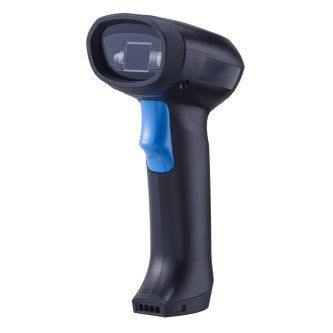
The CipherLab A2500SCBSU0T1 uses a 1D linear imager at 3 mil minimum resolution with a scan rate of 578 scans per second. Its auto-sense and continuous scan modes support a broad 1D symbology set — Codabar, Code 39, Code 93, Code 128, GS1 DataBar (RSS), Industrial 2 of 5, Interleave 2 of 5, ISBT-128, Italian and French Pharmacodes, Matrix 2 of 5, MSI, Plessey, Telepen, UPC/EAN/GS1-128, and Code 11. It cannot read 2D or matrix symbologies per the provided specs.
For any environment where 2D codes appear — prescription labels, patient wristbands, FDA UDI codes, or QR-based documentation — the Honeywell's 2D imager is the only viable option between the two. For operations restricted to 1D linear codes, the CipherLab's 578 scans/sec throughput and 3 mil resolution provide a quantified performance floor the Honeywell spec sheet does not match with equivalent figures.
How do the two scanners connect, and does the wireless implementation match your infrastructure?
The Honeywell 1962HSR-5USB-WC-N is described as a cordless handheld with USB connectivity and HID/keyboard-wedge interface. The spec data does not specify the wireless protocol (e.g., Bluetooth version, proprietary RF, or 802.11) used to achieve its cordless operation, nor does it list a wireless range or battery specification.
The CipherLab A2500SCBSU0T1 explicitly uses Bluetooth wireless as its primary link, with a USB wired option included as a kit component. The scan range is stated as Code 39: 3–60 cm and UPC-A: 0.5–38 cm. No Bluetooth version or wireless transmission range is specified in the provided specs.
Buyers deploying into Bluetooth-managed environments or needing a documented wireless protocol will find the CipherLab's Bluetooth designation more explicit than the Honeywell's vague 'cordless' label. Both offer USB fallback. Neither spec sheet discloses battery life, charging method, or wireless range, so those comparisons cannot be made from available data.
Which scanner is built for your physical environment and vertical?
The Honeywell 1962HSR-5USB-WC-N is explicitly positioned for healthcare point-of-care workflows. Its form factor is designed to eliminate cable drag at bedside and nursing stations. No ingress protection (IP) rating is listed in the provided specs, and no drop-resistance or disinfectant-resistance rating is cited.
The CipherLab A2500SCBSU0T1 carries an IP65 rating, meaning it is fully dust-sealed and protected against low-pressure water jets — a meaningful spec for warehouse, manufacturing, or outdoor-adjacent environments where moisture and particulate exposure are daily realities. No healthcare or disinfectant-wipe compatibility is noted in the provided specs.
The IP65 rating is a hard differentiator for industrial and logistics deployments. Healthcare buyers should note that the Honeywell's healthcare positioning implies (but the specs do not explicitly confirm) chemical-resistance or disinfectant-wipe tolerance; that claim cannot be made from the data provided. CipherLab's IP65 is an objectively verifiable spec; Honeywell's environmental rating is absent from the data provided.
Which should you choose: the 1962HSR-5USB-WC-N or the A2500SCBSU0T1?
Our take: The 1962HSR-5USB-WC-N is the stronger choice when the deployment involves 2D barcodes — patient wristbands, FDA UDI labels, QR codes, or PDF417 — in a healthcare point-of-care setting, since its 2D imager handles the full range of modern barcode symbologies in a single pass while the A2500SCBSU0T1's 1D linear imager cannot read matrix codes at all. Conversely, the A2500SCBSU0T1 is the stronger choice for warehouse, retail, or industrial deployments restricted to 1D linear codes: it offers a documented 578 scans/sec throughput, a 3 mil minimum resolution, an explicit IP65 dust-and-moisture seal, and a named Bluetooth wireless interface — none of which the Honeywell spec sheet quantifies. Buyers should note that Honeywell provides no IP rating and no scan-rate figure in the available data, and CipherLab provides no 2D capability. Platform qualifier: if your site runs mixed-code or healthcare workflows, choose the Honeywell; if your site is a high-throughput 1D-only logistics or retail floor, choose the CipherLab.
Side-by-Side Comparison
Spec-for-spec, from manufacturer data.
| Specification | Honeywell 1962HSR-5USB-WC-N | CipherLab A2500SCBSU0T1 |
|---|---|---|
| Product Type | Cordless healthcare barcode scanner | Bluetooth barcode scanner (USB kit) |
| Scanner Type | Handheld | Handheld |
| Form Factor | Cordless handheld | Handheld |
| Scan Engine | 2D Imager | 1D Linear Imager |
| Scan Engine Resolution | — | 3 mil minimum |
| Scan Pattern | Single-pass | Auto-sense and continuous modes |
| Scan Rate | — | 578 scans/second |
| Scan Range (Code 39) | — | 3–60 cm |
| Scan Range (UPC-A) | — | 0.5–38 cm |
| Wireless Technology | Cordless (protocol not specified) | Bluetooth |
| Wired Interface | USB | USB |
| Host Interface / Protocol | HID / keyboard-wedge | — |
| IP Rating | — | IP65 |
| 1D Symbologies | — | Codabar, Code 39, Code 93, Code 128, GS1 DataBar, UPC/EAN, ISBT-128, and others |
| 2D Symbology Support | Yes (2D imager) | No (1D only) |
| Warranty | Manufacturer Warranty (duration not specified) | 2-Year Warranty |
| Primary Use Case | Healthcare point-of-care | Warehouse / retail / industrial |
Frequently Asked Questions
Which should you choose: the 1962HSR-5USB-WC-N or the A2500SCBSU0T1?
The 1962HSR-5USB-WC-N is the stronger choice when the deployment involves 2D barcodes — patient wristbands, FDA UDI labels, QR codes, or PDF417 — in a healthcare point-of-care setting, since its 2D imager handles the full range of modern barcode symbologies in a single pass while the A2500SCBSU0T1's 1D linear imager cannot read matrix codes at all. Conversely, the A2500SCBSU0T1 is the stronger choice for warehouse, retail, or industrial deployments restricted to 1D linear codes: it offers a documented 578 scans/sec throughput, a 3 mil minimum resolution, an explicit IP65 dust-and-moisture seal, and a named Bluetooth wireless interface — none of which the Honeywell spec sheet quantifies. Buyers should note that Honeywell provides no IP rating and no scan-rate figure in the available data, and CipherLab provides no 2D capability. Platform qualifier: if your site runs mixed-code or healthcare workflows, choose the Honeywell; if your site is a high-throughput 1D-only logistics or retail floor, choose the CipherLab.
Can the Honeywell 1962HSR-5USB-WC-N or the CipherLab A2500SCBSU0T1 read QR codes and Data Matrix labels?
Only the Honeywell 1962HSR-5USB-WC-N can do so. It uses a 2D imager capable of single-pass capture of 2D matrix symbologies. The CipherLab A2500SCBSU0T1 is a 1D linear imager; per its provided specs it supports only linear (1D) symbologies and cannot read QR codes, Data Matrix, or other 2D formats.
Is either scanner rated for wet or dusty environments?
Yes — the CipherLab A2500SCBSU0T1 carries an IP65 rating, meaning it is fully dust-sealed and resistant to low-pressure water jets. The Honeywell 1962HSR-5USB-WC-N has no IP rating listed in its provided specifications, so an equivalent environmental protection claim cannot be made for it from available data.
Which scanner is better suited for a hospital or clinical setting?
The Honeywell 1962HSR-5USB-WC-N is explicitly specified for healthcare point-of-care workflows and its 2D imager supports the full barcode symbology range used in clinical environments, including FDA UDI and patient wristband codes. The CipherLab A2500SCBSU0T1 is specified for retail and industrial/warehouse use and its 1D-only imager would miss any 2D codes present in a clinical workflow. However, neither product's provided specs include disinfectant-wipe or chemical-resistance ratings, so that dimension cannot be compared from available data.
More Barcode Scanner Comparisons
- Datalogic QBT2131 vs Honeywell 1962HSR-5USB-WC-N
- Datalogic QBT2131 vs CipherLab A2500SCBSU0T1
- Datalogic QBT2131 vs Socket Mobile CX4523-3764
- Datalogic QBT2131 vs Socket Mobile CX4619-3886
- Datalogic QBT2131 vs Datalogic QBT2500-BK-BTK
- Datalogic QBT2500-BK-BTK vs Honeywell 1962HSR-5USB-WC-N
Barcode Scanner Buying Guides
Get a Second Opinion on Your Camera Choice
Share your site layout, coverage goals, and budget. Our team will validate the camera selection, flag anything we would change, and recommend products that match the use case.