
Datalogic QBT2131 vs Honeywell 1962HSR-5USB-WC-N: Specification Comparison
Both the Datalogic QuickScan QBT2131 and the Honeywell 1962HSR-5USB-WC-N are cordless handheld barcode scanners targeting mobile, cable-free workflows — making them a legitimate cross-shop for buyers evaluating wireless scanning solutions. The comparison covers the three dimensions most critical to this product type: scan engine capability and barcode coverage, wireless architecture and physical ergonomics, and interface compatibility with target deployment environments. Neither unit is an accessory or peripheral to the other; both are primary scanning instruments in the same device class.
In This Guide
- Which scanner reads more barcode types — and does the scan engine match your label mix?
- How does each scanner handle wireless connectivity, battery operation, and physical handling?
- Which interfaces and host environments does each scanner support, and how do they fit the target deployment?
- Which should you choose: the QBT2131 or the 1962HSR-5USB-WC-N?
- Side-by-Side Specs
- FAQ
Which scanner reads more barcode types — and does the scan engine match your label mix?
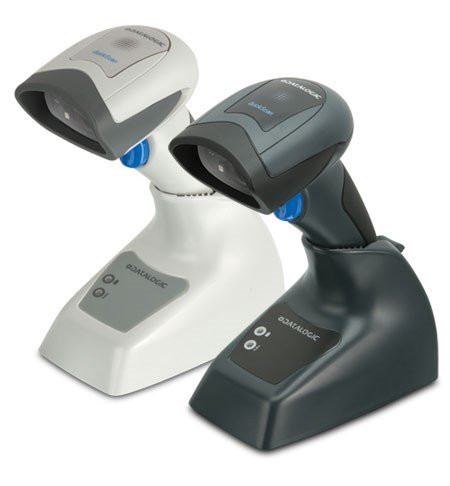
The Datalogic QBT2131 uses a 1D linear imager. Per the provided specs, it reads 1D linear barcodes using a single-pass linear scan pattern. This engine is purpose-built for standard retail and warehouse labels — Code 128, UPC/EAN, and similar linear symbologies — but cannot decode 2D symbologies such as QR codes, Data Matrix, or PDF417.
The Honeywell 1962HSR-5USB-WC-N is equipped with a 2D imager using a single-pass scan pattern. This engine reads both 1D and 2D symbologies in a single capture pass. In healthcare environments, this matters directly: GS1 DataMatrix codes appear on unit-dose medications, patient wristbands, and lab specimens — none of which a 1D imager can read. No barcode density or minimum-element-size figures are provided in the available specs for either unit.
How does each scanner handle wireless connectivity, battery operation, and physical handling?
The QBT2131 is a Bluetooth scanner with a rated wireless range of up to 25 m (82 ft) from its base station, supporting Bluetooth HID profile. It ships with a user-replaceable lithium-ion battery and includes a batch memory mode storing up to 500 codes, providing a fallback when out of radio range. Physical dimensions are 69 × 127 × 124 mm and weight is 159 g.
The Honeywell 1962HSR-5USB-WC-N is described in the provided specs as a cordless handheld unit with USB connectivity. However, no wireless protocol (Bluetooth version, radio frequency, or range figure) is specified in the available data. No battery chemistry, battery capacity, weight, or physical dimensions are provided for the Honeywell unit. Buyers requiring confirmed wireless range or battery runtime specifications for the 1962HSR-5USB-WC-N must consult the manufacturer datasheet directly.
Which interfaces and host environments does each scanner support, and how do they fit the target deployment?
The QBT2131 supports USB and RS-232 connectivity through its base station, plus Bluetooth HID for wireless host pairing. The RS-232 option extends compatibility to legacy point-of-sale and inventory systems that lack USB ports — a relevant consideration in older retail or warehouse infrastructure. The unit is cited as compatible with retail workflows.
The 1962HSR-5USB-WC-N presents a USB interface with HID/keyboard-wedge emulation, enabling plug-and-play operation on Windows workstations and mobile carts without driver installation. RS-232 support is not listed in the provided specs. The scanner is explicitly designated for healthcare point-of-care workflows, and the bundle options listed (1962HHD-5USB-WCBF) suggest a healthcare-accessory ecosystem. No IP rating, disinfectant-resistance rating, or cleanroom compliance data is present in the provided specs.
Which should you choose: the QBT2131 or the 1962HSR-5USB-WC-N?
Our take: The QBT2131 is the stronger choice when the deployment is retail or warehouse and label inventory consists entirely of 1D linear barcodes, while the 1962HSR-5USB-WC-N is the appropriate selection for healthcare point-of-care environments requiring 2D barcode capture. The most decisive spec delta is scan engine: the QBT2131 reads 1D only; the Honeywell reads both 1D and 2D in a single pass — a hard requirement for GS1 DataMatrix on medication packaging. The QBT2131 provides documented wireless range (25 m / 82 ft), confirmed weight (159 g), and a 500-code batch memory buffer; none of these figures are available in the provided Honeywell specs, limiting direct ergonomic comparison. Interface breadth favors the QBT2131, which adds RS-232 alongside USB for legacy-system compatibility. Choose the QBT2131 for 1D retail/warehouse workflows on mixed legacy-modern infrastructure; choose the 1962HSR-5USB-WC-N for healthcare settings where 2D symbology capture is non-negotiable.
Side-by-Side Comparison
Spec-for-spec, from manufacturer data.
| Specification | Datalogic QBT2131 | Honeywell 1962HSR-5USB-WC-N |
|---|---|---|
| Product Type | Wireless Handheld Barcode Scanner | Cordless Healthcare Scanner |
| Scan Engine | 1D Linear Imager | 2D Imager |
| Barcode Coverage | 1D linear only | 1D and 2D |
| Scan Pattern | Linear | Single-pass |
| Form Factor | Handheld | Cordless handheld |
| Wireless Protocol | Bluetooth (HID profile) | — |
| Wireless Range | Up to 25 m / 82 ft | — |
| Interface — USB | Yes (via base) | Yes |
| Interface — RS-232 | Yes (via base) | — |
| Interface — Bluetooth HID | Yes | — |
| Host Interface Mode | USB; RS-232; Bluetooth HID | HID / keyboard-wedge |
| Weight | 159 g | — |
| Dimensions | 69 × 127 × 124 mm | — |
| Battery | User-replaceable lithium-ion | — |
| Batch Memory | Up to 500 codes | — |
| Warranty | 3-Year Limited | Manufacturer Warranty (duration not specified) |
| Primary Use Case | Retail, warehouse | Healthcare point-of-care |
Frequently Asked Questions
Which should you choose: the QBT2131 or the 1962HSR-5USB-WC-N?
The QBT2131 is the stronger choice when the deployment is retail or warehouse and label inventory consists entirely of 1D linear barcodes, while the 1962HSR-5USB-WC-N is the appropriate selection for healthcare point-of-care environments requiring 2D barcode capture. The most decisive spec delta is scan engine: the QBT2131 reads 1D only; the Honeywell reads both 1D and 2D in a single pass — a hard requirement for GS1 DataMatrix on medication packaging. The QBT2131 provides documented wireless range (25 m / 82 ft), confirmed weight (159 g), and a 500-code batch memory buffer; none of these figures are available in the provided Honeywell specs, limiting direct ergonomic comparison. Interface breadth favors the QBT2131, which adds RS-232 alongside USB for legacy-system compatibility. Choose the QBT2131 for 1D retail/warehouse workflows on mixed legacy-modern infrastructure; choose the 1962HSR-5USB-WC-N for healthcare settings where 2D symbology capture is non-negotiable.
Can the QBT2131 read QR codes or Data Matrix barcodes found on medication packaging?
No. The QBT2131 is a 1D linear imager and cannot decode 2D symbologies such as QR codes, Data Matrix, or PDF417. If your use case includes medication labels, patient wristbands, or any GS1 DataMatrix codes, the 1D engine is a disqualifying limitation. The Honeywell 1962HSR-5USB-WC-N uses a 2D imager and reads both 1D and 2D barcodes in a single pass.
Does the Honeywell 1962HSR-5USB-WC-N work with legacy RS-232 systems, the way the Datalogic QBT2131 does?
Based on the provided specifications, the 1962HSR-5USB-WC-N lists only a USB interface with HID/keyboard-wedge emulation — RS-232 support is not documented in the available data. The QBT2131 explicitly supports RS-232 via its base station alongside USB and Bluetooth HID, making it the more compatible option for sites with legacy serial-port point-of-sale or inventory terminals.
What is the wireless range of the Honeywell 1962HSR-5USB-WC-N, and how does it compare to the QBT2131's 82-foot range?
The provided specifications for the 1962HSR-5USB-WC-N do not include a wireless range figure, radio protocol version, or frequency band. The Datalogic QBT2131 documents a Bluetooth range of up to 25 m (82 ft) from its base. A direct range comparison cannot be made from the available data; buyers should consult Honeywell's official datasheet for the 1962HSR-5USB-WC-N to obtain confirmed wireless performance figures before making a range-sensitive purchasing decision.
More Barcode Scanner Comparisons
- Datalogic QBT2131 vs CipherLab A2500SCBSU0T1
- Datalogic QBT2131 vs Socket Mobile CX4523-3764
- Datalogic QBT2131 vs Socket Mobile CX4619-3886
- Datalogic QBT2131 vs Datalogic QBT2500-BK-BTK
- Datalogic QBT2500-BK-BTK vs Honeywell 1962HSR-5USB-WC-N
- Datalogic QBT2500-BK-BTK vs CipherLab A2500SCBSU0T1
Barcode Scanner Buying Guides
Get a Second Opinion on Your Camera Choice
Share your site layout, coverage goals, and budget. Our team will validate the camera selection, flag anything we would change, and recommend products that match the use case.