
Honeywell 1960HHD-5-N vs Honeywell 3320G-5USBX-0: Specification Comparison
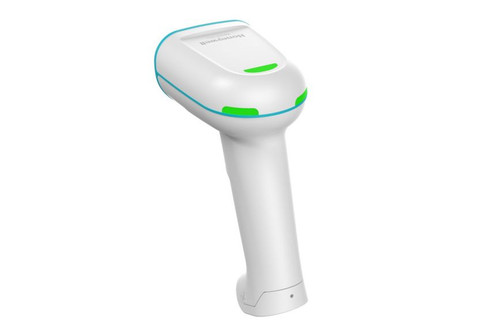
Both the Honeywell 1960HHD-5-N (Xenon XP 1952g series) and the Honeywell 3320G-5USBX-0 (Vuquest 3320g series) are 1D/2D area-imager barcode scanners from the same manufacturer, capable of reading identical symbology sets including Code 128, EAN/UPC, QR Code, Data Matrix, and PDF417. Where they diverge is in form factor and deployment model: the 1960HHD-5-N is a handheld wireless unit targeting mobile warehouse and general-purpose scanning, while the 3320G-5USBX-0 is a hands-free presentation scanner designed for fixed retail point-of-sale. Buyers choosing between them are selecting a workflow, not just a device.
In This Guide
- Which scanner fits the intended workflow — mobile handheld or fixed hands-free presentation?
- How do working range, environmental sealing, and drop resistance compare across likely deployment environments?
- Which unit tolerates a broader operating temperature range, and how does physical footprint compare?
- Which should you choose: the 1960HHD-5-N or the 3320G-5USBX-0?
- Side-by-Side Specs
- FAQ
Which scanner fits the intended workflow — mobile handheld or fixed hands-free presentation?
The 1960HHD-5-N is a handheld area imager with Bluetooth 4.2 wireless connectivity and a USB fallback, giving operators freedom of movement across a warehouse floor or stockroom. Its pistol-grip form factor requires an operator to pick up and aim the device at each item.
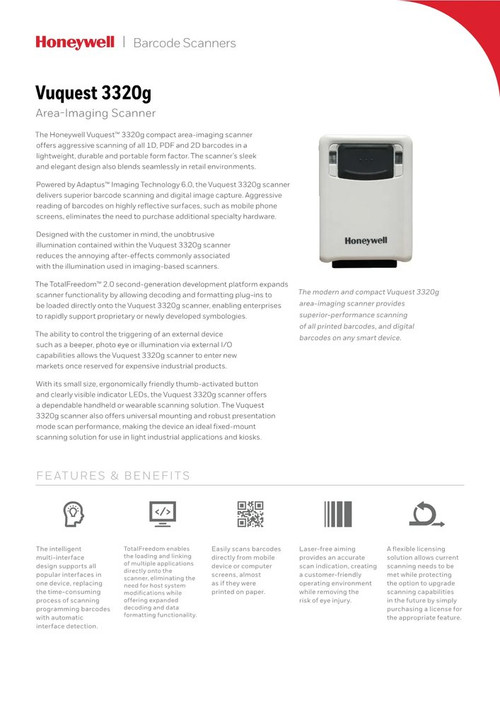
The 3320G-5USBX-0 is a corded USB presentation scanner in a fixed cradle-style form factor. It requires no operator hand-holding during scanning — items are passed in front of the sensor, making it purpose-built for retail POS checkout lanes where throughput and hands-free operation are the priority. Battery is not applicable; it is powered entirely from the USB host.
These are fundamentally different scan workflows. A buyer seeking cordless mobility should select the 1960HHD-5-N; a buyer installing a fixed checkout lane should select the 3320G-5USBX-0.
How do working range, environmental sealing, and drop resistance compare across likely deployment environments?
Working range differs significantly. The 1960HHD-5-N is specified at 2.5 to 50.8 cm (1 to 20 in), optimized for close-range handheld scanning of items held in hand or on a shelf. The 3320G-5USBX-0 covers a considerably longer 15 to 120 cm (6 to 48 in) range, which supports a wider presentation zone at a fixed checkout counter.
On environmental sealing, the 1960HHD-5-N carries an IP65 rating per the structured spec fields, indicating full dust-tight protection and resistance to water jets — suitable for wet or dusty warehouse environments. The 3320G-5USBX-0 is rated IP53 per its structured spec fields (the tilde-prefixed supplemental data references IP42, which conflicts; the structured field IP53 is used here as the primary source).
For drop resistance, the 1960HHD-5-N is rated to survive 2.0 m (6.5 ft) drops onto concrete. The 3320G-5USBX-0 is specified at 1.8 m (6 ft) drops to concrete. Both meet meaningful durability thresholds, but the 1960HHD-5-N has the higher rating — relevant given handheld units are more likely to be dropped.
Which unit tolerates a broader operating temperature range, and how does physical footprint compare?
The 3320G-5USBX-0 has a structured operating temperature of -20° to 50°C, giving it a notably wider cold-end tolerance that could matter in refrigerated retail environments or unheated storage areas. Note that a secondary spec field for this unit lists 0°C to 40°C — these values conflict, and the primary structured field (-20° to 50°C) is cited here; buyers should confirm against the product datasheet.
The 1960HHD-5-N is rated 0°C to 50°C, which covers standard ambient environments but does not extend into sub-zero territory.
On weight and physical size, the 1960HHD-5-N weighs 0.32 lbs (147.2 g / 5.2 oz) in its handheld form. The 3320G-5USBX-0 is lighter at 0.17 lbs (77 g / 2.7 oz) as a compact presentation unit. The 3320G-5USBX-0's imaging array is specified at 838 × 640 pixels; the 1960HHD-5-N's imager pixel count is not provided in the supplied specifications.
Which should you choose: the 1960HHD-5-N or the 3320G-5USBX-0?
Our take: The 1960HHD-5-N is the stronger choice when operators need untethered, mobile handheld scanning in demanding physical environments, while the 3320G-5USBX-0 is the correct selection for fixed retail POS installations requiring hands-free presentation scanning. Three concrete spec deltas illustrate the divide: the 1960HHD-5-N's Bluetooth 4.2 wireless versus the 3320G-5USBX-0's corded USB determines the fundamental workflow; the 1960HHD-5-N's IP65 sealing and 2.0 m drop rating exceed the 3320G-5USBX-0's IP53 and 1.8 m figures, favoring rugged mobile use; and the 3320G-5USBX-0's 15–120 cm working range nearly doubles the 1960HHD-5-N's 2.5–50.8 cm, optimizing the presentation unit for counter-top scanning. Warehouse, logistics, and general-purpose mobile deployments should choose the 1960HHD-5-N; retail checkout lane installations should choose the 3320G-5USBX-0.
Side-by-Side Comparison
Spec-for-spec, from manufacturer data.
| Specification | Honeywell 1960HHD-5-N | Honeywell 3320G-5USBX-0 |
|---|---|---|
| Product Series | Xenon XP 1952g | Vuquest 3320g |
| Part Number | 1960HHD-5-N | 3320G-5USBX-0 |
| Form Factor | Handheld | Presentation (fixed) |
| Scan Type | Area Imager (1D/2D) | Area Imager (1D/2D) |
| Connectivity | Bluetooth 4.2 + USB fallback | Corded USB |
| Working Range | 2.5–50.8 cm (1–20 in) | 15–120 cm (6–48 in) |
| IP Rating | IP65 | IP53 |
| Drop Rating | 2.0 m (6.5 ft) to concrete | 1.8 m (6 ft) to concrete |
| Operating Temperature | 0°C to 50°C | -20°C to 50°C (see note) |
| Weight | 0.32 lbs (147.2 g) | 0.17 lbs (77 g) |
| Power Source | Battery (wireless) | USB powered (no battery) |
| Imager Resolution | — | 838 × 640 pixels |
| Application | General purpose / warehouse | Retail point-of-sale |
| Symbologies (1D) | Code 128, UPC, EAN | Code 128, Code 39, EAN, UPC |
| Symbologies (2D) | QR Code, PDF417, Data Matrix | QR Code, Data Matrix, PDF417 |
| Warranty | 3-year | 3-year |
Frequently Asked Questions
Which should you choose: the 1960HHD-5-N or the 3320G-5USBX-0?
The 1960HHD-5-N is the stronger choice when operators need untethered, mobile handheld scanning in demanding physical environments, while the 3320G-5USBX-0 is the correct selection for fixed retail POS installations requiring hands-free presentation scanning. Three concrete spec deltas illustrate the divide: the 1960HHD-5-N's Bluetooth 4.2 wireless versus the 3320G-5USBX-0's corded USB determines the fundamental workflow; the 1960HHD-5-N's IP65 sealing and 2.0 m drop rating exceed the 3320G-5USBX-0's IP53 and 1.8 m figures, favoring rugged mobile use; and the 3320G-5USBX-0's 15–120 cm working range nearly doubles the 1960HHD-5-N's 2.5–50.8 cm, optimizing the presentation unit for counter-top scanning. Warehouse, logistics, and general-purpose mobile deployments should choose the 1960HHD-5-N; retail checkout lane installations should choose the 3320G-5USBX-0.
Can the 1960HHD-5-N or the 3320G-5USBX-0 scan QR codes and 2D barcodes?
Yes, both units are 1D/2D area imagers and both support QR Code, Data Matrix, PDF417, Code 128, EAN, and UPC per the supplied specifications. Neither model has an advantage on symbology coverage based on the provided specs.
Is the 1960HHD-5-N or the 3320G-5USBX-0 better for a cold-storage or refrigerated environment?
Based on the structured spec fields provided, the 3320G-5USBX-0 has a lower minimum operating temperature of -20°C versus the 1960HHD-5-N's 0°C floor, giving the 3320G-5USBX-0 the advantage in cold environments. However, a conflicting secondary field for the 3320G-5USBX-0 lists 0°C as its minimum; buyers should verify against Honeywell's official datasheet before specifying for refrigerated applications.
Which unit is more durable if it gets dropped — the 1960HHD-5-N or the 3320G-5USBX-0?
The 1960HHD-5-N is rated for 2.0 m (6.5 ft) drops to concrete, versus 1.8 m (6 ft) for the 3320G-5USBX-0. The 1960HHD-5-N also carries a higher IP65 seal versus IP53 on the 3320G-5USBX-0. As a handheld device carried by operators, the 1960HHD-5-N is both more exposed to drops and more specified to survive them.
More Barcode Scanner Comparisons
- Zebra DS8108 vs Datalogic GBT4600-HC-BTK1-HP
- Zebra DS8108 vs Datalogic GD4590-HCK10-HDR-B
- Zebra DS8108 vs Honeywell 1202G-2USB-5BF-N
- Zebra DS8108 vs Datalogic GBT4500-BK-BTK1DRA
- Zebra DS8108 vs Zebra DS3608
- Zebra DS8108 vs Zebra LI3608
Barcode Scanner Buying Guides
Get a Second Opinion on Your Camera Choice
Share your site layout, coverage goals, and budget. Our team will validate the camera selection, flag anything we would change, and recommend products that match the use case.