
Honeywell 1960GSR-2USB-2-N vs Honeywell 3320G-5USBX-0: Specification Comparison
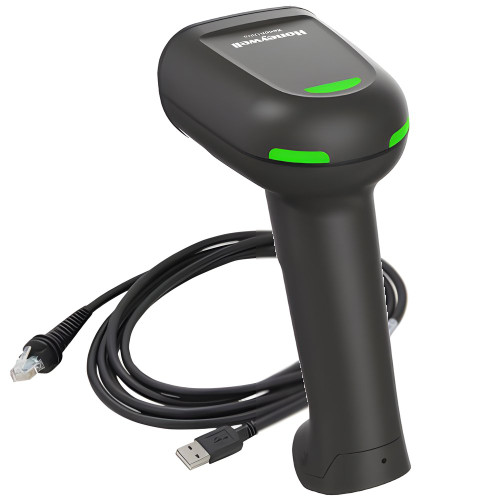
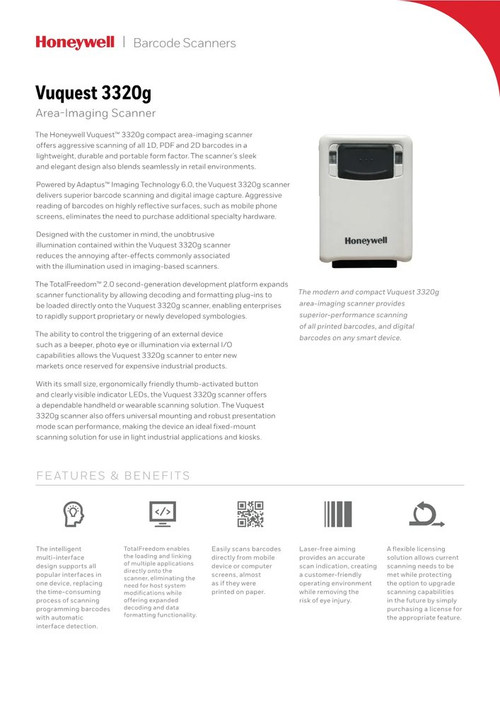
Both the Honeywell 1960GSR-2USB-2-N (Xenon XP series) and the Honeywell 3320G-5USBX-0 (Vuquest series) are 1D/2D area-imager barcode scanners sharing the same core decode capability and a three-year warranty. However, they diverge sharply in form factor, connectivity, environmental protection, and intended deployment environment — the 1960GSR-2USB-2-N is a handheld wireless unit aimed at warehouse and logistics use, while the 3320G-5USBX-0 is a corded presentation scanner designed for retail point-of-sale countertop stations. Buyers cross-shopping these models are typically evaluating mobility and ruggedness versus fixed-station simplicity and extended working range.
In This Guide
- Which scanner offers the right connectivity and mobility for your deployment?
- Which scanner is better protected against drops, dust, and moisture in your environment?
- Which scanner's working range and application fit matches your scanning task?
- Which should you choose: the 1960GSR-2USB-2-N or the 3320G-5USBX-0?
- Side-by-Side Specs
- FAQ
Which scanner offers the right connectivity and mobility for your deployment?
The 1960GSR-2USB-2-N connects via Bluetooth 4.2 and USB, enabling wireless operation up to several meters from the host — critical in warehouse picking, receiving docks, or any workflow where the operator moves freely. The Bluetooth 4.2 radio allows pairing with mobile terminals, tablets, or fixed base stations without tethering the user.
The 3320G-5USBX-0 is corded USB only, with no wireless capability specified. It draws power directly from the USB port (5 VDC ±0.25 V) and requires no battery management. For a checkout counter or fixed scanning station this is an advantage — no pairing, no charging, no radio interference concerns. However, it is unsuitable for any workflow requiring operator mobility. Buyers must choose the model whose connectivity model matches their workstation topology before evaluating other criteria.
Which scanner is better protected against drops, dust, and moisture in your environment?
The 1960GSR-2USB-2-N carries an IP65 rating, meaning it is fully dust-tight and protected against low-pressure water jets from any direction. Its specified drop rating is 2.0 m (6.5 ft) to concrete. At 147.2 g (5.2 oz), it is the heavier of the two — consistent with a reinforced housing designed for industrial handling. These figures make it suitable for warehouses, distribution centers, and light manufacturing where scanners are regularly dropped or exposed to dust and splash.
The 3320G-5USBX-0 presents conflicting IP data across its spec fields: the structured attributes list IP53, while the enriched card data cites IP42, and the drop specification of 1.8 m to concrete appears consistently. Because IP42 and IP53 are materially different ratings (IP42 protects against solid objects >1 mm and dripping water; IP53 adds dust protection and water spray), buyers should verify the actual rating against Honeywell's published datasheet before assuming either level of protection. Either way, both ratings fall below the 1960GSR-2USB-2-N's IP65. The 3320G-5USBX-0's lower weight (77 g / 2.7 oz) reflects its lighter-duty retail-counter design rather than hardened field construction.
Which scanner's working range and application fit matches your scanning task?
The 1960GSR-2USB-2-N specifies a working range of 2.5 to 50.8 cm (1 to 20 in). This close-to-mid-range window suits handheld scanning of items held near the scanner — cartons, labels on shelves, or items passed through a dock door. The LED aimer (525 nm) assists precise targeting in general-purpose environments. The application classification is 'general purpose,' supporting broad use-case flexibility across logistics, healthcare, and retail.
The 3320G-5USBX-0 specifies a significantly wider working range of 15 to 120 cm (6 to 48 in) and a scan pattern of 838 × 640 pixels, which underpins its presentation-scanner design — items placed or waved in front of the unit at varying distances are decoded without the operator aiming a handheld device. The application is classified as 'retail point-of-sale.' Its extended far-end range (120 cm vs. 50.8 cm) is an advantage at checkout where large or awkwardly shaped items may be held at arm's length. However, its minimum working distance of 15 cm means very close items may fall outside the decode window, whereas the 1960GSR-2USB-2-N reads from 2.5 cm. Operating temperature floor also differs: the 3320G-5USBX-0 datasheet body states 0°C to 40°C while the structured attribute field states −20°C to 50°C — buyers should confirm with the published datasheet, particularly for cold-storage or outdoor-vestibule deployments.
Which should you choose: the 1960GSR-2USB-2-N or the 3320G-5USBX-0?
Our take: The 1960GSR-2USB-2-N is the stronger choice when the deployment demands wireless mobility, superior ingress protection, and close-range scanning in industrial or logistics environments. It carries Bluetooth 4.2 versus the 3320G-5USBX-0's corded-USB-only design, an IP65 rating versus the Vuquest's contested IP42/IP53 rating, and a 2.0 m drop spec versus 1.8 m — meaningful margins in a warehouse or distribution center where scanners sustain frequent drops and exposure to dust and water splash. Conversely, the 3320G-5USBX-0 is the appropriate choice for a fixed retail checkout counter: its presentation form factor, 15–120 cm working range (extending 69 cm farther than the 1960GSR-2USB-2-N's 50.8 cm ceiling), and USB-powered corded simplicity suit stationary POS lanes where wireless management and industrial ruggedness add cost without benefit. Note that conflicting IP and operating-temperature values appear across the 3320G-5USBX-0 spec fields; verify against Honeywell's official datasheet before specifying for regulated or extreme-environment installations.
Side-by-Side Comparison
Spec-for-spec, from manufacturer data.
| Specification | Honeywell 1960GSR-2USB-2-N | Honeywell 3320G-5USBX-0 |
|---|---|---|
| Series / Family | Xenon XP 1952g | Vuquest 3320g |
| Form Factor | Handheld scanner | Presentation scanner |
| Scan Engine | Area Imager (1D/2D) | Area Imager (1D/2D) |
| Scan Pattern | — | 838 × 640 pixel array |
| Connectivity | Bluetooth 4.2 + USB | Corded USB only |
| Power Source | 4.4–5.5 V DC (battery/USB) | USB powered (5 VDC ±0.25 V) |
| Working Range | 2.5–50.8 cm (1–20 in) | 15–120 cm (6–48 in) |
| IP Rating | IP65 | IP53 (attr) / IP42 (card) — verify datasheet |
| Drop Rating | 2.0 m (6.5 ft) to concrete | 1.8 m (6 ft) to concrete |
| Weight | 147.2 g (5.2 oz) | 77 g (2.7 oz) |
| Operating Temperature | 0°C to 50°C | 0°C to 40°C (body) / −20°C to 50°C (attr) — verify datasheet |
| Application | General purpose | Retail point-of-sale |
| Symbologies — 1D | EAN, UPC, Code 128 (listed) | Code 128, Code 39, EAN, UPC |
| Symbologies — 2D | QR, Data Matrix, PDF417 | QR Code, Data Matrix, PDF417 |
| Warranty | 3-year | 3-year |
| Part Number | 1960GSR-2USB-2-N | 3320G-5USBX-0 |
Frequently Asked Questions
Which should you choose: the 1960GSR-2USB-2-N or the 3320G-5USBX-0?
The 1960GSR-2USB-2-N is the stronger choice when the deployment demands wireless mobility, superior ingress protection, and close-range scanning in industrial or logistics environments. It carries Bluetooth 4.2 versus the 3320G-5USBX-0's corded-USB-only design, an IP65 rating versus the Vuquest's contested IP42/IP53 rating, and a 2.0 m drop spec versus 1.8 m — meaningful margins in a warehouse or distribution center where scanners sustain frequent drops and exposure to dust and water splash. Conversely, the 3320G-5USBX-0 is the appropriate choice for a fixed retail checkout counter: its presentation form factor, 15–120 cm working range (extending 69 cm farther than the 1960GSR-2USB-2-N's 50.8 cm ceiling), and USB-powered corded simplicity suit stationary POS lanes where wireless management and industrial ruggedness add cost without benefit. Note that conflicting IP and operating-temperature values appear across the 3320G-5USBX-0 spec fields; verify against Honeywell's official datasheet before specifying for regulated or extreme-environment installations.
Is the 1960GSR-2USB-2-N or 3320G-5USBX-0 better for a warehouse picking operation?
The 1960GSR-2USB-2-N is better suited to warehouse picking. It offers Bluetooth 4.2 wireless connectivity, freeing operators to move through aisles without a cable tether, and its IP65 rating plus 2.0 m drop spec provide the ingress protection and impact resilience expected in distribution-center environments. The 3320G-5USBX-0 is corded USB only and is designed for retail POS countertop use, making it impractical for mobile warehouse workflows.
Can either scanner read 2D barcodes like QR codes and Data Matrix?
Yes — both models use 1D/2D area-imager scan engines and support QR Code, Data Matrix, and PDF417 alongside standard 1D symbologies such as Code 128, Code 39, EAN, and UPC. The 1960GSR-2USB-2-N lists these symbologies explicitly in its specs; the 3320G-5USBX-0 lists the same set across its symbology fields. Neither scanner should be preferred over the other solely on 2D decode capability — that decision should rest on connectivity, form factor, and environmental requirements.
Which scanner is easier to deploy at a retail checkout counter with an existing POS system?
The 3320G-5USBX-0 is designed specifically for retail point-of-sale and connects via corded USB, drawing power directly from the host port (5 VDC ±0.25 V) with no battery charging, pairing, or wireless configuration required. Its presentation scanner form factor allows cashiers to wave items past the unit hands-free. The 1960GSR-2USB-2-N can connect via USB but its primary value-add is Bluetooth wireless mobility, which adds setup complexity that offers no benefit at a fixed checkout lane.
More Barcode Scanner Comparisons
- Zebra DS8108 vs Datalogic GBT4600-HC-BTK1-HP
- Zebra DS8108 vs Datalogic GD4590-HCK10-HDR-B
- Zebra DS8108 vs Honeywell 1202G-2USB-5BF-N
- Zebra DS8108 vs Datalogic GBT4500-BK-BTK1DRA
- Zebra DS8108 vs Zebra DS3608
- Zebra DS8108 vs Zebra LI3608
Barcode Scanner Buying Guides
Get a Second Opinion on Your Camera Choice
Share your site layout, coverage goals, and budget. Our team will validate the camera selection, flag anything we would change, and recommend products that match the use case.