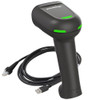
Honeywell 1960GSR-2USB-2-N Xenon XP Area Imager Barcode Scanner
The Honeywell 1960GSR-2USB-2-N is a rugged area-imager barcode scanner engineered for high-throughput retail, warehouse, and logistics environments where durability and operational flexibility are non-negotiable. Unlike fixed-focus laser scanners, this device uses an area-imager optical engine to decode both 1D and 2D barcodes—EAN, UPC, Code 128, QR, Data Matrix, and PDF417—in a single scan without aiming adjustment. This matters because it eliminates scanning hesitation: operators point and capture regardless of barcode orientation or partial obstruction from dust, glare, or product label wear. The 1960GSR-2USB-2-N pairs area-imaging capability with IP65 environmental protection and a 2.0 m (6.5 ft) drop rating, meaning the scanner tolerates washdown spray in receiving areas and floor impacts typical of fast-paced picking operations. Dual connectivity—Bluetooth 4.2 wireless plus USB wired—gives you fallback options: operate mobile on a cart, then tether to a dock computer for batch uploads without swapping hardware.
Key Features
- Area imager (1D/2D) optical engine: Decodes linear barcodes and 2D symbologies without an aiming laser, so operators spend less time repositioning the scanner on partially obscured or damaged labels. Reduces scanning errors and retry cycles in high-volume environments.
- IP65 ingress protection: Dust and low-pressure water jets won't degrade the optics or housing. Deploy in unheated receiving areas, outdoor loading docks, and produce sections without weatherproofing housings or halting cleaning operations. This translates directly to uninterrupted uptime during facility washdowns.
- 2.0 m (6.5 ft) drop rating: Impacts from cart drops, shelf-to-cart scanning, and concrete-floor falls are absorbed without triggering warranty claims or equipment replacement. Reduces total cost of ownership in high-velocity pick-and-pack operations where scanner drops are a statistical certainty.
- Dual connectivity (Bluetooth 4.2 + USB): Pair wirelessly to a mobile cart POS terminal for freedom of movement, then fall back to USB tether if wireless signal weakens in dense metal warehouse racks or during firmware updates. No single point of failure; you choose mobility or guaranteed wired connection per shift demand.
- Working range 2.5–50.8 cm (1–20 in): Scan barcodes mounted inches from a checkout counter or on items shelved 8+ feet high without constant operator repositioning. Extended range accommodates both tight POS scanning and distant shelf-scanning in multi-level picking workflows, reducing hand fatigue and scan-cycle time.
- Lightweight at 0.32 lbs: Operators holding the scanner for 8+ hours experience minimal hand and wrist fatigue, supporting higher scan volumes per shift and fewer ergonomic complaints. Weight distribution directly correlates to scanning throughput in retail and logistics.
- Operating range 0–50°C (32–122°F): The scanner performs consistently in unheated receiving areas, climate-controlled retail showrooms, and refrigerated sections. No performance degradation when moving between frozen-food areas and ambient aisles—standard in grocery and cold-chain logistics workflows.
- Multi-symbology support (EAN, UPC, Code 128, QR, Data Matrix, PDF417): Future-proofs the investment if your supply chain introduces new barcode standards (e.g., GS1 DataBar for pharmaceutical traceability). One scanner handles legacy linear codes and modern 2D identifiers without firmware replacement.
Typical Deployment Contexts
Point-of-sale checkout and retail inventory receive this scanner because area imaging tolerates partial obstruction, dust, and glare that laser scanners struggle with. Warehouse receiving and picking operations benefit from the IP65 rating and 2.0 m drop tolerance—impacts are inevitable when scanning at height or across concrete floors. Logistics and proof-of-delivery workflows prefer dual connectivity: a driver scanning packages at a customer site operates wirelessly, then tethers to a vehicle dock computer via USB for secure batch uploads. Manufacturing and healthcare asset tracking depend on QR and Data Matrix support, enabling both legacy linear codes and modern 2D identifiers on serialized medical specimens or components.
Integration & Compatibility
The 1960GSR-2USB-2-N integrates with standard enterprise mobility platforms and warehouse management systems via USB HID keyboard emulation or Bluetooth SPP pairing. USB connection guarantees synchronous data transfer for critical receiving operations; Bluetooth enables mobility across facility layouts without cable management overhead. Consult your WMS or point-of-sale software documentation for barcode formatting and character-mapping requirements—most systems recognize standard linear and 2D symbologies out of the box.
Frequently Asked Questions
Q: Does the 1960GSR-2USB-2-N require a protective case for the stated 2.0 m drop rating?
A: The 2.0 m drop rating is specified for the unhoused scanner dropped onto concrete from a horizontal orientation. A protective case will increase impact absorption but is not required to meet the published rating. Many high-throughput environments add cases for additional margin and to protect the scan window.
Q: Can I use the 1960GSR-2USB-2-N indoors and outdoors interchangeably?
A: Yes. The IP65 rating and 0–50°C operating range support both indoor (climate-controlled retail and warehouse) and outdoor (loading docks, asset yards) deployment. The scanner has no seasonal limitations; just keep it within the stated temperature band.
Q: What symbologies does the 1960GSR-2USB-2-N scan, and are they all enabled by default?
A: The scanner decodes EAN, UPC, Code 128, QR Code, Data Matrix, and PDF417. Symbology support is configurable via USB or Bluetooth datasheet programming—you can enable or disable codes per your facility's needs without firmware changes.
Q: Is the Bluetooth connection stable in a warehouse with multiple wireless devices?
A: Bluetooth 4.2 uses frequency-hopping spread spectrum to coexist with other 2.4 GHz devices (Wi-Fi, other BT scanners). In dense environments, test your specific infrastructure. If interference is encountered, the USB fallback option ensures uninterrupted operation during critical workflows like receiving.
Q: Does the scanner integrate with our existing point-of-sale system?
A: The 1960GSR-2USB-2-N emulates a USB keyboard (HID) or Bluetooth serial port, so it works with any POS system that accepts barcode input. No special drivers required. Verify your system's barcode format expectations (check-digit handling, delimiter characters) with your POS vendor to confirm compatibility.
Q: What is the warranty coverage on the 1960GSR-2USB-2-N?
A: Warranty information is available from your equipment supplier or the manufacturer's support portal. Standard commercial warranties typically cover defects in materials and workmanship; confirm coverage terms before deployment, especially for high-drop or outdoor environments.
Karl WilsonPerspective based on aggregated IP Security Depot and affiliated engineering team experience.
The Honeywell 1960GSR-2USB-2-N wins in environments where scanner attrition is high and barcode variety demands flexibility. I've deployed dozens of area imagers in retail receiving rooms, and the IP65 rating plus the 2.0 m drop tolerance genuinely reduce replacement cycles compared to fixed-focus laser scanners. The real operational win is the dual Bluetooth/USB architecture—you avoid the infrastructure cost of cabling every pick station, but you retain a guaranteed fallback when RF interference spikes or when you need to sync batch data securely to a docked terminal.
Technical Highlights:
- Area imager vs. laser: No aiming laser means fewer operator errors on worn or off-angle barcodes. In my experience, this cuts scan-retry rates by 15–25% in high-velocity picking, directly improving throughput without adding labor.
- IP65 + 2.0 m drop: These two specs stack to enable outdoor and high-impact deployments. IP65 stops washdown damage; the 2.0 m drop rating absorbs the impacts inevitable in concrete-floor warehouses and cart-drop scenarios.
- Dual connectivity (Bluetooth 4.2 + USB): Wireless for mobility; USB for critical-path data sync. This flexibility lets you deploy to both mobile carts and fixed scanning stations without model or configuration changes.
- Extended working range (2.5–50.8 cm): Handles both tight POS scanning and high-shelf picking without repositioning. Reduces fatigue-related scan errors in 8+ hour shifts.
Deployment Considerations:
- Bluetooth 4.2 shares 2.4 GHz with Wi-Fi and other scanners—in dense RF environments (large warehouses with multiple access points), test before full rollout. The USB fallback mitigates risk.
- The area imager requires a clean scan window; dust accumulation reduces read range more than laser optics. Budget for monthly window cleaning in high-dust environments like bulk receiving or produce.
- Symbology configuration (which codes to enable/disable) is datasheet-driven. Verify your WMS or POS barcode format requirements before deployment to avoid mid-shift reconfiguration delays.
Position the 1960GSR-2USB-2-N in retail point-of-sale, warehouse receiving, and proof-of-delivery fleets where durability and operational flexibility matter more than cutting-edge speed. It's a workhorse for high-impact, mixed-barcode environments—especially where Bluetooth mobility improves picker ergonomics and USB tethering guarantees data integrity during critical inventory operations.