
Hanwha XRN-3220RB2 vs Hanwha PRN-3200B4: Specification Comparison
The Hanwha XRN-3220RB2 and PRN-3200B4 are both 32-channel, 32MP-capable rackmount NVRs from Hanwha's Wisenet line, squarely targeting mid-to-large enterprise surveillance deployments requiring 8K-class recording. Both support H.265 compression, ONVIF integration, N+1 failover redundancy, and three 1Gbps Ethernet ports. The comparison centers on recording bandwidth, storage scalability, AI analytics depth, and display output capability — the practical differentiators a systems integrator or IT buyer would weigh when specifying either unit.
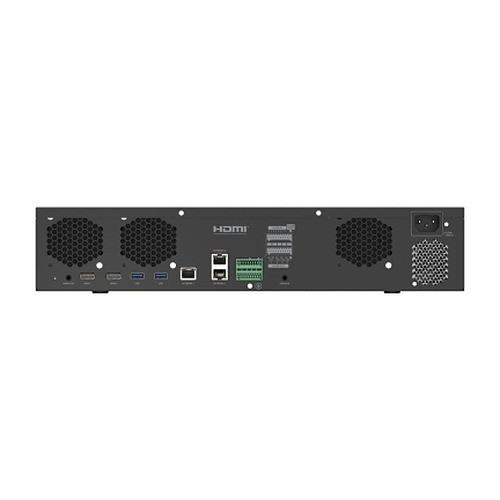
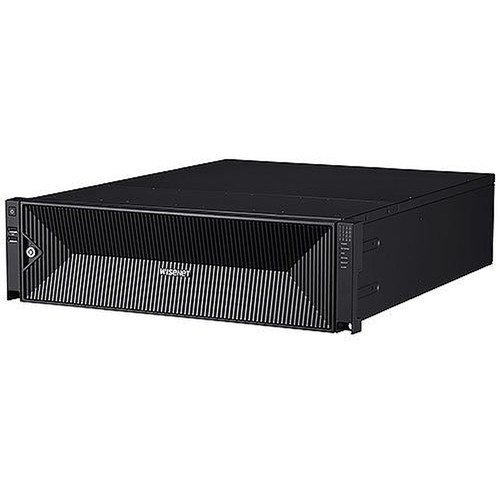
In This Guide
- Which NVR delivers more recording bandwidth and storage headroom?
- Which unit provides stronger AI analytics, display output, and playback capabilities?
- How do the two units compare on integration, cybersecurity, and physical/power specifications?
- Which should you choose: the XRN-3220RB2 or the PRN-3200B4?
- Side-by-Side Specs
- FAQ
Which NVR delivers more recording bandwidth and storage headroom?
The XRN-3220RB2 is specified at 520 Mbps recording bandwidth versus the PRN-3200B4's 400 Mbps — a 30% advantage in sustained throughput. For dense deployments with many high-bitrate 4K or 8K streams, this gap is meaningful: at 32 channels, the XRN-3220RB2 allows roughly 16.25 Mbps per channel versus approximately 12.5 Mbps on the PRN-3200B4.
On storage, the positions reverse. The PRN-3200B4 provides 16 SATA bays supporting up to 160TB (non-RAID) with hot-swap capability, and RAID 5/6 configured as two 8-HDD arrays. The XRN-3220RB2 offers 8 SATA bays with a maximum of 80TB, also with RAID 5/6 and N+1 failover. For long-retention or high-channel-count storage-constrained deployments, the PRN-3200B4's 160TB ceiling is a decisive advantage — it holds twice the raw capacity at the same drive density.
The PRN-3200B4 also supports iSCSI external storage expansion, providing a path beyond its internal 160TB ceiling. The XRN-3220RB2 spec sheet does not list iSCSI support. The XRN-3220RB2 ships pre-installed with 32TB; the PRN-3200B4 ships without pre-installed drives per the provided specs.
Which unit provides stronger AI analytics, display output, and playback capabilities?
The PRN-3200B4 specifies AI Search with object attribute detection for persons, faces (with Wisenet AI cameras), vehicles, and license plates (English and numeric LPR via Wisenet AI/P/X cameras). The XRN-3220RB2 lists analytics as 'Defocus, Audio, Dynamic Event, User Event' — no person, vehicle, face, or LPR detection is specified for that model.
On local display, the PRN-3200B4 outputs dual HDMI: 4K@30Hz plus 1080p@60Hz simultaneously, with up to 36-division multi-screen display. The XRN-3220RB2 spec data provided does not enumerate HDMI output count, resolution, or multi-screen division count.
Playback on the PRN-3200B4 supports up to 80 simultaneous channels (32 local, 16 per remote user) and fisheye dewarping on one local channel. The XRN-3220RB2 spec data provided does not specify simultaneous playback channel count or fisheye dewarping support. The PRN-3200B4 supports up to 300 PTZ presets and P2P QR-code configuration; these are not specified for the XRN-3220RB2 in the provided data.
How do the two units compare on integration, cybersecurity, and physical/power specifications?
Both NVRs support ONVIF, Wisenet (SUNAPI), Wisenet mobile, and Wisenet Viewer/Smart Viewer, providing equivalent ecosystem integration for Hanwha camera deployments and third-party ONVIF cameras. Both operate on Embedded Linux and support IPv4/IPv6 with HTTPS and SNMP.
On cybersecurity, the XRN-3220RB2 specifies TPM (Trusted Platform Module) integration and NDAA compliance — neither of these is listed in the PRN-3200B4's provided specifications. The PRN-3200B4 specifies 802.1x port authentication, encryption, device certificates via Hanwha Techwin Root CA, signed firmware, and IP address filtering. NDAA compliance and TPM are not listed for the PRN-3200B4 in the provided data.
Physically, the PRN-3200B4 is significantly larger and heavier: 440 × 132 × 571.1mm and approximately 13.6kg (without HDDs), drawing up to 285W with 16 drives installed. The XRN-3220RB2 is specified at 8.8kg (without HDDs); its dimensions and maximum power draw are not provided in the supplied spec data. Both units are rated for 0°C to +40°C operation. The PRN-3200B4 additionally specifies 20%–85% RH operating humidity and a wide 100–240VAC ±10% input voltage range; these are not listed for the XRN-3220RB2 in the provided data.
Which should you choose: the XRN-3220RB2 or the PRN-3200B4?
Our take: The XRN-3220RB2 is the stronger choice when bandwidth headroom, NDAA compliance, and hardware-rooted cybersecurity (TPM) are the primary requirements. It delivers 520 Mbps versus the PRN-3200B4's 400 Mbps — a 30% throughput advantage — and explicitly carries NDAA compliance and TPM integration, neither of which is specified for the PRN-3200B4. Conversely, the PRN-3200B4 is the better fit when AI-driven forensic search, storage depth, or dual-HDMI local display are decisive: it offers person, face, vehicle, and LPR detection (not specified on the XRN-3220RB2), 16 SATA bays expandable to 160TB with hot-swap and iSCSI (versus 8 bays/80TB on the XRN-3220RB2), and dual 4K+1080p HDMI output. Integrators building NDAA-sensitive or federal-adjacent projects should specify the XRN-3220RB2; those prioritizing long-retention, AI forensics, or large-scale video walls should evaluate the PRN-3200B4.
Side-by-Side Comparison
Spec-for-spec, from manufacturer data.
| Specification | Hanwha XRN-3220RB2 | Hanwha PRN-3200B4 |
|---|---|---|
| Device Type | Rackmount NVR | Rackmount NVR |
| Max Channels | 32CH | 32CH |
| Max Recording Resolution | 32MP | 32MP |
| Recording Bandwidth | 520 Mbps | 400 Mbps |
| Playback Bandwidth | — | Max. 64 Mbps (32CH simultaneous) |
| HDD Bays | 8 SATA bays | 16 SATA bays, hot-swap |
| Max Internal Storage | 80TB | 160TB (non-RAID mode) |
| Pre-installed Storage | 32TB | — |
| External Storage | — | iSCSI |
| RAID Support | RAID 5/6 | RAID 5/6 (8 HDD × 2 arrays) |
| N+1 Failover | Yes | Yes |
| Video Compression | H.265, H.264, MJPEG, WiseStream | H.265, H.264, MJPEG, WiseStream |
| Local Display Output | — | Dual HDMI: 4K@30Hz + 1080p@60Hz |
| AI Search | — | Person, face, vehicle, LPR |
| Cybersecurity Features | TPM, NDAA compliant | 802.1x, device cert, signed firmware |
| Ethernet Ports | RJ-45 3× (1Gbps) | RJ-45 3× (1Gbps) |
| Operating Temperature | 0°C to +40°C | 0°C to +40°C |
| Max Power Draw | — | 285W (with 16 HDDs) |
| Weight (without HDD) | 8.8kg (19.4 lb) | 13.6kg (30 lb) |
| ONVIF | Yes | Yes |
| Operating System | Embedded Linux | Embedded Linux |
| Audio | G.711, G.726, AAC (16/48kHz) | G.711, G.726, AAC (16/48kHz) |
| Warranty | 5-Year | — |
Frequently Asked Questions
Which should you choose: the XRN-3220RB2 or the PRN-3200B4?
The XRN-3220RB2 is the stronger choice when bandwidth headroom, NDAA compliance, and hardware-rooted cybersecurity (TPM) are the primary requirements. It delivers 520 Mbps versus the PRN-3200B4's 400 Mbps — a 30% throughput advantage — and explicitly carries NDAA compliance and TPM integration, neither of which is specified for the PRN-3200B4. Conversely, the PRN-3200B4 is the better fit when AI-driven forensic search, storage depth, or dual-HDMI local display are decisive: it offers person, face, vehicle, and LPR detection (not specified on the XRN-3220RB2), 16 SATA bays expandable to 160TB with hot-swap and iSCSI (versus 8 bays/80TB on the XRN-3220RB2), and dual 4K+1080p HDMI output. Integrators building NDAA-sensitive or federal-adjacent projects should specify the XRN-3220RB2; those prioritizing long-retention, AI forensics, or large-scale video walls should evaluate the PRN-3200B4.
Is the XRN-3220RB2 or PRN-3200B4 better for large-retention deployments requiring many terabytes of on-board storage?
The PRN-3200B4 supports 16 SATA bays with a maximum of 160TB internal storage (non-RAID mode) plus iSCSI external expansion. The XRN-3220RB2 provides 8 SATA bays with a maximum of 80TB. For deployments where retention duration is the primary driver, the PRN-3200B4 offers significantly more internal headroom and an additional external storage path not specified for the XRN-3220RB2.
Which NVR is the right choice for a government or federally-regulated project requiring NDAA-compliant hardware?
The XRN-3220RB2 explicitly lists NDAA compliance in its provided specifications. NDAA compliance is not listed in the PRN-3200B4's provided spec data. Integrators working on projects subject to NDAA Section 889 restrictions should verify compliance status directly with Hanwha for any unit under consideration, and based on the provided data, the XRN-3220RB2 is the only one of the two with that designation documented.
Does either NVR support AI-based search for people, vehicles, or license plates without an external VMS?
Yes — the PRN-3200B4 specifies on-device AI Search for persons, faces (with compatible Wisenet AI cameras), vehicles, and license plate recognition (English/numeric, requiring Wisenet AI, P, or X series cameras). The XRN-3220RB2's provided specifications list analytics as Defocus, Audio, Dynamic Event, and User Event only; person, vehicle, face, or LPR detection is not specified for that model in the provided data.
Get a Second Opinion on Your Camera Choice
Share your site layout, coverage goals, and budget. Our team will validate the camera selection, flag anything we would change, and recommend products that match the use case.