
Hanwha XNV-8083R vs Hanwha XNV-8083RZ: Specification Comparison
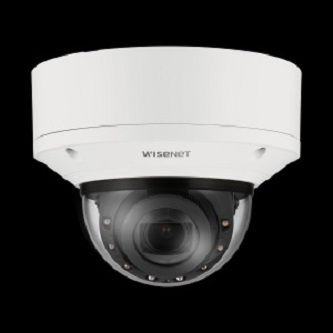
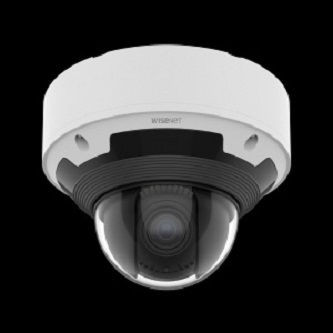
The Hanwha XNV-8083R and XNV-8083RZ are both 6MP outdoor vandal dome cameras sharing the same 1/1.8" progressive CMOS sensor, 3328×1872 resolution, and 4.4–9.3mm (2.1x) motorized varifocal lens. Both are fixed (non-PTZ), IP66/IK10-rated, PoE+-powered units aimed at outdoor perimeter and general surveillance. The comparison examines where the two models diverge across imaging, installation, and systems-integration criteria relevant to professional installers and IT procurement teams.
In This Guide
How do the imaging specs compare?
Both cameras share the same 1/1.8" progressive CMOS sensor, 3328×1872 resolution at 30fps, 4.4–9.3mm (2.1x) motorized varifocal P-iris lens, F1.3 (Wide) to F2.15 (Tele) aperture, and extremeWDR rated at 120dB. The XNV-8083R specifies minimum illumination of 0.04 Lux color / 0 Lux IR; the XNV-8083RZ is slightly more sensitive at 0.03 Lux color / 0 Lux IR. Horizontal field of view is effectively identical: 112.1° (XNV-8083R) vs 113° (XNV-8083RZ) at wide end.
The most significant imaging difference is IR range. The XNV-8083R specifies WiseIR at 50m (164ft). The XNV-8083RZ specifies 15m (49ft) ceiling-mount / 30m (98ft) wall-installation scenario — materially shorter under either scenario. DORI detection distances at wide are similarly close (44.8m vs 44.1m), but the 8083R's greater IR throw will illuminate longer-range targets in darkness. Both cameras carry WiseNR II and SSNR V noise reduction, digital image stabilization, defog, and gyro-sensor-based stabilization is explicitly stated for the XNV-8083R; the XNV-8083RZ lists "Support" for DIS without specifying gyro.
What about installation and environment?
Both models carry identical environmental ratings: IP66/IP67/IP6K9K, NEMA 4X, and IK10+. Operating temperature is –50°C to +55°C for both. The XNV-8083R specifies operating humidity up to 95% RH; the XNV-8083RZ lists 0–100% RH. Both are PoE+ (IEEE 802.3at, Class 4) with a 22.5W maximum draw. The XNV-8083R also lists 12VDC as an alternative input voltage; the XNV-8083RZ specs provided do not list a 12VDC option.
Physically, the XNV-8083R measures Ø180×125mm and weighs 1,900g (4.19 lb). The XNV-8083RZ is slightly taller at Ø180×135mm and heavier at 2,000g (4.41 lb). The XNV-8083RZ specs include explicit conduit knockout dimensions (19.1mm / 3/4" / M25) and a named hanging mount accessory (SBP-187HMW), and list detailed EMC/safety certifications (FCC, CE/UKCA, UL 62368-1, etc.); the XNV-8083R specs provided do not enumerate these. Pan/Tilt/Rotate range differs slightly: XNV-8083R is 0°–360° / –45°–85° / 0°–355°; XNV-8083RZ is 0°–350° / 0°–85° / 0°–340°.
Which fits your VMS and analytics better?
Both cameras support ONVIF Profile S/G/T, SUNAPI, and the Wisenet open platform. The XNV-8083RZ additionally lists ONVIF Profile M, which adds metadata streaming for AI object data — relevant if your VMS leverages Profile M for structured analytics ingestion. The XNV-8083RZ protocol stack also includes MQTT and CDP (Cisco Discovery Protocol) beyond what is listed for the XNV-8083R. Both support SNMPv1/v2c/v3, 802.1X (EAP-TLS/LEAP/PEAP), TPM 2.0 (FIPS 140-2 Level 2), HTTPS/SSL, IP filtering, and user access logs.
AI analytics on the XNV-8083R include object detection (Person/Face/Vehicle sub-types/License Plate), IVA (virtual line/area, Enter/Exit, Loitering, Direction, Appear/Disappear, Intrusion), Defocus detect, and Business Intelligence (People Counting, Queue Management, Heatmap). The XNV-8083RZ lists object detection and virtual line/area IVA analytics but the provided spec text is truncated; Queue Management and Heatmap are not confirmed in the supplied data for the XNV-8083RZ, while People Counting is explicitly listed as AI-based. Both cameras include audio in (mic/line selectable) and line out — the XNV-8083R specs explicitly state these; the XNV-8083RZ specs provided do not list dedicated audio I/O fields, though alarm-event audio clip playback may be implied by the truncated alarm events field. Both provide dual Micro SD slots (max 1TB / 512GB×2) and alarm trigger/event support. The XNV-8083R explicitly lists 2 configurable I/O ports with 12VDC output (max 50mA); the XNV-8083RZ specs note alarm I/O requires the optional NW I/O Box SPM-4210.
Which should you choose: the XNV-8083R or the XNV-8083RZ?
Our take: The XNV-8083R is the stronger choice when long-range night-vision coverage and on-board alarm I/O without accessory hardware are priorities. Its WiseIR reaches 50m vs the XNV-8083RZ's 15–30m, a meaningful gap on large parking lots or perimeters. It includes 2 native configurable I/O ports with 12VDC output; the XNV-8083RZ requires the external SPM-4210 I/O box for the same functionality. It also offers a fuller confirmed analytics set (Queue Management, Heatmap, IVA) per the provided specs. Conversely, the XNV-8083RZ edges out in minimum illumination (0.03 vs 0.04 Lux color), adds ONVIF Profile M for structured metadata streaming, supports MQTT and CDP, and carries explicit UL/FCC/CE/UKCA safety certifications in its spec sheet. Choose the XNV-8083RZ where VMS Profile M integration, MQTT-based event pipelines, or certified regulatory compliance documentation are procurement requirements.
Side-by-Side Comparison
Spec-for-spec, from manufacturer data.
| Specification | Hanwha XNV-8083R | Hanwha XNV-8083RZ |
|---|---|---|
| Resolution | 3328×1872 (6MP) | 3328×1872 (6MP) |
| Image Sensor | 1/1.8" Progressive CMOS | 1/1.8" Progressive CMOS |
| Lens / Focal Length | 4.4–9.3mm (2.1x) Motorized Varifocal, P-iris | 4.4–9.3mm (2.1x) Motorized Varifocal, P-iris |
| Max Aperture | F1.3 (Wide) / F2.15 (Tele) | F1.3 (Wide) / F2.15 (Tele) |
| Max Frame Rate | 30fps | 30fps @ 6MP |
| Min Illumination (Color / IR) | 0.04 Lux / 0 Lux | 0.03 Lux / 0 Lux |
| IR Range | 50m (164ft) WiseIR | 15m (49ft) ceiling / 30m (98ft) wall |
| Wide Dynamic Range | extremeWDR 120dB | extremeWDR 120dB |
| Video Compression | H.265 / H.264 (Main/High) / MJPEG | H.265 / H.264 (Main/Baseline/High) / MJPEG |
| IP / Impact Rating | IP66 / IP67 / IP6K9K / NEMA 4X / IK10+ | IP66 / IP67 / IP6K9K / NEMA 4X / IK10+ |
| Operating Temperature | -50°C to +55°C, 95% RH | -50°C to +55°C, 0–100% RH |
| Power Input / PoE Class | PoE+ (802.3at, Class 4) or 12VDC; Max 22.5W | PoE+ (802.3at Type 2, Class 4); Max 22.5W (typical 12.1W) |
| Onboard Alarm I/O | 2 configurable I/O ports, 12VDC out (50mA) | Requires optional SPM-4210 I/O Box |
| ONVIF Profiles | S / G / T | S / G / T / M |
| Edge Storage | 2× Micro SD/SDHC/SDXC, Max 1TB (512GB×2) | 2× Micro SD/SDHC/SDXC, Max 1TB (512GB×2) |
| Dimensions / Weight | Ø180×125mm / 1,900g (4.19 lb) | Ø180×135mm / 2,000g (4.41 lb) |
| Warranty | 3-year | 3-year |
Frequently Asked Questions
Which should you choose: the XNV-8083R or the XNV-8083RZ?
The XNV-8083R is the stronger choice when long-range night-vision coverage and on-board alarm I/O without accessory hardware are priorities. Its WiseIR reaches 50m vs the XNV-8083RZ's 15–30m, a meaningful gap on large parking lots or perimeters. It includes 2 native configurable I/O ports with 12VDC output; the XNV-8083RZ requires the external SPM-4210 I/O box for the same functionality. It also offers a fuller confirmed analytics set (Queue Management, Heatmap, IVA) per the provided specs. Conversely, the XNV-8083RZ edges out in minimum illumination (0.03 vs 0.04 Lux color), adds ONVIF Profile M for structured metadata streaming, supports MQTT and CDP, and carries explicit UL/FCC/CE/UKCA safety certifications in its spec sheet. Choose the XNV-8083RZ where VMS Profile M integration, MQTT-based event pipelines, or certified regulatory compliance documentation are procurement requirements.
Is the XNV-8083R or XNV-8083RZ better for low-light and night coverage?
The XNV-8083R has the clear advantage in darkness: its WiseIR illuminator reaches 50m (164ft), versus 15m ceiling-mount / 30m wall-mount on the XNV-8083RZ. Both reach 0 Lux with IR active. The XNV-8083RZ is marginally more sensitive in color mode (0.03 Lux vs 0.04 Lux), but for extended outdoor areas lit only by the camera's own IR, the XNV-8083R covers roughly 1.7× the distance.
Do I need extra hardware for alarm inputs and outputs with either camera?
The XNV-8083R includes 2 configurable I/O ports and a 12VDC output (max 50mA) built in — no additional hardware required. The XNV-8083RZ's provided specs state that alarm input and alarm output require the optional NW I/O Box SPM-4210, which is not included and represents an additional procurement and installation step.
Which camera is better supported in modern VMS platforms using ONVIF?
Both support ONVIF Profile S, G, and T. The XNV-8083RZ adds ONVIF Profile M, which enables structured metadata streaming (AI object classification data) to compatible VMS platforms. If your VMS leverages Profile M for analytics integration, the XNV-8083RZ is the better fit. For VMS platforms that rely on Profile S/G/T only, both cameras are equivalent at the ONVIF layer.
Get a Second Opinion on Your Camera Choice
Share your site layout, coverage goals, and budget. Our team will validate the camera selection, flag anything we would change, and recommend products that match the use case.