
Hanwha XND-8083RV vs i-PRO X25700-V2LN: Specification Comparison
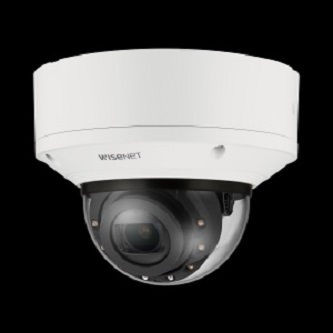
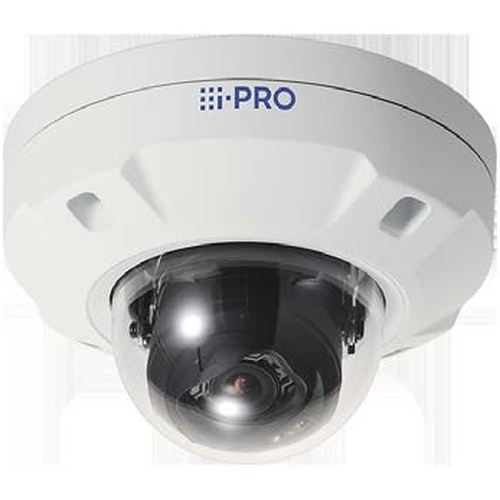
Both the Hanwha XND-8083RV and the i-PRO WV-X25700-V2LN are fixed 6MP motorized-varifocal dome cameras aimed at B2B installers seeking AI-assisted analytics in a vandal-resistant housing. Despite sharing the same sensor class and camera form factor, they diverge meaningfully in deployment environment—the Hanwha is rated for indoor use (IP52) while the i-PRO carries an outdoor IP66/IP67/NEMA 4X rating—as well as in WDR headroom, IR range, storage capacity, ONVIF profile depth, and warranty length.
In This Guide
How do the imaging specs compare?
Both cameras use an approximately 1/1.8-inch progressive CMOS sensor and deliver 30 fps, but their resolutions differ: the XND-8083RV outputs 3328×1872 (approximately 6.2 MP effective), while the WV-X25700-V2LN outputs 3840×2160 (approximately 8.3 MP effective), giving the i-PRO a pixel-count edge useful for wider scene coverage or digital zoom. Low-light performance is close—the Hanwha specifies 0.04 Lux color / 0 Lux with IR on; the i-PRO specifies 0.03 Lux (B/W, 50 IRE, F1.5, 1/30s)—but these figures use different measurement conditions, so direct comparison should be treated as approximate. The Hanwha's wider aperture at the wide end (F1.3 vs. F1.5) provides a slight optical light-gathering advantage.
WDR is a clear differentiator: the XND-8083RV claims extremeWDR at 120 dB, while the WV-X25700-V2LN claims Super Dynamic at a maximum of 132 dB (Level 31), giving the i-PRO a 12 dB advantage in high-contrast scenes. Lens ranges are similar—4.4–9.3 mm (2.1x zoom) for the Hanwha versus 4.3–8.6 mm (2.0x optical zoom, up to 12x extra digital zoom) for the i-PRO. The Hanwha's horizontal field of view spans 112.1° wide to approximately 48° tele; the i-PRO spans 52–101° horizontal. The Hanwha's IR illumination reaches 50 m (WiseIR), while the i-PRO extends to 70 m, a 40% range increase relevant to large open spaces.
What about installation and environment?
Environmental protection is a fundamental split between these two models. The XND-8083RV carries an IP52 rating (dust-protected, drip-resistant) and is specified for indoor use, making it unsuitable for direct outdoor exposure. The WV-X25700-V2LN is rated IP66/IP67 (IEC 60529), Type 4X (UL50E), and NEMA 4X compliant, enabling full outdoor deployment in rain, dust, and washdown environments. Both cameras achieve IK10 impact resistance, but the i-PRO additionally meets 50 J shock resistance per IEC 60068-2-75 and a wind resistance rating of up to 40 m/s (approx. 89 mph).
Operating temperature ranges differ significantly. The XND-8083RV is rated –25 °C to +50 °C; the WV-X25700-V2LN is rated –40 °C to +55 °C, with PoE power-on starting at –30 °C. Both accept PoE+ (802.3at, Class 4) and 12 VDC. The Hanwha also specifies a Gigabit Ethernet interface (10/100/1000BASE-T), while the i-PRO specifies only 10BASE-T/100BASE-TX. Mounting adjustability differs: the Hanwha supports 0°–360° pan / –45° to +85° tilt / 0°–355° rotation; the i-PRO supports –194° to +166° pan / –30° to +85° tilt / ±100° yaw.
Which fits your VMS and analytics better?
Both cameras support ONVIF, but the i-PRO covers Profiles G, S, T, and M, while the Hanwha covers Profiles S, G, and T—the i-PRO adds Profile M (metadata streaming), which is relevant for VMS platforms that ingest structured AI metadata. The Hanwha exposes SUNAPI (HTTP API) and the Wisenet open platform for deeper Hanwha-ecosystem integration. On the analytics side, the XND-8083RV includes AI-based object detection (person, face, vehicle sub-types, license plate), IVA event rules, business intelligence (people counting, queue management, heatmap), and defocus detection. The WV-X25700-V2LN provides AI motion, face, and vehicle detection plus AI Sound Classification (gunshot, yell, vehicle horn, glass break), Scene Change Detection, and Audio Detection—an audio-analytics capability the Hanwha spec does not list at the same classification level.
Edge storage capacity favors the Hanwha: it provides two microSD/SDHC/SDXC slots supporting up to 1 TB total (512 GB × 2), compared to the i-PRO's single microSD/SDHC/SDXC slot supporting up to 512 GB. The Hanwha supports up to 20 unicast users and 10 stream profiles; the i-PRO supports up to 14 simultaneous users. Both support G.711 and G.726 audio compression; the i-PRO additionally supports AAC-LC. The Hanwha includes TPM 2.0 (FIPS 140-2 Level 2) hardware security; the i-PRO spec lists Secure Boot and Signed Firmware but does not reference a TPM or FIPS certification in the provided specifications.
Which should you choose: the XND-8083RV or the X25700-V2LN?
Our take: The WV-X25700-V2LN is the stronger choice when the deployment is outdoor or in harsh environments, extreme temperatures, or long IR-range applications. Its IP66/IP67/NEMA 4X rating and –40 °C floor make it the only viable option of the two for exposed outdoor use, where the XND-8083RV's IP52 rating is insufficient. The i-PRO also edges the Hanwha in WDR headroom (132 dB vs. 120 dB) and IR range (70 m vs. 50 m), and its 3840×2160 output provides roughly 34% more pixels than the Hanwha's 3328×1872. Conversely, the XND-8083RV is the stronger indoor choice: it delivers a wider aperture (F1.3 vs. F1.5) for marginally better low-light optics, double the edge storage capacity (two-slot 1 TB vs. single-slot 512 GB), broader AI analytics including license plate detection and business intelligence, TPM 2.0/FIPS 140-2 L2 hardware security, and a Gigabit Ethernet interface. Warranty also differs: Hanwha specifies 3 years; i-PRO specifies 5 years.
Side-by-Side Comparison
Spec-for-spec, from manufacturer data.
| Specification | Hanwha XND-8083RV | i-PRO X25700-V2LN |
|---|---|---|
| Resolution | 3328×1872 | 3840×2160 |
| Image Sensor | 1/1.8" progressive CMOS | Approx. 1/1.8 type CMOS |
| Lens / Focal Length | 4.4–9.3 mm, 2.1x motorized varifocal | 4.3–8.6 mm, 2.0x motorized varifocal |
| Max Aperture (Wide) | F1.3 | F1.5 |
| Horizontal Field of View | Wide 112.1° / Tele not stated | Wide 101° / Tele 52° |
| Min. Illumination | 0.04 Lux color / 0 Lux (IR on) | 0.03 Lux (B/W, 50 IRE, F1.5, 1/30s) |
| IR Range | 50 m (WiseIR) | 70 m |
| WDR | extremeWDR 120 dB | Super Dynamic max 132 dB |
| Max Frame Rate | 30 fps | 30 fps |
| Video Compression | H.265, H.264, MJPEG | H.265, H.264, MJPEG |
| IP Rating | IP52 | IP66 / IP67 / NEMA 4X |
| Impact Rating | IK10 | IK10, 50 J (IEC 60068-2-75) |
| Operating Temperature | –25 °C to +50 °C | –40 °C to +55 °C |
| Power Input / PoE Class | PoE+ (802.3at) Class 4 / 12 VDC, max 22.5 W | PoE+ (802.3at) Class 4 / DC12V 1.2A, 14 W |
| Ethernet | 10/100/1000BASE-T (Gigabit) | 10BASE-T / 100BASE-TX |
| ONVIF Profiles | S, G, T | G, S, T, M |
| Edge Storage | Dual microSD/SDHC/SDXC, max 1 TB (512 GB × 2) | Single microSD/SDHC/SDXC, max 512 GB |
| Audio Compression | G.711, G.726 | G.726, G.711, AAC-LC |
| Alarm I/O | 2 configurable I/O ports | 4 alarm I/O terminals |
| AI Analytics | Object detection (person/face/vehicle/LPR), IVA, people counting, queue, heatmap | AI motion/face/vehicle detection, AI sound classification (gunshot/yell/horn/glass break) |
| Hardware Security | TPM 2.0 (FIPS 140-2 Level 2) | Secure Boot, Signed Firmware (no TPM/FIPS stated) |
| Environment Rating | Indoor | Outdoor |
| Dimensions | Ø160 × 125 mm | Ø154 × 105 mm (H) |
| Weight | 1,600 g (3.53 lb) | 1,100 g (2.43 lb) |
| Warranty | 3 years | 5 years |
Frequently Asked Questions
Which should you choose: the XND-8083RV or the X25700-V2LN?
The WV-X25700-V2LN is the stronger choice when the deployment is outdoor or in harsh environments, extreme temperatures, or long IR-range applications. Its IP66/IP67/NEMA 4X rating and –40 °C floor make it the only viable option of the two for exposed outdoor use, where the XND-8083RV's IP52 rating is insufficient. The i-PRO also edges the Hanwha in WDR headroom (132 dB vs. 120 dB) and IR range (70 m vs. 50 m), and its 3840×2160 output provides roughly 34% more pixels than the Hanwha's 3328×1872. Conversely, the XND-8083RV is the stronger indoor choice: it delivers a wider aperture (F1.3 vs. F1.5) for marginally better low-light optics, double the edge storage capacity (two-slot 1 TB vs. single-slot 512 GB), broader AI analytics including license plate detection and business intelligence, TPM 2.0/FIPS 140-2 L2 hardware security, and a Gigabit Ethernet interface. Warranty also differs: Hanwha specifies 3 years; i-PRO specifies 5 years.
Is the XND-8083RV or the WV-X25700-V2LN better for low-light performance?
Both use approximately the same 1/1.8-inch CMOS sensor. The i-PRO specifies 0.03 Lux (B/W, F1.5, 1/30s) and 70 m IR range; the Hanwha specifies 0.04 Lux color / 0 Lux with IR and 50 m IR range. The Hanwha's wider maximum aperture (F1.3 wide vs. F1.5 wide on the i-PRO) provides a slight optical advantage at the lens level, but the i-PRO's 70 m IR reach is 40% longer—relevant for large open spaces. Measurement conditions differ, so treat the illumination figures as approximate.
Can I install the XND-8083RV outdoors?
Based on the provided specifications, no. The XND-8083RV carries an IP52 rating and is listed as an indoor camera. IP52 protects against limited dust ingress and dripping water but does not qualify for rain, washdown, or submersion exposure. The WV-X25700-V2LN, rated IP66/IP67 and NEMA 4X, is the outdoor-rated option between these two.
Which camera offers more on-board edge storage?
The XND-8083RV supports two microSD/SDHC/SDXC card slots for a combined maximum of 1 TB (512 GB × 2). The WV-X25700-V2LN supports one microSD/SDHC/SDXC slot with a maximum of 512 GB. If maximizing on-camera redundant or high-capacity local recording is a priority, the Hanwha has the clear advantage.
Get a Second Opinion on Your Camera Choice
Share your site layout, coverage goals, and budget. Our team will validate the camera selection, flag anything we would change, and recommend products that match the use case.