
Hanwha C8083RV vs i-PRO X25700-V2LN: Specification Comparison
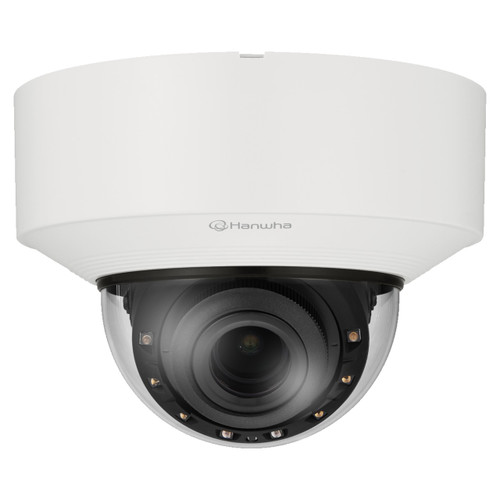
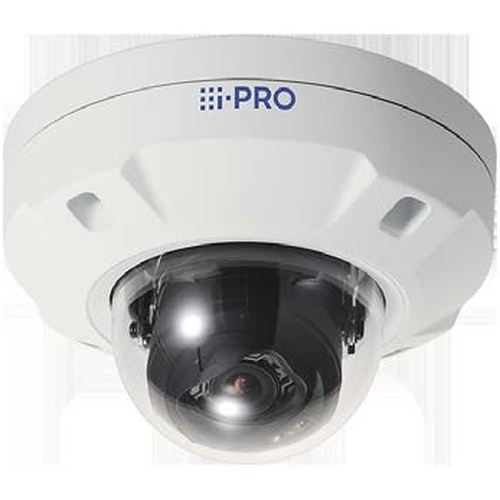
Both the Hanwha XND-C8083RV and the i-PRO WV-X25700-V2LN are fixed-lens, motorized-varifocal dome cameras rated at 6MP resolution — a genuine cross-shop pairing for installers specifying AI-capable domes in the same resolution tier. The Hanwha is rated for indoor use (IP52/IK08), while the i-PRO targets outdoor deployments (IP66/IP67/IK10). This comparison draws exclusively from the published specifications for each model to help integrators and IT buyers evaluate imaging performance, environmental suitability, and platform integration.
In This Guide
How do the imaging specs compare?
Both cameras share a 1/1.8-inch progressive CMOS sensor and deliver 6MP at 30fps with H.265/H.264/MJPEG compression. The Hanwha XND-C8083RV resolves 3328×1872 with a 4.4–9.3mm (2.1x) motorized varifocal lens at F1.3–F2.15; the i-PRO WV-X25700-V2LN resolves 3840×2160 (true 4K-class 16:9) with a 4.3–8.6mm (2.0x) motorized varifocal lens at F1.5–F2.4. The i-PRO's wider aperture at the tele end (F2.4 vs. F2.15 on the Hanwha) is marginally less light-efficient at distance, but its minimum illumination spec of 0.03 Lux (B&W, 50IRE, F1.5, 1/30s) edges the Hanwha's 0.04 Lux color / 0 Lux IR (with IR on).
Dynamic range differs substantially: the Hanwha claims extremeWDR at 120dB, while the i-PRO's Super Dynamic reaches a specified maximum of 132dB at level 31. The Hanwha's IR illuminator is rated to 40m (131ft); the i-PRO extends to 70m (230ft) — a 75% reach advantage. On the DORI detect range, at tele the i-PRO reaches 157.5m vs. the Hanwha's 151.3m, a modest difference; at wide the i-PRO detects to 63.3m versus the Hanwha's 44.8m, a more significant gap. Both include a built-in gyro-based digital image stabilizer. The Hanwha adds WiseNR II (AI-based noise reduction) and SSNR V; the i-PRO specifies a configurable DNR level (0–255) but does not name an AI noise-reduction engine in the provided specs.
What about installation and environment?
Environmental ratings diverge sharply. The Hanwha XND-C8083RV is rated IP52 (dust-protected, splash-resistant) and IK08 (5J impact resistance), explicitly listed for indoor use. The i-PRO WV-X25700-V2LN is rated IP66/IP67 (dust-tight and jet/immersion water resistant), IK10 (50J impact resistance per IEC 60068-2-75 and IEC 62262), NEMA 4X, and wind-resistant to 40 m/s (~89 mph) — a full outdoor-rated enclosure. Installers specifying outdoor or exposed locations must select the i-PRO; the Hanwha is not rated for those conditions.
Power requirements also differ: the Hanwha draws up to 12.95W on PoE IEEE 802.3af (Class 3) or 12VDC. The i-PRO requires PoE+ (802.3at, Class 4) at up to 14W or DC12V 1.2A. Existing PoE (af) switches cannot power the i-PRO without an upgrade or injector. Operating temperature range is another critical delta: the Hanwha is rated −10°C to +50°C; the i-PRO operates from −40°C to +55°C (power-on from −30°C), making it viable in extreme cold climates where the Hanwha would not be specified. Both ship as dome form-factor units; the Hanwha measures Ø160×118mm at 1,350g and the i-PRO Ø154×105mm at 1.1kg (2.43 lbs).
Which fits your VMS and analytics better?
Both cameras support ONVIF Profile S/G/T; the i-PRO additionally carries ONVIF Profile M, which adds metadata streaming for AI analytics interoperability. The Hanwha supports SUNAPI (HTTP API) and the Wisenet open platform, providing deeper integration with Wisenet VMS and compatible third-party platforms. The i-PRO's provided specs do not list a proprietary SDK equivalent. Simultaneous user sessions are 20 unicast on the Hanwha versus 14 on the i-PRO. Both support up to 10 (Hanwha) or an unspecified number of H.265/H.264 stream profiles; the Hanwha explicitly lists up to 10 profiles and 3 virtual channels.
On-camera analytics diverge meaningfully. The Hanwha's AI engine covers object detection (person, face, vehicle sub-types including car/bus/truck/motorcycle/bicycle, and license plate), IVA events (virtual line, area, enter/exit, loitering, direction, appear/disappear, intrusion), defocus detection, and business intelligence functions (people counting, queue management, heatmap) — all listed in spec. The i-PRO provides AI motion, face, and vehicle detection plus AI sound classification (gunshot, yell, vehicle horn, glass break), and scene change detection; people counting, queue management, and heatmap are not listed in the provided specs. The i-PRO supports 8 privacy zones vs. the Hanwha's 32. Edge storage is microSD/SDHC/SDXC up to 512GB on both. Audio I/O: the Hanwha has a selectable mic/line input and line output (1Vrms); the i-PRO provides a 3.5mm stereo mini jack input and 3.5mm stereo jack output plus 4 alarm I/O terminals vs. the Hanwha's 2 configurable I/O ports.
Which should you choose: the C8083RV or the X25700-V2LN?
Our take: The XND-C8083RV is the stronger choice when the deployment is indoor, PoE (af) infrastructure is already in place, and on-camera business intelligence analytics — people counting, queue management, heatmap, license plate detection, and 32 privacy zones — are required at the edge. Against the i-PRO, three spec deltas are decisive in each camera's favor: the i-PRO's IP66/IP67 and IK10 rating versus the Hanwha's IP52/IK08 makes outdoor installation a non-starter for the Hanwha; the i-PRO's 70m IR range versus the Hanwha's 40m provides a 75% greater illumination reach for large perimeters; and the i-PRO's broader operating range of −40°C to +55°C versus the Hanwha's −10°C to +50°C is required in cold climates. Conversely, the i-PRO requires PoE+ (Class 4, 14W) versus the Hanwha's PoE af (Class 3, 12.95W). Specify the Hanwha for indoor AI-analytics-heavy deployments on af infrastructure; specify the i-PRO for outdoor, extreme-environment, or long-range IR scenarios where PoE+ is available.
Side-by-Side Comparison
Spec-for-spec, from manufacturer data.
| Specification | Hanwha C8083RV | i-PRO X25700-V2LN |
|---|---|---|
| Resolution | 3328×1872 (6MP) | 3840×2160 (6MP / 4K-class) |
| Image Sensor | 1/1.8" progressive CMOS | Approx. 1/1.8" type CMOS |
| Lens / Focal Length | 4.4–9.3mm motorized varifocal (2.1x) | 4.3–8.6mm motorized varifocal (2.0x) |
| Max Aperture | F1.3 (Wide) / F2.15 (Tele) | F1.5 (Wide) / F2.4 (Tele) |
| Min. Illumination | 0.04 Lux color / 0 Lux (IR on) | 0.03 Lux (B&W, 50IRE, F1.5, 1/30s) |
| IR Range | 40m (131ft) WiseIR | 70m (230ft) |
| WDR / Dynamic Range | 120dB extremeWDR | 132dB Super Dynamic (max, level 31) |
| Max Frame Rate | 30fps | 30fps |
| Video Compression | H.265, H.264 (Main/High), MJPEG | H.265, H.264, MJPEG |
| IP Rating | IP52 | IP66 / IP67 / NEMA 4X |
| IK / Impact Rating | IK08 | IK10 (50J, IEC 60068-2-75) |
| Operating Temperature | -10°C to +50°C | -40°C to +55°C (PoO: -30°C) |
| Power Input / PoE Class | PoE 802.3af Class 3 / 12VDC; 12.95W max | PoE+ 802.3at Class 4 / DC12V 1.2A; 14W max |
| Alarm I/O | 2 configurable I/O ports | 4 alarm I/O terminals |
| Edge Storage | microSD/SDHC/SDXC up to 512GB | microSD/SDHC/SDXC up to 512GB |
| ONVIF Profiles | S, G, T | G, S, T, M |
| Dimensions | Ø160×118mm (Ø6.30×4.65") | Ø154×105mm (Ø6-1/16×4-1/8") |
| Weight | 1,350g (2.98 lb) | 1.1kg (2.43 lb) |
| Environment Rating | Indoor (IP52) | Outdoor (IP66/IP67/NEMA 4X) |
| Warranty | 3-year | 5-year |
Frequently Asked Questions
Which should you choose: the C8083RV or the X25700-V2LN?
The XND-C8083RV is the stronger choice when the deployment is indoor, PoE (af) infrastructure is already in place, and on-camera business intelligence analytics — people counting, queue management, heatmap, license plate detection, and 32 privacy zones — are required at the edge. Against the i-PRO, three spec deltas are decisive in each camera's favor: the i-PRO's IP66/IP67 and IK10 rating versus the Hanwha's IP52/IK08 makes outdoor installation a non-starter for the Hanwha; the i-PRO's 70m IR range versus the Hanwha's 40m provides a 75% greater illumination reach for large perimeters; and the i-PRO's broader operating range of −40°C to +55°C versus the Hanwha's −10°C to +50°C is required in cold climates. Conversely, the i-PRO requires PoE+ (Class 4, 14W) versus the Hanwha's PoE af (Class 3, 12.95W). Specify the Hanwha for indoor AI-analytics-heavy deployments on af infrastructure; specify the i-PRO for outdoor, extreme-environment, or long-range IR scenarios where PoE+ is available.
Is the XND-C8083RV or WV-X25700-V2LN better for low-light performance?
The i-PRO WV-X25700-V2LN specifies a minimum illumination of 0.03 Lux (B&W, 50IRE, F1.5, 1/30s) versus the Hanwha XND-C8083RV's 0.04 Lux color / 0 Lux with IR. The Hanwha achieves 0 Lux only when its built-in IR illuminator is active at up to 40m; the i-PRO's IR extends to 70m (230ft). For large, dark outdoor areas the i-PRO's longer IR reach is the controlling factor; for indoor scenes within 40m both cameras achieve near-zero-lux performance with IR on.
Can I use my existing PoE switches to power both cameras?
Not necessarily. The Hanwha XND-C8083RV draws up to 12.95W and is powered by standard PoE (IEEE 802.3af, Class 3), which standard PoE switches support. The i-PRO WV-X25700-V2LN requires PoE+ (802.3at, Class 4) at up to 14W. Existing 802.3af-only switches cannot power the i-PRO; you would need 802.3at-capable switch ports or a mid-span PoE+ injector at each camera location.
Which camera supports more on-camera analytics out of the box?
Based on the provided specifications, the Hanwha XND-C8083RV lists a broader set of on-camera AI analytics: object detection (person, face, vehicle sub-types — car, bus, truck, motorcycle, bicycle — and license plate), IVA events (virtual line, area, enter/exit, loitering, direction, appear/disappear, intrusion), defocus detection, and business intelligence functions including people counting, queue management, and heatmap. The i-PRO WV-X25700-V2LN specifies AI motion, face, and vehicle detection, plus AI sound classification (gunshot, yell, vehicle horn, glass break) and scene change detection; people counting, queue management, and heatmap are not listed in the provided i-PRO specs.
Get a Second Opinion on Your Camera Choice
Share your site layout, coverage goals, and budget. Our team will validate the camera selection, flag anything we would change, and recommend products that match the use case.