
Hanwha XNV-8083R vs i-PRO X25700-V2LN: Specification Comparison
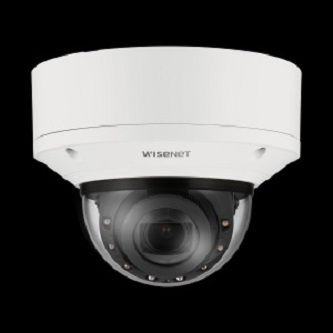
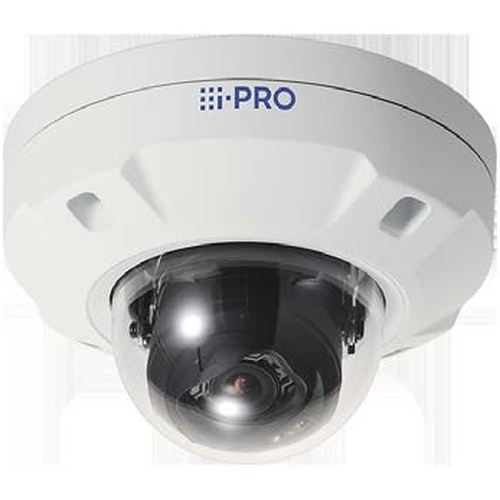
Both the Hanwha XNV-8083R and i-PRO WV-X25700-V2LN are 6MP outdoor vandal-rated dome cameras targeting perimeter and general surveillance applications. They share a motorized varifocal lens, IR illumination, PoE+ power, IK10 impact resistance, and ONVIF interoperability—making them direct competitors at the same resolution tier. This comparison examines how their imaging, environmental, and integration specs differ to help installers and IT buyers choose the right unit for their deployment.
In This Guide
How do the imaging specs compare?
Both cameras use an approximately 1/1.8" CMOS sensor at 6MP and 30fps, but their native resolutions differ: the XNV-8083R outputs 3328×1872, while the WV-X25700-V2LN outputs 3840×2160 (4K UHD). The i-PRO unit's wider resolution provides a larger pixel canvas for digital zoom workflows. Low-light minimum illumination is 0.04 Lux color for the Hanwha versus 0.03 Lux (BW, F1.5, 1/30s) for the i-PRO, a marginal difference favoring i-PRO. WDR is specified at 120dB (extremeWDR) for the Hanwha versus 132dB (Super Dynamic On, Level 31) for the i-PRO—a meaningful 12dB advantage for the i-PRO in high-contrast scenes.
On the lens side, the XNV-8083R covers 4.4–9.3mm at F1.3–F2.15 (2.1x motorized varifocal) with a P-iris, while the WV-X25700-V2LN covers 4.3–8.6mm at F1.5–F2.4 (2.0x motorized varifocal). The Hanwha's wider maximum aperture (F1.3 vs F1.5) provides a slight optical light-gathering advantage at the wide end. IR illumination range differs substantially: Hanwha specifies 50m (WiseIR) versus i-PRO's 70m—a 40% increase in rated IR throw favoring the i-PRO for longer-distance nocturnal coverage. DORI detection at tele is 151.3m (Hanwha) versus 157.5m (i-PRO), with both providing comparable identification distances at tele (15.1m vs 15.7m).
What about installation and environment?
Both cameras are IP66/IK10-rated outdoor domes on PoE+ (IEEE 802.3at, Class 4). The Hanwha also carries IP67 and IP6K9K (high-pressure wash) certifications and is NEMA 4X rated. The i-PRO WV-X25700-V2LN matches with IP66/IP67 and NEMA 4X compliance and additionally specifies wind resistance up to 40m/s (≈89 mph) and a 50J shock resistance per IEC 60068-2-75—the Hanwha specifies IK10+ but does not list a joule rating in the provided specs. Operating temperature range is identical: −40°C to +55°C for both units (note the Hanwha spec sheet lists −50°C to +55°C for product operating temp and the i-PRO lists −40°C to +55°C with a PoE start-up floor of −30°C).
The Hanwha XNV-8083R draws up to 22.5W (with a separate spec line citing 9W, which may reflect typical/idle draw—buyers should confirm with Hanwha). The i-PRO is specified at PoE+ with 14W maximum. The Hanwha is physically larger and heavier at Ø180×125mm / 1,900g versus the i-PRO's Ø154×105mm / 1,100g—a 73% weight difference that affects junction-box selection and pole/wall load calculations. The i-PRO spec lists pan adjustment range of −194° to +166°, tilt −30° to +85°, yaw ±100°; the Hanwha lists pan 0°–360°, tilt −45°–85°, rotate 0°–355°.
Which fits your VMS and analytics better?
Both cameras support ONVIF Profile S/G/T; the i-PRO WV-X25700-V2LN additionally carries ONVIF Profile M, which enables metadata streaming for analytics interoperability with Profile M-compliant VMS platforms—a differentiator for modern AI-VMS pipelines. The Hanwha supports Wisenet SUNAPI (HTTP API) and the Wisenet open platform, providing deep integration with Wisenet VMS and third-party systems via open API. Streaming concurrency differs: the Hanwha supports up to 20 unicast users across up to 10 stream profiles (3 virtual channels), while the i-PRO supports up to 14 simultaneous users.
On-camera analytics differ in scope. The Hanwha includes AI-based object detection (person, face, vehicle subtypes: car/bus/truck/motorcycle/bicycle, license plate), IVA events (virtual line, area, enter/exit, loitering, direction, appear/disappear, intrusion), and business intelligence functions (people counting, queue management, heatmap). The i-PRO provides AI motion, face, and vehicle detection plus AI sound classification (gunshot, yell, vehicle horn, glass break) and scene change detection—but does not list license plate detection or business intelligence functions in the provided specs. Edge storage is 2× microSD slots up to 1TB total on the Hanwha versus 1× microSD up to 512GB on the i-PRO. Security features: the Hanwha includes TPM 2.0 (FIPS 140-2 Level 2); the i-PRO lists signed firmware and secure boot in the provided spec attributes. Both support 802.1X, HTTPS, and digest authentication.
Which should you choose: the XNV-8083R or the X25700-V2LN?
Our take: The XNV-8083R is the stronger choice when deep on-camera analytics, dual-slot edge redundancy, and Wisenet ecosystem integration are priorities. Its AI engine covers license plate detection, vehicle sub-classification, and business intelligence (people counting, queue management, heatmap) that are absent from the i-PRO's listed specs, and its dual microSD slots support up to 1TB versus the i-PRO's 512GB single slot. The WV-X25700-V2LN is the stronger choice when raw WDR headroom (132dB vs 120dB), longer IR throw (70m vs 50m), higher native resolution (3840×2160 vs 3328×1872), ONVIF Profile M metadata streaming, or a significantly lighter and more compact form factor (1.1kg vs 1.9kg) are the deciding factors. Platform matters: buyers on Wisenet VMS gain SUNAPI depth with the Hanwha; buyers on Profile M-capable VMS platforms gain richer metadata interoperability with the i-PRO.
Side-by-Side Comparison
Spec-for-spec, from manufacturer data.
| Specification | Hanwha XNV-8083R | i-PRO X25700-V2LN |
|---|---|---|
| Resolution | 3328×1872 | 3840×2160 |
| Image Sensor | 1/1.8" progressive CMOS | Approx. 1/1.8" CMOS |
| Lens / Focal Length | 4.4–9.3mm motorized varifocal (2.1x) | 4.3–8.6mm motorized varifocal (2.0x) |
| Max Aperture | F1.3 (Wide) / F2.15 (Tele) | F1.5 (Wide) / F2.4 (Tele) |
| Min Illumination | 0.04 Lux color / 0 Lux IR | 0.03 Lux (BW, F1.5, 1/30s) |
| IR Range | 50m (WiseIR) | 70m |
| Wide Dynamic Range | 120dB (extremeWDR) | 132dB (Super Dynamic, Level 31) |
| Max Frame Rate | 30fps | 30fps |
| Video Compression | H.265, H.264, MJPEG | H.265, H.264, MJPEG |
| IP Rating | IP66 / IP67 / IP6K9K / NEMA 4X | IP66 / IP67 / NEMA 4X |
| Impact Rating | IK10+ | IK10 / 50J (IEC 60068-2-75) |
| Operating Temperature | -50°C to +55°C | -40°C to +55°C (PoE start: -30°C) |
| Power Input / PoE Class | PoE+ (802.3at) Class 4 / 12VDC; max 22.5W | PoE+ (802.3at) Class 4 / DC12V; max 14W |
| Edge Storage | 2x microSD/SDHC/SDXC up to 1TB (512GB×2) | 1x microSD/SDHC/SDXC up to 512GB |
| ONVIF Profiles | S / G / T | S / G / T / M |
| Audio I/O | Selectable mic/line in; line out 1Vrms | 3.5mm stereo jack in; 3.5mm stereo jack out |
| On-Camera Analytics | Person, face, vehicle subtypes, LPD, IVA, people counting, queue, heatmap | AI motion, face, vehicle detection; AI sound classification (gunshot, yell, horn, glass break) |
| Dimensions | Ø180×125mm | Ø154×105mm |
| Weight | 1,900g (4.19 lb) | 1,100g (2.43 lb) |
| Warranty | 3 years | 5 years |
Frequently Asked Questions
Which should you choose: the XNV-8083R or the X25700-V2LN?
The XNV-8083R is the stronger choice when deep on-camera analytics, dual-slot edge redundancy, and Wisenet ecosystem integration are priorities. Its AI engine covers license plate detection, vehicle sub-classification, and business intelligence (people counting, queue management, heatmap) that are absent from the i-PRO's listed specs, and its dual microSD slots support up to 1TB versus the i-PRO's 512GB single slot. The WV-X25700-V2LN is the stronger choice when raw WDR headroom (132dB vs 120dB), longer IR throw (70m vs 50m), higher native resolution (3840×2160 vs 3328×1872), ONVIF Profile M metadata streaming, or a significantly lighter and more compact form factor (1.1kg vs 1.9kg) are the deciding factors. Platform matters: buyers on Wisenet VMS gain SUNAPI depth with the Hanwha; buyers on Profile M-capable VMS platforms gain richer metadata interoperability with the i-PRO.
Is the XNV-8083R or WV-X25700-V2LN better for low-light and IR coverage?
The WV-X25700-V2LN has a slight edge in rated IR throw—70m versus the XNV-8083R's 50m—and a marginally lower minimum illumination (0.03 Lux vs 0.04 Lux color). However, the XNV-8083R's maximum aperture is F1.3 (wide) versus the i-PRO's F1.5, giving Hanwha a slight optical light-gathering advantage at the wide end. For scenes requiring longer IR reach, the i-PRO has the spec advantage; for optical sensitivity at wide angle, the Hanwha is closer.
Which camera handles high-contrast lighting better?
The i-PRO WV-X25700-V2LN specifies a maximum dynamic range of 132dB (Super Dynamic On, Level 31), compared to the Hanwha XNV-8083R's 120dB (extremeWDR). A 12dB difference is significant in scenes with simultaneous bright windows and shadowed areas, such as building entrances. Both also support BLC and HLC, but on peak WDR specification alone, the i-PRO leads.
Which camera is easier to integrate into a modern AI-capable VMS?
It depends on the VMS. The Hanwha XNV-8083R supports ONVIF Profiles S/G/T plus Wisenet SUNAPI, making it the natural fit for Wisenet VMS environments and offering broader on-camera AI (license plate, vehicle subtypes, people counting, heatmap). The i-PRO WV-X25700-V2LN adds ONVIF Profile M—which enables standardized metadata streaming for AI analytics—making it better suited to VMS platforms that consume Profile M metadata. Neither choice is universally superior; the right answer depends on the VMS in use.
Get a Second Opinion on Your Camera Choice
Share your site layout, coverage goals, and budget. Our team will validate the camera selection, flag anything we would change, and recommend products that match the use case.