
Hanwha XNB-6000 vs Hanwha XNB-6001: Specification Comparison
The Hanwha XNB-6000 and XNB-6001 are both 2MP wired box cameras in the Wisenet X series, aimed at installers who need a compact, lens-interchangeable form factor for covert or specialty fixed-angle applications. Both deliver 1080p-class resolution, PoE Class 3 power, ONVIF Profile S/G/T, H.265 compression, and IP66 weatherproofing. The comparison is meaningful for a buyer choosing between a full-featured standard box body and a lower-profile mini box body for the same resolution requirement.
In This Guide
How do the imaging specs compare?
The XNB-6000 uses a 1/2.8" CMOS sensor and specifies a minimum illumination of 0.01 Lux in color mode and 0.001 Lux in B/W mode, made possible by a physical ICR (IR Cut filter Removal) mechanism that performs the day-to-night transition mechanically. Its Wide Dynamic Range is rated at 150dB. The XNB-6001 does not specify a sensor size or minimum illumination figure in the provided specs. Its day/night switching is electrical (no ICR), and its WDR is rated at 120dB — 30dB below the XNB-6000. For scenes with extreme contrast or near-darkness, the XNB-6000's mechanical ICR and the specified 0.001 Lux floor are concrete advantages the XNB-6001 cannot match on available data.
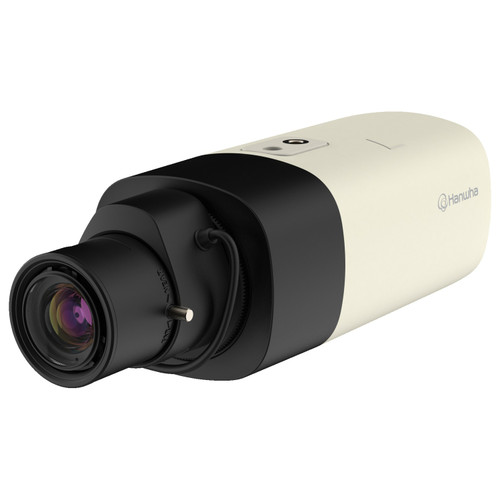
Lens compatibility also diverges significantly. The XNB-6000 accepts C-mount and CS-mount lenses and is compatible with DC auto iris, P-iris, Manual, and I-CS lens types, with listed optional lenses including the SLA-M2890DN and SLA-M2890PN varifocal models. The XNB-6001 uses a different, proprietary lens module system (SLA-T series: SLA-T1080F, SLA-T2480, SLA-T2480V, SLA-T4680, SLA-T4680V) and the mount type is listed as Wall/Ceiling/Rack rather than C/CS — making the two cameras incompatible with each other's lens accessories. The XNB-6000's C/CS compatibility gives it a substantially wider third-party lens ecosystem.
What about installation and environment?
Both cameras are rated IP66 and operate on PoE IEEE 802.3af Class 3. The XNB-6000 also supports 12VDC and 24VAC inputs, giving installers additional power flexibility; the XNB-6001 supports PoE and 12VDC only (24VAC is not listed). Maximum power draw differs: the XNB-6000 is rated at 7.5W max, while the XNB-6001 draws a maximum of 6.5W over PoE or 6.0W on 12VDC. The XNB-6001 also includes a built-in gyroscope for digital image stabilization per the XNB-6000 spec; the XNB-6001 lists DIS support without specifying a gyro sensor. IK impact ratings are not provided for either model.
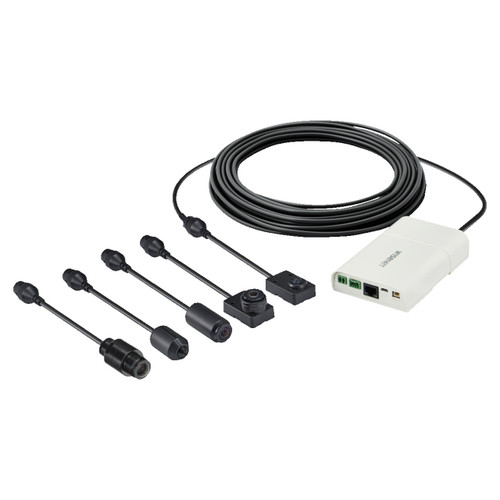
Form factor is a key differentiator. The XNB-6000 body measures 73.1 × 66.6 × 147.8 mm and weighs 420g (0.93 lb), while the XNB-6001 is substantially smaller at 131.1 × 28 × 86 mm and weighs only 245g (0.54 lb) — roughly 40% lighter. The XNB-6001's low-profile, flat mini-box shape is purpose-built for covert or flush-mount installations where the XNB-6000's taller body would be conspicuous. Operating temperature is identical at -10°C to +55°C for both, but storage temperature differs: the XNB-6000 is rated down to -50°C storage, versus -30°C for the XNB-6001.
Which fits your VMS and analytics better?
Both cameras share the same VMS integration baseline: ONVIF Profile S/G/T, SUNAPI (HTTP API), and Wisenet Open Platform. Video compression is identical — H.265/H.264 (Main/Baseline/High) and MJPEG, with CBR/VBR bitrate control and WiseStream II smart codec. Unicast supports up to 20 users and both support up to 10 simultaneous streaming profiles. The protocol stacks are nearly equivalent; the XNB-6001 adds PIM-SM to its listed protocol set, which the XNB-6000 does not list.
Analytics coverage differs at the margin. The XNB-6000 lists audio detection and sound classification as analytic events; neither appears in the XNB-6001's analytics list. The XNB-6000 also specifies audio clip playback as an alarm event action and includes an RS-485/422 serial interface for PTZ or third-party device control — neither is present in the XNB-6001 spec. For alarm triggers, the XNB-6000 adds Time Schedule and App Event triggers not listed for the XNB-6001. On-board storage is another split: the XNB-6000 supports two microSD/SDHC/SDXC slots up to 512GB total (256GB × 2), while the XNB-6001 has a single slot capped at 256GB. Both cameras support NAS recording at event triggers.
Which should you choose: the XNB-6000 or the XNB-6001?
Our take: The XNB-6000 is the stronger choice when imaging performance, lens flexibility, and full feature depth are the priority. Its 150dB WDR outperforms the XNB-6001's 120dB rating by 30dB, it provides a specified minimum illumination of 0.001 Lux B/W via mechanical ICR (the XNB-6001 lists no illumination figure and uses electrical day/night switching only), and its dual microSD slots deliver up to 512GB of on-board storage versus the XNB-6001's 256GB single-slot limit. It also adds RS-485/422 serial control, audio detection analytics, sound classification, and 24VAC power input — none of which are listed for the XNB-6001. The XNB-6001 is the correct choice when the installation demands a compact, low-profile covert form factor: at 28mm tall and 245g, it is purpose-built for flush or concealed mounting where the XNB-6000's body would be impractical. Choose the XNB-6000 for performance-first fixed deployments; choose the XNB-6001 where physical concealment is the overriding constraint.
Side-by-Side Comparison
Spec-for-spec, from manufacturer data.
| Specification | Hanwha XNB-6000 | Hanwha XNB-6001 |
|---|---|---|
| Resolution | 2MP | 1920×1080 (2MP) |
| Image Sensor | 1/2.8" CMOS | Not specified |
| Day/Night Mechanism | Auto ICR (mechanical) | Auto (Electrical) |
| Min. Illumination | 0.01 Lux color / 0.001 Lux B/W | Not specified |
| Wide Dynamic Range | 150dB | 120dB |
| Max Frame Rate | 60fps | 60fps |
| Video Compression | H.265 / H.264 / MJPEG | H.265 / H.264 / MJPEG |
| Lens Mount / Type | C-mount, CS-mount; DC auto iris, P-iris, Manual, I-CS | Proprietary SLA-T module (SLA-T1080F, SLA-T2480, SLA-T2480V, SLA-T4680, SLA-T4680V) |
| IP Rating | IP66 | IP66 |
| Operating Temperature | -10°C to +55°C | -10°C to +55°C |
| Storage Temperature | -50°C to +60°C | -30°C to +60°C |
| Power Input | PoE 802.3af Class 3 / 12VDC / 24VAC | PoE 802.3af Class 3 / 12VDC |
| Max Power Draw | 7.5W | 6.5W (PoE) / 6.0W (12VDC) |
| Edge Storage | 2× microSD/SDHC/SDXC, max 512GB | 1× microSD/SDHC/SDXC, max 256GB |
| Audio In | Mic in / Line in / Built-in mic (selectable) | Mic in / Line in (selectable); no built-in mic listed |
| Audio Out | Line out | Line out |
| Serial Interface | RS-485/422 | Not specified |
| Alarm I/O | Input 1 / Output 1 | Input 1 / Output 1 |
| Analytics | Defocus, Directional, Fog, Face, Motion, Auto tracking, Appear/Disappear, Enter/Exit, Loitering, Tampering, Virtual line, Audio detection, Sound classification | Defocus, Directional, Fog, Face, Motion, Auto tracking, Appear/Disappear, Enter/Exit, Loitering, Tampering, Virtual line |
| ONVIF | Profile S/G/T | Profile S/G/T |
| Dimensions (W×H×D) | 73.1 × 66.6 × 147.8 mm | 131.1 × 28 × 86 mm |
| Weight | 420g (0.93 lb) | 245g (0.54 lb) |
| Warranty | 3 years | 3 years |
Frequently Asked Questions
Which should you choose: the XNB-6000 or the XNB-6001?
The XNB-6000 is the stronger choice when imaging performance, lens flexibility, and full feature depth are the priority. Its 150dB WDR outperforms the XNB-6001's 120dB rating by 30dB, it provides a specified minimum illumination of 0.001 Lux B/W via mechanical ICR (the XNB-6001 lists no illumination figure and uses electrical day/night switching only), and its dual microSD slots deliver up to 512GB of on-board storage versus the XNB-6001's 256GB single-slot limit. It also adds RS-485/422 serial control, audio detection analytics, sound classification, and 24VAC power input — none of which are listed for the XNB-6001. The XNB-6001 is the correct choice when the installation demands a compact, low-profile covert form factor: at 28mm tall and 245g, it is purpose-built for flush or concealed mounting where the XNB-6000's body would be impractical. Choose the XNB-6000 for performance-first fixed deployments; choose the XNB-6001 where physical concealment is the overriding constraint.
Is the XNB-6000 or XNB-6001 better for low-light performance?
Based on available specs, the XNB-6000 is the stronger low-light performer. It specifies a minimum illumination of 0.01 Lux in color mode and 0.001 Lux in B/W mode, achieved via a mechanical ICR day/night mechanism. The XNB-6001 uses electrical day/night switching and does not list a minimum illumination figure in the provided specifications, so a direct lux-for-lux comparison cannot be made — but the absence of mechanical ICR is a known limitation in near-zero-light conditions.
Can I use my existing C-mount lenses with the XNB-6001?
No. The XNB-6000 supports standard C-mount and CS-mount lenses across DC auto iris, P-iris, Manual, and I-CS types. The XNB-6001 uses a proprietary SLA-T series lens module system (SLA-T1080F, SLA-T2480, SLA-T2480V, SLA-T4680, SLA-T4680V) and is not listed as C/CS-mount compatible. If you have an existing C- or CS-mount lens inventory, only the XNB-6000 will accept them.
Which camera supports more on-board storage — the XNB-6000 or XNB-6001?
The XNB-6000 supports two microSD/SDHC/SDXC card slots with a combined maximum of 512GB (256GB per slot). The XNB-6001 has a single microSD/SDHC/SDXC slot with a maximum of 256GB. If extended local recording without NAS dependency is important, the XNB-6000's dual-slot design provides twice the on-board capacity.
Get a Second Opinion on Your Camera Choice
Share your site layout, coverage goals, and budget. Our team will validate the camera selection, flag anything we would change, and recommend products that match the use case.