
Hanwha X530L-28GPX-90 vs Hanwha GS970M/28PS-10: Specification Comparison
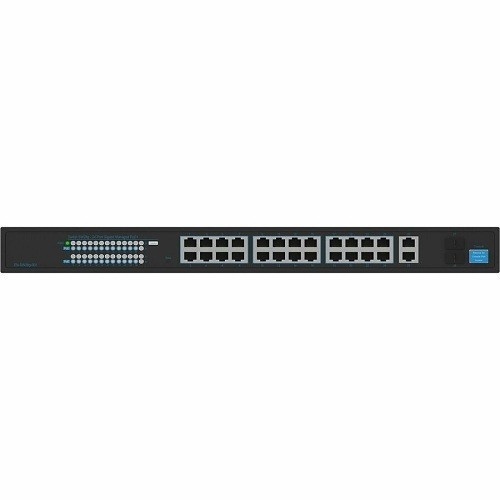
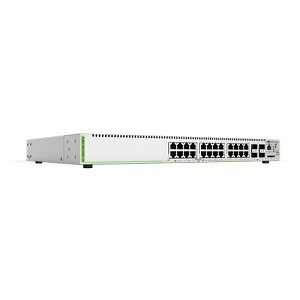
Both the Hanwha HV-X530L-28GPX-90 and HV-GS970M/28PS-10 are 24-port, 802.3at PoE+ managed switches positioned for IP surveillance deployments. Each provides 24 Gigabit PoE+ access ports and four uplink ports, making them directly cross-shoppable for integrators sizing a surveillance LAN. The comparison centers on PoE power budget, uplink speed and switching capacity, and management and compliance features—the three axes that most directly drive camera density, bandwidth headroom, and suitability for government or multi-site projects.
In This Guide
- Which switch delivers more PoE power, and how does that affect camera density?
- How do the uplink speeds and switching fabric compare for high-bandwidth video aggregation?
- Which switch offers stronger management, compliance credentials, and integration options?
- Which should you choose: the X530L-28GPX-90 or the GS970M/28PS-10?
- Side-by-Side Specs
- FAQ
Which switch delivers more PoE power, and how does that affect camera density?
The HV-X530L-28GPX-90 specifies a 740W total PoE budget across its 24 × 1GbE PoE+ ports, yielding an average per-port allocation of approximately 30.8W—enough to simultaneously drive 24 ports at the full 802.3at ceiling of 30W per port without constraint. This headroom supports high-power PTZ cameras, multi-sensor units, and cameras with onboard heaters.
The HV-GS970M/28PS-10 specifies a 370W total PoE budget across its 24 × Gigabit 802.3at ports, yielding an average per-port allocation of approximately 15.4W. At this budget, powering all 24 ports at full 30W draw simultaneously is not possible; integrators must budget port assignments carefully when mixing high-power devices. For deployments dominated by standard fixed cameras drawing 7–15W, the 370W budget is often sufficient.
How do the uplink speeds and switching fabric compare for high-bandwidth video aggregation?
The HV-X530L-28GPX-90 provides four 10GbE SFP+ uplinks and a 128 Gbps wire-speed switching fabric. The 10GbE uplinks are particularly significant in aggregation or spine-leaf topologies where multiple cameras stream simultaneously; a single 10GbE uplink can sustain roughly 10× the throughput of a 1GbE uplink, reducing the risk of uplink saturation in dense deployments. The 128 Gbps fabric supports full wire-speed forwarding across all ports concurrently.
The HV-GS970M/28PS-10 provides four SFP uplinks rated at 100/1000Base-X (1GbE maximum) and a 56 Gbps non-blocking switching fabric. The 1GbE uplinks are appropriate for moderate camera counts or deployments where the upstream NVR or core switch is also 1GbE. The 56 Gbps non-blocking fabric is sufficient for the port count but provides less aggregate headroom than the X530L's 128 Gbps.
Which switch offers stronger management, compliance credentials, and integration options?
The HV-X530L-28GPX-90 is specified as NDAA and TAA certified, making it explicitly eligible for U.S. federal, state, and local government projects subject to those mandates. Its management is listed as FrameworkTM (AMF) with encryption noted for management traffic. ONVIF-compatible camera integration is cited, and the unit supports stacking of multiple units. No Layer designation (L2/L3) is stated in the provided specs.
The HV-GS970M/28PS-10 is specified as a Layer 3 managed switch with SNMP, web interface, and CLI management—a broader standard management stack explicitly documented. It is listed under FrameworkTM Plus management. Layer 3 capability enables inter-VLAN routing and multi-subnet deployments without a separate router, which is relevant for multi-site or segmented surveillance networks. No NDAA or TAA compliance is stated in the provided specs for this model.
Which should you choose: the X530L-28GPX-90 or the GS970M/28PS-10?
Our take: The HV-X530L-28GPX-90 is the stronger choice when PoE power headroom, uplink speed, and government compliance are the primary requirements. Its 740W PoE budget is exactly double the GS970M/28PS-10's 370W, allowing all 24 ports to run at full 802.3at draw simultaneously. Its four 10GbE SFP+ uplinks and 128 Gbps switching fabric—versus the GS970M/28PS-10's 1GbE SFP uplinks and 56 Gbps fabric—provide substantially more bandwidth for high-camera-count or 4K-stream aggregation. NDAA and TAA certification on the X530L-28GPX-90 is a hard requirement for many U.S. government projects; this compliance is not stated for the GS970M/28PS-10. Conversely, the GS970M/28PS-10's explicit Layer 3 capability with SNMP, web, and CLI management suits multi-subnet or multi-VLAN deployments where routing at the access layer is needed and PoE budget is not a binding constraint.
Side-by-Side Comparison
Spec-for-spec, from manufacturer data.
| Specification | Hanwha X530L-28GPX-90 | Hanwha GS970M/28PS-10 |
|---|---|---|
| SKU | HV-X530L-28GPX-90 | HV-GS970M/28PS-10 |
| PoE+ Access Ports | 24 × 1GbE PoE+ | 24 × Gigabit PoE+ |
| PoE Standard | 802.3at (PoE+) | 802.3at (PoE+) |
| Total PoE Budget | 740W | 370W |
| Avg. Power per Port | ~30.8W | ~15.4W |
| Uplink Ports | 4 × 10GbE SFP+ | 4 × SFP 100/1000Base-X (1GbE) |
| Switching Fabric | 128 Gbps wire-speed | 56 Gbps non-blocking |
| Layer | Not stated in specs | Layer 3 |
| Management | FrameworkTM (AMF) | FrameworkTM Plus; SNMP, web, CLI |
| Stackable | Yes (multiple units) | Not stated in specs |
| NDAA Compliant | Yes | Not stated in specs |
| TAA Compliant | Yes | Not stated in specs |
| ONVIF Compatible | Yes | Not stated in specs |
| Mount Type | Rack-mount | Wall; Rack |
| Housing Color | White | White |
| Warranty | 5-Year | 5-Year |
Frequently Asked Questions
Which should you choose: the X530L-28GPX-90 or the GS970M/28PS-10?
The HV-X530L-28GPX-90 is the stronger choice when PoE power headroom, uplink speed, and government compliance are the primary requirements. Its 740W PoE budget is exactly double the GS970M/28PS-10's 370W, allowing all 24 ports to run at full 802.3at draw simultaneously. Its four 10GbE SFP+ uplinks and 128 Gbps switching fabric—versus the GS970M/28PS-10's 1GbE SFP uplinks and 56 Gbps fabric—provide substantially more bandwidth for high-camera-count or 4K-stream aggregation. NDAA and TAA certification on the X530L-28GPX-90 is a hard requirement for many U.S. government projects; this compliance is not stated for the GS970M/28PS-10. Conversely, the GS970M/28PS-10's explicit Layer 3 capability with SNMP, web, and CLI management suits multi-subnet or multi-VLAN deployments where routing at the access layer is needed and PoE budget is not a binding constraint.
Is the HV-X530L-28GPX-90 or HV-GS970M/28PS-10 better for a large PTZ or multi-sensor camera deployment?
The HV-X530L-28GPX-90 is better suited. Its 740W PoE budget allows all 24 ports to operate near the 802.3at maximum simultaneously, whereas the HV-GS970M/28PS-10's 370W budget requires careful power planning when high-draw cameras populate all 24 ports. Additionally, the X530L-28GPX-90's 10GbE uplinks handle the higher aggregate bitrate that PTZ and multi-sensor cameras generate.
Can either switch be used on a U.S. federal government contract requiring NDAA compliance?
Only the HV-X530L-28GPX-90 is specified as both NDAA and TAA certified in the provided specifications. No NDAA or TAA compliance claim is listed in the provided specs for the HV-GS970M/28PS-10. Confirm current compliance status with Hanwha documentation before specifying either unit on a government contract.
Which switch is better for a multi-VLAN or multi-subnet surveillance network?
The HV-GS970M/28PS-10 is explicitly specified as a Layer 3 managed switch, enabling inter-VLAN routing at the access layer without a separate router. The HV-X530L-28GPX-90 specs provided do not state a Layer designation. If Layer 3 routing is a firm requirement, the GS970M/28PS-10 has a documented advantage on that specific feature.
More Network Switch Comparisons
- Vivotek GEV-288A-370 vs Axis T8524
- Vivotek GEV-288A-370 vs Cradlepoint SW2400P-GN
- Vivotek GEV-288A-370 vs Allied Telesis AT-x530L-28GPX-901
- Vivotek GEV-288A-370 vs Ubiquiti USW-ENTERPRISE-24-POE
- Axis T8524 vs Cradlepoint SW2400P-GN
- Axis T8524 vs Allied Telesis AT-x530L-28GPX-901
Network Switch Buying Guides
Get a Second Opinion on Your Camera Choice
Share your site layout, coverage goals, and budget. Our team will validate the camera selection, flag anything we would change, and recommend products that match the use case.