
Hanwha QRN-1630S vs Hanwha PRN-1600B2: Specification Comparison
Both the Hanwha QRN-1630S and PRN-1600B2 are 16-channel network video recorders running embedded Linux, supporting SUNAPI and ONVIF protocols, dual HDMI outputs, H.265/H.264/MJPEG compression, and Hanwha's WAVE/SSM/Webviewer software ecosystem. The comparison examines three decision-relevant axes for mid-market NVR buyers: recording capacity and resolution ceiling; storage architecture and physical scale; and AI, connectivity, and integration depth. Both units are legitimately cross-shoppable as 16-channel NVRs, though they differ substantially in throughput, storage capacity, and analytical capability.
In This Guide
- Which NVR delivers higher recording bandwidth and resolution ceiling?
- How do the two units differ in storage capacity, RAID support, and physical build?
- Which unit offers more complete connectivity, AI analytics, and integration options?
- Which should you choose: the QRN-1630S or the PRN-1600B2?
- Side-by-Side Specs
- FAQ
Which NVR delivers higher recording bandwidth and resolution ceiling?
The QRN-1630S records at a maximum of 128 Mbps and supports camera inputs up to 8MP (4K). Its decoding engine handles 8MP at 60 fps, 1080p at 240 fps, and 720p at 480 fps. Simultaneous remote playback is capped at 8 channels per user (up to 3 remote users), with a total simultaneous playback ceiling of 40 channels (16 local, 8 per remote user).
The PRN-1600B2 records at a maximum of 250 Mbps — nearly double the QRN-1630S — and accepts camera inputs up to 32MP. Its decoding engine handles 32MP at 15 fps, 12MP at 30 fps, 8.3MP at 120 fps, and 1080p at 480 fps. Simultaneous playback reaches 64 channels (16 local, 16 per remote user), and playback bandwidth in RAID mode is up to 64 Mbps versus 32 Mbps for the QRN-1630S. The PRN-1600B2's higher throughput and resolution ceiling make it the appropriate choice where next-generation high-megapixel cameras (12MP, 32MP) are deployed or planned.
How do the two units differ in storage capacity, RAID support, and physical build?
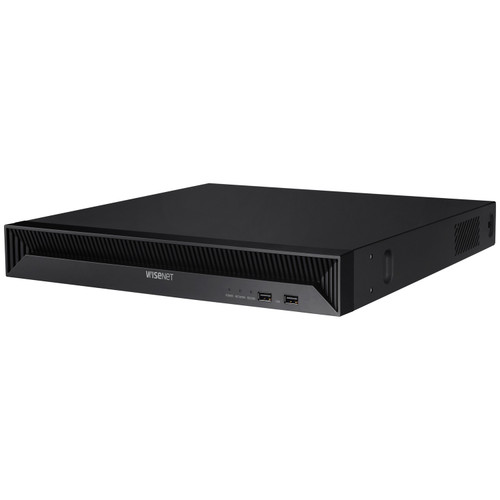
The QRN-1630S provides two SATA HDD slots supporting up to 10TB per drive, for a maximum raw capacity of 20TB. It offers no RAID or iSCSI support per the provided specifications. The unit measures 370.0 × 50.7 × 320 mm and weighs 2.87 kg, consistent with a 1U desktop or rack-mountable form factor. Maximum power draw is 200W including PoE and two HDDs.
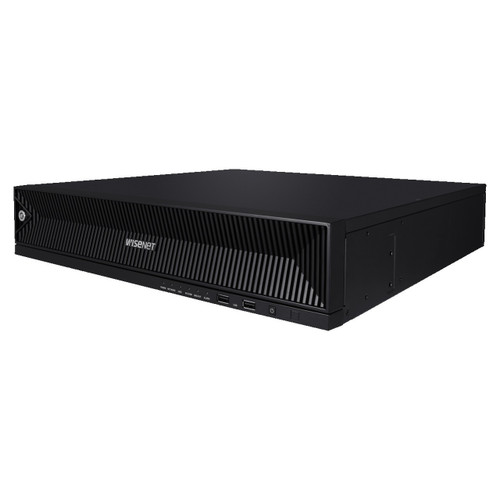
The PRN-1600B2 provides eight SATA HDD slots supporting up to 10TB per drive, yielding a maximum raw capacity of 80TB in non-RAID mode. It also supports RAID-5 and RAID-6 (single array) for data redundancy, and external iSCSI storage expansion — neither feature is present on the QRN-1630S. The unit measures 438 × 86 × 434.9 mm and weighs approximately 9.1 kg (without HDDs), reflecting a larger 2U rack chassis. Maximum power draw is 205W with eight 10TB HDDs installed. Front-panel indicators on the PRN-1600B2 include dedicated HDD, RAID, Backup, and Alarm LEDs; the QRN-1630S shows only Power, Record, and Network.
Which unit offers more complete connectivity, AI analytics, and integration options?
The QRN-1630S includes 16 integrated PoE+ (802.3at) RJ-45 ports at 10/100 Mbps plus one Gigabit RJ-45 uplink, with a 130W PoE budget. This built-in PoE switch eliminates the need for a separate PoE switch for most small-to-mid deployments. Alarm I/O is 4 inputs and 2 outputs. USB is limited to two front-facing USB 2.0 ports. PTZ control is via GUI and Webviewer. The QRN-1630S specification does not list AI search or object attribute analytics. Backup supports up to 8 channels simultaneously.
The PRN-1600B2 provides three Gigabit RJ-45 ports (no integrated PoE), requiring an external PoE switch for camera power. Alarm I/O expands to 8 inputs and 4 outputs — double the QRN-1630S in both directions. USB expands to four ports: two USB 2.0 (front) and two USB 3.0 (rear). PTZ control adds hardware controller support via the SPC-2000. The PRN-1600B2 explicitly includes AI Search with object attribute detection (Human, Face, Vehicle, License Plate) and License Plate Recognition (LPR) for English and numeric plates using Wisenet AI cameras. Backup supports up to 16 channels simultaneously. The PRN-1600B2 also notes explicit third-party VMS integration via CGI(SUNAPI) in its viewer software specification.
Which should you choose: the QRN-1630S or the PRN-1600B2?
Our take: The QRN-1630S is the stronger choice when budget, simplicity, and integrated PoE camera power are the primary drivers on a 16-channel site. Its 16-port 130W PoE+ switch eliminates a separate switching layer, its 20TB two-drive footprint suits installations with moderate retention needs, and its 2.87 kg / 1U-class chassis is straightforward to rack. However, the PRN-1600B2 outperforms it on every capacity axis: 250 Mbps versus 128 Mbps recording bandwidth, 32MP versus 8MP camera resolution ceiling, 80TB versus 20TB maximum storage, RAID-5/6 plus iSCSI versus no RAID, and 64-channel versus 40-channel simultaneous playback. The PRN-1600B2 also adds AI object search (human, face, vehicle, LPN), double the alarm I/O (8-in/4-out versus 4-in/2-out), USB 3.0 rear ports, and SPC-2000 hardware controller support. Choose the QRN-1630S for plug-and-play PoE deployments with 8MP-or-below cameras; choose the PRN-1600B2 for high-resolution, high-retention, or forensic-search environments requiring RAID resilience and AI analytics.
Side-by-Side Comparison
Spec-for-spec, from manufacturer data.
| Specification | Hanwha QRN-1630S | Hanwha PRN-1600B2 |
|---|---|---|
| Product Type | NVR | NVR |
| Max Camera Inputs | 16 CH | 16 CH |
| Max Camera Resolution | 8MP | 32MP |
| Recording Bandwidth | Max. 128 Mbps | Max. 250 Mbps |
| Decoding — Max Resolution/fps | 8MP @ 60fps | 32MP @ 15fps |
| HDD Bays | 2x SATA (Max. 20TB) | 8x SATA (Max. 80TB, Non-RAID) |
| RAID Support | — | RAID-5/6 (Single Array) |
| External Storage | — | iSCSI |
| Integrated PoE Ports | 16x PoE+ RJ-45 (10/100), 130W budget | — |
| Network Uplinks | 1x RJ-45 1Gbps | 3x RJ-45 1Gbps |
| Alarm I/O | 4 In / 2 Out | 8 In / 4 Out |
| USB Ports | 2x USB 2.0 (Front) | 2x USB 2.0 (Front) + 2x USB 3.0 (Rear) |
| Simultaneous Playback | Max. 40CH (Local 16, Remote 8/user) | Max. 64CH (Local 16, Remote 16/user) |
| AI Search / Object Analytics | — | Human, Face, Vehicle, License Plate; LPR |
| PTZ Hardware Controller | — | SPC-2000 |
| Max Power Draw | 200W (2 HDDs, PoE ON) | 205W (8x 10TB HDDs) |
| Dimensions (WxHxD mm) | 370.0 x 50.7 x 320 | 438 x 86 x 434.9 |
| Weight | 2.87 kg (6.33 lb) | ~9.1 kg (20.1 lb, no HDDs) |
| Operating OS | Embedded Linux | Embedded Linux |
| Compression | H.265, H.264, MJPEG | H.265, H.264, MJPEG |
| ONVIF | Yes (Profile-S) | Yes (Profile-S) |
| Redundancy | N+1 Failover, ARB | N+1 Failover, ARB |
| Web Viewer OS | Windows 10, macOS 11 | Windows 10, macOS 10.13 |
Frequently Asked Questions
Which should you choose: the QRN-1630S or the PRN-1600B2?
The QRN-1630S is the stronger choice when budget, simplicity, and integrated PoE camera power are the primary drivers on a 16-channel site. Its 16-port 130W PoE+ switch eliminates a separate switching layer, its 20TB two-drive footprint suits installations with moderate retention needs, and its 2.87 kg / 1U-class chassis is straightforward to rack. However, the PRN-1600B2 outperforms it on every capacity axis: 250 Mbps versus 128 Mbps recording bandwidth, 32MP versus 8MP camera resolution ceiling, 80TB versus 20TB maximum storage, RAID-5/6 plus iSCSI versus no RAID, and 64-channel versus 40-channel simultaneous playback. The PRN-1600B2 also adds AI object search (human, face, vehicle, LPN), double the alarm I/O (8-in/4-out versus 4-in/2-out), USB 3.0 rear ports, and SPC-2000 hardware controller support. Choose the QRN-1630S for plug-and-play PoE deployments with 8MP-or-below cameras; choose the PRN-1600B2 for high-resolution, high-retention, or forensic-search environments requiring RAID resilience and AI analytics.
Is the QRN-1630S or PRN-1600B2 better for a deployment where I need to power cameras directly from the NVR?
The QRN-1630S is the only option of the two that includes integrated PoE ports. It provides 16 PoE+ (802.3at) RJ-45 ports at 10/100 Mbps with a 130W shared PoE budget, allowing direct camera connection without a separate switch. The PRN-1600B2 provides three Gigabit uplink ports only — no integrated PoE — so an external PoE switch is required for camera power in a PRN-1600B2 installation.
Can either NVR support RAID storage for redundancy?
Only the PRN-1600B2 supports RAID. Its specification lists RAID-5 and RAID-6 in a single-array configuration across its eight SATA drive bays, plus external iSCSI expansion. The QRN-1630S has two SATA bays with no RAID capability listed in its specifications. For installations where drive failure cannot result in footage loss, the PRN-1600B2 is the appropriate choice.
Does either NVR include AI-based search for people, vehicles, or license plates?
The PRN-1600B2 specification explicitly includes AI Search with object attribute detection for Human, Face, Vehicle, and License Plate, along with License Plate Recognition (LPR) for English and numeric plates when used with compatible Wisenet AI or P/X series cameras. The QRN-1630S specification does not list AI Search or object attribute analytics among its capabilities.
Get a Second Opinion on Your Camera Choice
Share your site layout, coverage goals, and budget. Our team will validate the camera selection, flag anything we would change, and recommend products that match the use case.