
Hanwha PRN-3200B4 vs Hanwha XRN-3220B4: Specification Comparison
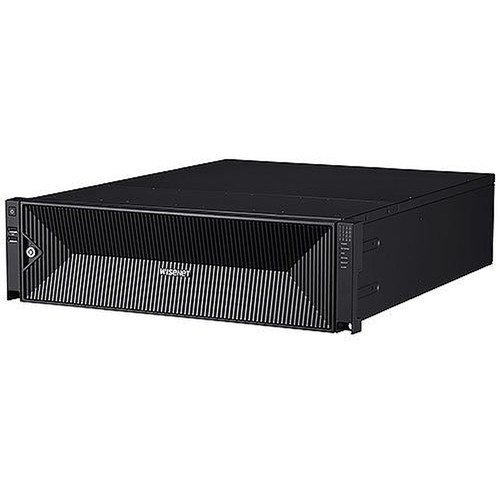
The PRN-3200B4 and XRN-3220B4 are both Hanwha 32-channel, 8K-capable rack-mount NVRs running embedded Linux, targeting enterprise physical-security deployments where high-resolution recording, large local storage, and network redundancy are primary concerns. Both accept up to 32MP camera feeds, share identical SATA bay counts and RAID configurations, and output dual HDMI. The comparison centers on recording bandwidth, AI analytics depth, protocol ecosystem, power draw, and OS/browser compatibility — the dimensions that most directly affect system design decisions for integrators and IT buyers.

In This Guide
- Which NVR delivers higher recording and playback bandwidth for dense, high-resolution deployments?
- How do the two units differ in AI search capabilities, protocol support, and camera ecosystem compatibility?
- Are there meaningful differences in power consumption, physical footprint, and client OS or browser support?
- Which should you choose: the PRN-3200B4 or the XRN-3220B4?
- Side-by-Side Specs
- FAQ
Which NVR delivers higher recording and playback bandwidth for dense, high-resolution deployments?
The XRN-3220B4 specifies a recording bandwidth of up to 520 Mbps, compared to 400 Mbps for the PRN-3200B4 — a 30% advantage that is material when aggregating multiple 32MP or 12MP streams at full frame rate across all 32 channels simultaneously.
On the playback side, the XRN-3220B4 specifies up to 200 Mbps simultaneous playback across 32 channels. The PRN-3200B4 specifies a maximum playback bandwidth of 64 Mbps for 32-channel simultaneous playback — notably lower, though both units support up to 80 total simultaneous playback channels (local 32CH, remote 16CH per user) and the same maximum of 4 concurrent users (1 local, 3 remote).
Decoding resolution tiers are identical at the leading edge: 32MP @ 15 fps and 12MP @ 30 fps on both units. The PRN-3200B4 additionally specifies 8.3MP @ 120 fps as a discrete tier; the XRN-3220B4 specification lists 1080p and 720p tiers below 12MP but does not call out an equivalent 8.3MP/120 fps figure. The PRN-3200B4 also specifies a multi-screen display maximum of 36 divisions versus 32 divisions on the XRN-3220B4. Recording modes on both include Normal, Dual Stream, Schedule, and Event; the XRN-3220B4 adds a Bookmark mode not listed for the PRN-3200B4.
How do the two units differ in AI search capabilities, protocol support, and camera ecosystem compatibility?
The PRN-3200B4 provides explicit AI search specifications: object attributes covering Person, Face (with Wisenet AI camera), Vehicle, and License Plate, with LPR supporting English and Number recognition via Wisenet AI P/X cameras. The XRN-3220B4 states only 'Compatible for Hanwha AI Camera' under object attributes and does not enumerate specific AI search object types or LPR language support in the provided specifications.
On network protocols, the PRN-3200B4 lists Wisenet and ONVIF under camera input protocols and provides an extensive IP stack including IPv4, IPv6, TCP/IP, UDP/IP, RTP (UDP/TCP), RTSP, NTP, HTTP, DHCP (Server/Client), PPPoE, SMTP, ICMP, IGMP, ARP, DNS, DDNS, uPnP, HTTPS, SNMP, and ONVIF Profile-S, plus SUNAPI (Server and Client). The XRN-3220B4 lists SUNAPI and ONVIF as camera input protocols; a full IP protocol stack is not provided in its specifications.
Both units share ONVIF compatibility, P2P QR-code easy configuration, and PTZ control with 300 presets. Camera registration (Auto/Manual), fisheye dewarping (1CH local, CMS), and Hallway View are specified for the PRN-3200B4; the XRN-3220B4 camera setup item list does not include Hallway View. The PRN-3200B4 names SPC-2000 controller support and lists SNMP as a managed-network protocol; neither is specified for the XRN-3220B4.
Are there meaningful differences in power consumption, physical footprint, and client OS or browser support?
Maximum power draw with 16 HDDs installed is 285 W (972.5 BTU/hr) for the PRN-3200B4 and 265 W (904.2 BTU/hr) for the XRN-3220B4 — a 20 W difference that is relevant in dense rack environments with constrained UPS or PDU capacity. Both units share an identical chassis footprint (440.0 × 132.0 × 571.1 mm) and accept the same 100–240 VAC ± 10% / 50–60 Hz input. The XRN-3220B4 specifies 2.7 A (Single SMPS); the PRN-3200B4 does not state a current draw figure. The XRN-3220B4 is slightly heavier at approximately 14 kg versus 13.6 kg for the PRN-3200B4 (both without HDDs).
Web-client OS requirements differ: the PRN-3200B4 lists Windows 10 and macOS 10.13 (High Sierra) as supported operating systems. The XRN-3220B4 specifies Windows 10 or higher and macOS 13.5.2 (Ventura) or higher — a significantly more current macOS floor that may require OS upgrades on older Mac workstations in existing control rooms. Both support Google Chrome, Microsoft Edge, and Mac Safari. Both list the same viewer software ecosystem: Webviewer, Smart Viewer, Wisenet Mobile, and CGI/SUNAPI. Both support iOS and Android mobile clients with identical RTP/RTSP/HTTP/CGI protocol support, 16CH live and 4CH playback on mobile, and the same remote user limits.
Which should you choose: the PRN-3200B4 or the XRN-3220B4?
Our take: The XRN-3220B4 is the stronger choice when sustained recording throughput is the primary constraint, delivering 520 Mbps versus the PRN-3200B4's 400 Mbps — a 30% headroom advantage directly relevant to all-32MP or mixed high-resolution deployments. The XRN-3220B4 also draws 20 W less at full HDD load (265 W vs. 285 W), which compounds across multi-rack installations. However, the PRN-3200B4 holds a clear advantage for deployments requiring verified AI analytics: it explicitly specifies person, face, vehicle, and license-plate detection with English/numeric LPR, while the XRN-3220B4 states only generic Hanwha AI camera compatibility without enumerating search object types. The PRN-3200B4 additionally documents SNMP support and SPC-2000 controller integration, relevant for IT-managed or enterprise access-control environments. Choose the XRN-3220B4 for bandwidth-intensive, power-constrained sites on modern macOS; choose the PRN-3200B4 for deployments requiring documented AI search, LPR, or SNMP-based network management on the Wisenet platform.
Side-by-Side Comparison
Spec-for-spec, from manufacturer data.
| Specification | Hanwha PRN-3200B4 | Hanwha XRN-3220B4 |
|---|---|---|
| Product Type | NVR | NVR |
| Max Camera Channels | 32CH | 32CH |
| Max Recording Bandwidth | 400 Mbps | 520 Mbps |
| Max Playback Bandwidth | 64 Mbps (32CH simultaneous) | 200 Mbps (32CH simultaneous) |
| Decoding Resolution / Frame Rate | 32MP@15fps, 12MP@30fps, 8.3MP@120fps | 32MP@15fps, 12MP@30fps, 1080p, 720p, D1 |
| Multi-Screen Display | 36 division max | 32 division max |
| HDD Slots / Max Capacity | 16 SATA, up to 160TB (non-RAID) | 16 SATA, up to 160TB (non-RAID) |
| RAID Support | RAID-5/6 (8 HDD × 2 array) | RAID-5/6 (8 HDD × 2 array) |
| AI Search Objects | Person, Face, Vehicle, License Plate | Compatible with Hanwha AI Camera (types not specified) |
| LPR | English, Numeric (Wisenet AI P/X cameras) | — |
| Camera Protocols | Wisenet, ONVIF | SUNAPI, ONVIF |
| SNMP Support | Specified | Not specified |
| Redundancy | N+1 Failover, ARB | N+1 Failover, ARB |
| Max Power (16 HDDs) | 285 W (972.5 BTU/hr) | 265 W (904.2 BTU/hr) |
| Supported macOS (Web Viewer) | macOS 10.13 or later | macOS 13.5.2 or later |
| Chassis Dimensions (W×H×D) | 440.0 × 132.0 × 571.1 mm | 440.0 × 132.0 × 571.1 mm |
| Weight (without HDDs) | Approx. 13.6 kg (30 lb) | Approx. 14 kg (30.9 lb) |
Frequently Asked Questions
Which should you choose: the PRN-3200B4 or the XRN-3220B4?
The XRN-3220B4 is the stronger choice when sustained recording throughput is the primary constraint, delivering 520 Mbps versus the PRN-3200B4's 400 Mbps — a 30% headroom advantage directly relevant to all-32MP or mixed high-resolution deployments. The XRN-3220B4 also draws 20 W less at full HDD load (265 W vs. 285 W), which compounds across multi-rack installations. However, the PRN-3200B4 holds a clear advantage for deployments requiring verified AI analytics: it explicitly specifies person, face, vehicle, and license-plate detection with English/numeric LPR, while the XRN-3220B4 states only generic Hanwha AI camera compatibility without enumerating search object types. The PRN-3200B4 additionally documents SNMP support and SPC-2000 controller integration, relevant for IT-managed or enterprise access-control environments. Choose the XRN-3220B4 for bandwidth-intensive, power-constrained sites on modern macOS; choose the PRN-3200B4 for deployments requiring documented AI search, LPR, or SNMP-based network management on the Wisenet platform.
Is the XRN-3220B4 or PRN-3200B4 better if I'm recording a full 32 cameras at 32MP?
The XRN-3220B4 specifies a higher recording bandwidth ceiling of 520 Mbps versus 400 Mbps for the PRN-3200B4. For a full 32-channel deployment at maximum resolution, the XRN-3220B4 provides more headroom before bandwidth becomes a bottleneck. Both units decode 32MP at 15 fps and 12MP at 30 fps.
Does either NVR support license plate recognition, and does it matter which cameras I use?
Only the PRN-3200B4 explicitly specifies LPR in its provided specifications, supporting English and numeric recognition via Wisenet AI P/X series cameras. The XRN-3220B4's specification states general compatibility with Hanwha AI cameras but does not enumerate LPR capability. If LPR is a project requirement, the PRN-3200B4's specification provides a documented basis; the XRN-3220B4 should be verified directly with Hanwha before specifying it for LPR use.
My control room Macs are running macOS 12 — will either NVR's web viewer work?
The PRN-3200B4 specifies macOS 10.13 (High Sierra) or later as its supported OS floor, so macOS 12 falls within its stated compatibility range. The XRN-3220B4 specifies macOS 13.5.2 (Ventura) or higher, which would exclude macOS 12. If upgrading those workstations is not planned, the PRN-3200B4 is the compatible choice based on the provided specifications.
Get a Second Opinion on Your Camera Choice
Share your site layout, coverage goals, and budget. Our team will validate the camera selection, flag anything we would change, and recommend products that match the use case.