
Hanwha L7022R vs Pelco SRXE4P-4V9-EBT-IR1: Specification Comparison
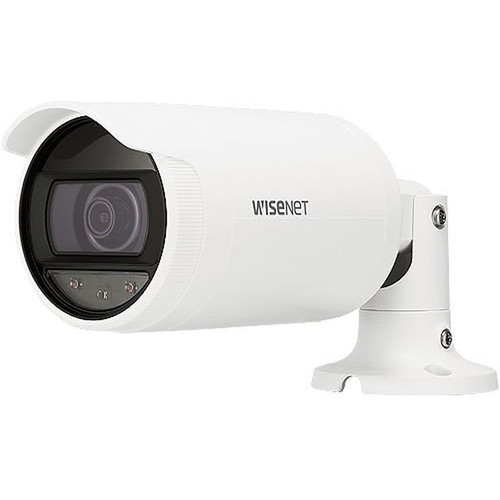
Both the Hanwha ANO-L7022R and the Pelco SRXE4P-4V9-EBT-IR1 are 4MP (2560×1440) outdoor bullet IP cameras aimed at fixed perimeter surveillance. They share the same resolution class and camera form factor, making them legitimate cross-shop candidates for installers evaluating mid-range to enterprise-grade fixed bullet deployments. The comparison covers imaging performance, environmental and installation requirements, and VMS/analytics integration to help B2B buyers determine which camera better fits their project constraints and security posture.
In This Guide
How do the imaging specs compare?
The Pelco SRXE4P-4V9-EBT-IR1 holds a clear imaging advantage in several measurable dimensions. Its 1/1.8-inch progressive scan CMOS sensor is physically larger than the Hanwha ANO-L7022R's 1/3-inch CMOS, which typically yields better low-light signal collection. This is confirmed by minimum illumination figures: the Pelco reaches 0.003 lux color / 0 lux IR, versus the Hanwha's 0.13 lux color / 0 lux IR. The Pelco also delivers a higher maximum frame rate at 60 fps compared to the Hanwha's 30 fps, and its WDR is rated at 130 dB (SureVision) versus the Hanwha's 120 dB.
On optics, the Hanwha ANO-L7022R ships with a fixed 4 mm focal length lens (F1.6 aperture), providing a 79° horizontal field of view with no field adjustment. The Pelco SRXE4P-4V9-EBT-IR1 uses a motorized 4.4–9.3 mm varifocal lens (F1.4 aperture) covering 32–109° HFOV, allowing post-install zoom adjustment without a field lens swap. The Pelco's IR range is specified at approximately 70 meters (229 ft) at 850 nm; the Hanwha's IR is specified at 25 meters (82 ft) at 850 nm—a 2.8× difference in stated illumination reach.
What about installation and environment?
The Pelco SRXE4P-4V9-EBT-IR1 offers a significantly more robust ingress protection profile: IP66, IP67, IP68 (2 m for 2 hr), IPX9K, and NEMA 4X, plus an IK11 impact rating. The Hanwha ANO-L7022R is rated IP66 only; no IK impact rating is stated in the provided specifications. For installations subject to temporary submersion, high-pressure washdown, or deliberate physical attack, the Pelco's ratings are materially stronger.
On operating temperature, the Pelco is specified from -50°C to +65°C (with PoE+ or external power), while the Hanwha operates from -30°C to +55°C—a 20°C wider cold-end range and 10°C wider hot-end range for the Pelco. Power delivery differs: the Hanwha draws up to 7.5 W on PoE IEEE 802.3af (Class 3). The Pelco's power source is listed as PoE+ (802.3at) or 12/24 Vdc external; specific wattage for the Pelco is not stated in the provided specifications. Both cameras are housed in white bullet enclosures.
Which fits your VMS and analytics better?
Both cameras declare ONVIF Profile S, Profile T, and Profile G compliance. The Pelco additionally claims ONVIF Profile M, which covers metadata and analytics interoperability. The Hanwha supports SUNAPI (HTTP API) alongside ONVIF, which is relevant for Hanwha Wisenet VMS environments. The Pelco's analytics suite as specified includes person/vehicle detection, direction violation, loitering, beam crossing, crowd detection, audio analytics, and tamper alert. The Hanwha's on-board analytics include motion detection, tampering, defocus detection, virtual area (intrusion/enter/exit), and virtual line (crossing/direction)—a narrower set with no person/vehicle classification or audio analytics stated.
For edge storage, the Hanwha specifies a Micro SD/SDHC/SDXC slot supporting up to 128 GB. The Pelco lists microSD storage support; a capacity ceiling is not stated in the provided specifications. The Hanwha supports up to 6 unicast streams and 3 simultaneous profiles. Pelco stream count and profile limits are not stated in the provided specifications. Audio I/O is not specified for either camera in the provided data, though the Pelco lists audio analytics as an analytic trigger.
Which should you choose: the L7022R or the SRXE4P-4V9-EBT-IR1?
Our take: The Pelco SRXE4P-4V9-EBT-IR1 is the stronger choice when the deployment demands long-range IR coverage, extreme environmental resilience, or government-mandated cybersecurity compliance. Three concrete spec deltas stand out: IR range is 70 m versus 25 m, making the Pelco the only viable option when illumination must extend beyond roughly 82 ft; minimum illumination is 0.003 lux versus 0.13 lux, a 43× advantage that matters on unlit perimeters; and ingress protection extends to IP68/IPX9K/NEMA 4X/IK11 versus IP66 only, critical for washdown environments or vandal-prone locations. The Pelco also carries FIPS 140-3 Level 3, NDAA Section 889, and TAA compliance—requirements in many federal and critical-infrastructure projects where the Hanwha's spec sheet does not list equivalent certifications. The Hanwha ANO-L7022R is the practical choice for standard commercial outdoor deployments where PoE 802.3af infrastructure is already in place, budget constraints favor a simpler fixed-lens bullet, and Wisenet VMS or SUNAPI integration is a platform requirement.
Side-by-Side Comparison
Spec-for-spec, from manufacturer data.
| Specification | Hanwha L7022R | Pelco SRXE4P-4V9-EBT-IR1 |
|---|---|---|
| Resolution | 4MP (2560×1440) | 4MP (2560×1440) |
| Image Sensor | 1/3" CMOS | 1/1.8" Progressive Scan CMOS |
| Lens / Focal Length | 4 mm fixed focal (F1.6) | 4.4–9.3 mm motorized varifocal (F1.4) |
| Horizontal FOV | 79° | 32–109° |
| Min. Illumination | 0.13 lux color / 0 lux IR | 0.003 lux color / 0 lux IR |
| IR Range | 25 m (82 ft) @ 850 nm | ~70 m (229 ft) @ 850 nm |
| Wide Dynamic Range | 120 dB | 130 dB SureVision |
| Max Frame Rate | 30 fps | 60 fps |
| Video Compression | H.265 / H.264 / MJPEG | H.265 / H.264 / Motion JPEG |
| IP Rating | IP66 | IP66 / IP67 / IP68 (2m/2hr) / IPX9K / NEMA 4X |
| Impact Rating | — | IK11 |
| Operating Temperature | -30°C to +55°C | -50°C to +65°C |
| Power Input / PoE Class | PoE 802.3af, Class 3; max 7.5 W | PoE+ 802.3at or 12/24 Vdc external; wattage not stated |
| ONVIF Compliance | Profile S / G / T | Profile S / T / G / M |
| Edge Storage | Micro SD/SDHC/SDXC up to 128 GB | microSD (max capacity not stated) |
| Cybersecurity / Compliance | Firmware encryption; 802.1X; HTTPS | FIPS 140-3 Level 3; TPM; Secure Boot; HTTPS; 802.1X; NDAA §889; TAA |
| Warranty | 3-year | 5-year |
Frequently Asked Questions
Which should you choose: the L7022R or the SRXE4P-4V9-EBT-IR1?
The Pelco SRXE4P-4V9-EBT-IR1 is the stronger choice when the deployment demands long-range IR coverage, extreme environmental resilience, or government-mandated cybersecurity compliance. Three concrete spec deltas stand out: IR range is 70 m versus 25 m, making the Pelco the only viable option when illumination must extend beyond roughly 82 ft; minimum illumination is 0.003 lux versus 0.13 lux, a 43× advantage that matters on unlit perimeters; and ingress protection extends to IP68/IPX9K/NEMA 4X/IK11 versus IP66 only, critical for washdown environments or vandal-prone locations. The Pelco also carries FIPS 140-3 Level 3, NDAA Section 889, and TAA compliance—requirements in many federal and critical-infrastructure projects where the Hanwha's spec sheet does not list equivalent certifications. The Hanwha ANO-L7022R is the practical choice for standard commercial outdoor deployments where PoE 802.3af infrastructure is already in place, budget constraints favor a simpler fixed-lens bullet, and Wisenet VMS or SUNAPI integration is a platform requirement.
Is the ANO-L7022R or the SRXE4P-4V9-EBT-IR1 better for low-light performance?
Based on provided specifications, the Pelco SRXE4P-4V9-EBT-IR1 is significantly better for low-light use. Its minimum illumination is rated at 0.003 lux color / 0 lux IR versus the Hanwha ANO-L7022R's 0.13 lux color / 0 lux IR—a 43× sensitivity advantage in color mode. The Pelco also has a larger 1/1.8-inch sensor compared to the Hanwha's 1/3-inch sensor and a wider F1.4 aperture versus F1.6, both of which support greater light collection.
Can the SRXE4P-4V9-EBT-IR1 be used in a washdown or outdoor industrial environment where the ANO-L7022R cannot?
Yes, based on provided specifications. The Pelco SRXE4P-4V9-EBT-IR1 carries IP67, IP68 (2 m for 2 hr), IPX9K, NEMA 4X, and IK11 ratings, covering temporary submersion, high-pressure/high-temperature washdown, and impact resistance. The Hanwha ANO-L7022R is rated IP66 only, with no stated IK impact rating, making it unsuitable for locations requiring those additional certifications.
Which camera is required for NDAA- or TAA-compliant federal government deployments?
Based on provided specifications, only the Pelco SRXE4P-4V9-EBT-IR1 lists NDAA Section 889 and TAA compliance, along with FIPS 140-3 Level 3 cybersecurity certification. The Hanwha ANO-L7022R's provided specifications do not include these certifications. Buyers with federal procurement requirements under NDAA Section 889 or FAR/DFARS TAA clauses should verify compliance documentation directly with each manufacturer, but the Pelco is the only one of the two that asserts these approvals in its published specs.
Get a Second Opinion on Your Camera Choice
Share your site layout, coverage goals, and budget. Our team will validate the camera selection, flag anything we would change, and recommend products that match the use case.