
Hanwha L7022R vs Pelco SRXE4-6V9-EBT-IR1: Specification Comparison
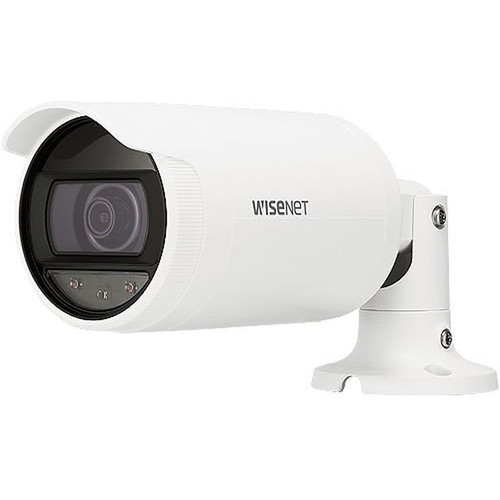
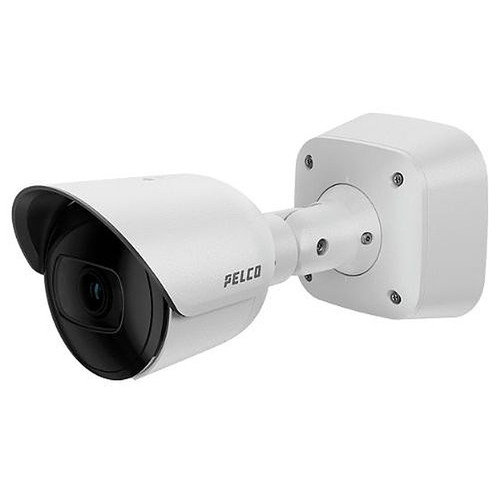
Both the Hanwha ANO-L7022R and the Pelco SRXE4-6V9-EBT-IR1 are 4MP (2560×1440) outdoor fixed bullet IP cameras designed for perimeter and general surveillance applications. This comparison examines how they differ across imaging performance, installation requirements, and systems integration—helping installers and IT buyers determine which unit better suits a given deployment's technical and compliance requirements.
In This Guide
How do the imaging specs compare?
The Pelco SRXE4-6V9-EBT-IR1 holds a meaningful advantage in several imaging fundamentals. Its 1/1.8-inch progressive-scan CMOS sensor is physically larger than the Hanwha ANO-L7022R's 1/3-inch CMOS, which directly supports its superior minimum illumination of 0.003 lux color versus 0.13 lux color on the Hanwha—a 43× sensitivity advantage in low-light conditions. The Pelco also delivers a higher maximum frame rate of 60 fps compared to the Hanwha's 30 fps, and its WDR rating is 130 dB (SureVision) versus 120 dB on the Hanwha—a 10 dB improvement for high-contrast scenes. The Pelco's F1.4 maximum aperture is wider than the Hanwha's F1.6, further supporting light-gathering capability.
The lens configurations differ substantially. The Pelco ships with a 4.4–9.3 mm motorized varifocal lens providing a horizontal field of view of 32–109°, giving installers remote zoom and focus adjustment without physical access to the camera. The Hanwha ANO-L7022R uses a fixed 4 mm lens with a horizontal FOV of 79°—simpler to maintain but offering no optical zoom flexibility post-installation. On IR range, the Pelco's specified range is approximately 70 m (per product card data) versus the Hanwha's specified 25 m (82 ft)—nearly a 3× difference for unlit perimeter coverage. Both cameras use 850 nm IR LEDs and support 0 lux operation with IR active.
What about installation and environment?
The Pelco SRXE4-6V9-EBT-IR1 carries a substantially more robust environmental rating: IP66, IP67, IP68 (2 m for 2 hr), IPX9K, and NEMA 4X, plus an IK11 impact rating. The Hanwha ANO-L7022R is rated IP66 only, with no published IK impact rating. For installations exposed to high-pressure washdown, temporary submersion, or vandalism risk, the Pelco's ratings cover significantly more adverse conditions. The Pelco's operating temperature range of −50°C to +65°C (with PoE+ or external power) is wider than the Hanwha's −30°C to +55°C, making the Pelco more suitable for extreme cold or heat environments.
On power, both cameras are PoE, but they differ in class. The Hanwha ANO-L7022R draws a maximum of 7.5 W and is powered by IEEE 802.3af (Class 3), meaning it works with standard PoE switches. The Pelco SRXE4-6V9-EBT-IR1 specifies PoE+ (802.3at) or 12/24 Vdc at approximately 13 W, requiring PoE+ capable switch ports or a separate power supply—an infrastructure consideration when planning switch upgrades or budgeting. Both cameras are white outdoor bullet form factors. The Hanwha's physical dimensions are ø78.0 × 262.0 mm at 390 g; the Pelco's dimensions and weight are not published in the provided specifications.
Which fits your VMS and analytics better?
Both cameras support ONVIF Profile S, T, and G. The Pelco SRXE4-6V9-EBT-IR1 additionally supports ONVIF Profile M, which covers metadata streaming for analytics events—relevant for VMS platforms that consume standardized analytics metadata. The Hanwha ANO-L7022R also exposes SUNAPI (HTTP API), which is native to Hanwha's Wisenet VMS ecosystem and enables deeper integration with Hanwha NVRs and the WiseStream II smart codec for adaptive bitrate control across up to 5 defined areas. The Hanwha supports up to 3 simultaneous streaming profiles with unicast (6 users) or multicast, and a broad protocol list including SNMPv1/v2c/v3, LLDP, and Bonjour.
Analytics differ in depth and classification. The Pelco provides person/vehicle detection, direction violation, loitering, beam crossing, crowd detection, audio analytics, and tamper alert as named smart analytics. The Hanwha offers motion detection, tampering, defocus detection, virtual area (intrusion/enter/exit), and virtual line (crossing/direction)—no person/vehicle classification or crowd detection is listed in the provided specifications. On-board edge storage is supported by both via microSD; the Hanwha explicitly specifies up to 128 GB (Micro SD/SDHC/SDXC). The Pelco's microSD capacity maximum is not stated in the provided specifications. Audio analytics are listed for the Pelco; no audio input/output specs are published for the Hanwha in the provided data. Cybersecurity posture differs significantly: the Pelco carries FIPS 140-3 Level 3, TPM, and Secure Boot certifications alongside HTTPS and 802.1X, and holds NDAA Section 889 and TAA compliance designations. The Hanwha provides firmware encryption, HTTPS/SRTP, 802.1X (EAP-TLS/LEAP/PEAP), SD card partition encryption, digest authentication, brute-force prevention, and device certificate via Hanwha Private Root CA—but no FIPS, TPM, Secure Boot, NDAA, or TAA listings appear in the provided specifications.
Which should you choose: the L7022R or the SRXE4-6V9-EBT-IR1?
Our take: The Pelco SRXE4-6V9-EBT-IR1 is the stronger choice when the deployment demands maximum low-light sensitivity, flexible optical framing, extreme environmental durability, or federal compliance. Three concrete spec deltas drive this: first, the Pelco's minimum illumination is 0.003 lux color versus 0.13 lux on the Hanwha—a 43× advantage that materially affects image quality in near-dark outdoor scenes. Second, the Pelco's IR range reaches approximately 70 m versus 25 m on the Hanwha, nearly tripling unlit coverage distance. Third, the Pelco adds IP67/IP68/IPX9K/NEMA 4X and IK11 ratings beyond the Hanwha's IP66-only envelope, covering washdown and impact scenarios the Hanwha is not rated for. The Hanwha ANO-L7022R is the appropriate choice where standard PoE (802.3af) infrastructure is fixed, Wisenet/SUNAPI-native VMS integration is preferred, or a lower-power fixed-lens bullet meets the coverage requirement at reduced cost and complexity.
Side-by-Side Comparison
Spec-for-spec, from manufacturer data.
| Specification | Hanwha L7022R | Pelco SRXE4-6V9-EBT-IR1 |
|---|---|---|
| Resolution | 4MP (2560×1440) | 4MP (2560×1440) |
| Image Sensor | 1/3" CMOS | 1/1.8" progressive scan CMOS |
| Max Frame Rate | 30 fps | 60 fps |
| Lens / Focal Length | 4 mm fixed | 4.4–9.3 mm motorized varifocal |
| Horizontal FOV | 79° | 32–109° |
| Max Aperture | F1.6 | F1.4 |
| Min Illumination (Color) | 0.13 lux | 0.003 lux |
| Min Illumination (B/W / IR) | 0 lux (IR on) | 0 lux (IR on) |
| IR Range | 25 m (82 ft) | ~70 m (850 nm) |
| WDR | 120 dB | 130 dB SureVision |
| IP / Ingress Rating | IP66 | IP66 / IP67 / IP68 (2m/2hr) / IPX9K / NEMA 4X |
| Impact Rating | — | IK11 |
| Operating Temperature | -30°C to +55°C | -50°C to +65°C |
| Power Input / PoE Class | PoE 802.3af Class 3 (max 7.5 W) | PoE+ 802.3at or 12/24 Vdc (~13 W) |
| ONVIF Profiles | S / G / T | S / T / G / M |
| Edge Storage | microSD/SDHC/SDXC up to 128 GB | microSD (max capacity not specified) |
| Cybersecurity Certifications | Firmware encryption; HTTPS; SRTP; 802.1X; SD encrypt; Device Cert | FIPS 140-3 Level 3; TPM; Secure Boot; HTTPS; 802.1X |
| NDAA / TAA Compliance | — | NDAA Section 889; TAA Compliant |
| Video Compression | H.265 / H.264 / MJPEG | H.265 / H.264 / Motion JPEG |
| Warranty | 3-year | 5-year |
Frequently Asked Questions
Which should you choose: the L7022R or the SRXE4-6V9-EBT-IR1?
The Pelco SRXE4-6V9-EBT-IR1 is the stronger choice when the deployment demands maximum low-light sensitivity, flexible optical framing, extreme environmental durability, or federal compliance. Three concrete spec deltas drive this: first, the Pelco's minimum illumination is 0.003 lux color versus 0.13 lux on the Hanwha—a 43× advantage that materially affects image quality in near-dark outdoor scenes. Second, the Pelco's IR range reaches approximately 70 m versus 25 m on the Hanwha, nearly tripling unlit coverage distance. Third, the Pelco adds IP67/IP68/IPX9K/NEMA 4X and IK11 ratings beyond the Hanwha's IP66-only envelope, covering washdown and impact scenarios the Hanwha is not rated for. The Hanwha ANO-L7022R is the appropriate choice where standard PoE (802.3af) infrastructure is fixed, Wisenet/SUNAPI-native VMS integration is preferred, or a lower-power fixed-lens bullet meets the coverage requirement at reduced cost and complexity.
Is the ANO-L7022R or the SRXE4-6V9-EBT-IR1 better for low-light performance?
The Pelco SRXE4-6V9-EBT-IR1 is significantly better in low light by the published specs. Its minimum color illumination is 0.003 lux versus 0.13 lux for the Hanwha ANO-L7022R—a 43× sensitivity advantage—and its IR range is specified at approximately 70 m compared to 25 m on the Hanwha. Both cameras reach 0 lux with IR active.
Will either camera work with a standard 802.3af PoE switch, or do I need PoE+?
The Hanwha ANO-L7022R is rated for IEEE 802.3af (Class 3, max 7.5 W) and will power from any standard PoE switch port. The Pelco SRXE4-6V9-EBT-IR1 requires PoE+ (802.3at) or a separate 12/24 Vdc power supply at approximately 13 W, so existing 802.3af-only switch infrastructure would need to be upgraded or supplemented to power the Pelco.
Which camera is better suited for a government or federally regulated installation?
The Pelco SRXE4-6V9-EBT-IR1 lists NDAA Section 889 compliance, TAA compliance, FIPS 140-3 Level 3, TPM, and Secure Boot in its provided specifications—attributes directly required or favored in many federal and DoD procurement contexts. The Hanwha ANO-L7022R does not list NDAA, TAA, FIPS, TPM, or Secure Boot compliance in the provided specifications, making the Pelco the documented choice for federally regulated deployments.
Get a Second Opinion on Your Camera Choice
Share your site layout, coverage goals, and budget. Our team will validate the camera selection, flag anything we would change, and recommend products that match the use case.