
Hanwha L7022R vs Pelco SRXE4-2V12-EBT-IR1: Specification Comparison
Both the Hanwha ANO-L7022R and the Pelco SRXE4-2V12-EBT-IR1 are 4MP outdoor bullet IP cameras targeting perimeter and general surveillance applications. They share the same resolution class (2560×1440), wired PoE power, and H.265/H.264 compression, making them a genuine cross-shop for installers evaluating mid-range fixed bullet cameras. The comparison below examines imaging performance, environmental and installation suitability, and VMS/analytics integration—drawing exclusively from the specifications provided for each model.
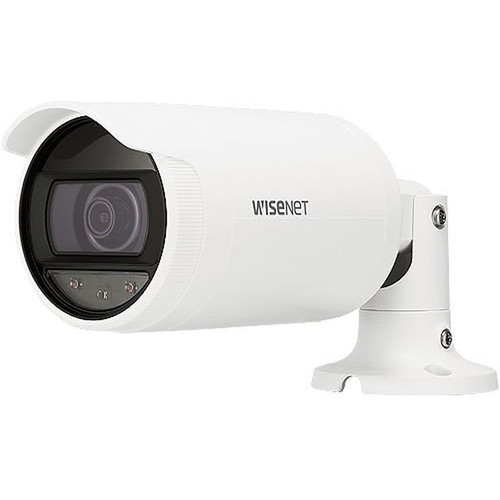
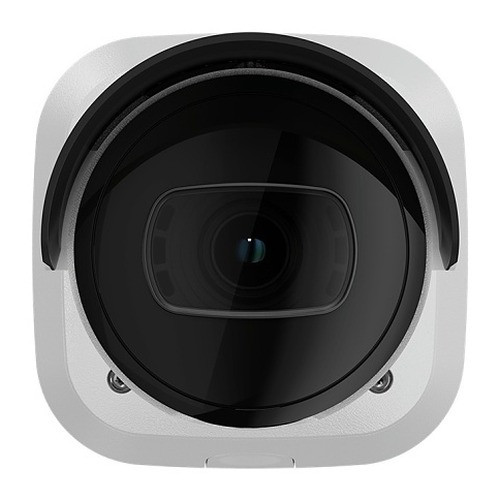
In This Guide
How do the imaging specs compare?
The Pelco SRXE4-2V12-EBT-IR1 holds a clear advantage in raw imaging capability. Its 1/1.8-inch progressive-scan CMOS sensor is physically larger than the Hanwha ANO-L7022R's 1/3-inch CMOS, which contributes directly to the Pelco's superior minimum illumination of 0.003 lux color versus the Hanwha's 0.13 lux color—a difference of more than 40× in light sensitivity. The Pelco also delivers 130 dB SureVision WDR versus the Hanwha's 120 dB WDR, a 10 dB advantage for high-contrast scenes such as entrances with strong backlighting. The Pelco's maximum frame rate is 60 fps compared to the Hanwha's 30 fps, relevant for capturing fast-moving subjects or meeting evidentiary standards that require higher frame rates. The Pelco's wider aperture of F1.4 versus the Hanwha's F1.6 further supports low-light collection.
On the lens side, the Pelco ships with a 4.4–9.3 mm motorized varifocal lens providing a 32–109° horizontal field of view, allowing field adjustment without lens swaps. The Hanwha ANO-L7022R uses a fixed 4 mm lens with a 79° horizontal field of view; once mounted, the scene coverage cannot be adjusted. IR illumination reach favors the Pelco as well: the provided specification indicates approximately 70 m (850 nm), while the Hanwha is rated at 25 m (82 ft). Buyers requiring longer detection corridors or flexible field tuning after installation will find the Pelco's optical specification substantially more capable.
What about installation and environment?
Environmental protection strongly favors the Pelco SRXE4-2V12-EBT-IR1. It carries IP66, IP67, IP68 (2 m for 2 hours), IPX9K, and NEMA 4X ratings, plus an IK11 impact rating—meaning it is rated for temporary submersion, high-pressure wash-down, and heavy mechanical impact. The Hanwha ANO-L7022R is rated IP66 only, with no IK or NEMA 4X designation provided in the specifications. For installations in car washes, tunnel entrances, correctional facilities, or flood-prone areas, the Pelco's ingress and impact ratings represent a significant deployment advantage.
Operating temperature range also favors the Pelco: –50 °C to +65 °C (with PoE+ or external power) versus the Hanwha's –30 °C to +55 °C, a meaningful difference for extreme-climate deployments. Both cameras are PoE-powered; the Pelco is noted as PoE Class 3, and the Hanwha is explicitly rated IEEE 802.3af Class 3 with a 7.5 W maximum draw. The Hanwha's dimensions are ø78.0 × 262.0 mm at 390 g; comparable physical dimensions and weight are not provided in the Pelco specification. Both cameras are white-housed outdoor bullets. The Hanwha's note regarding a spec field 'Form Factor: Dome' appears inconsistent with its stated bullet type and is not relied upon here.
Which fits your VMS and analytics better?
Both cameras comply with ONVIF Profile S, Profile T, and Profile G. The Pelco additionally declares ONVIF Profile M, which adds metadata streaming for analytics events—useful for VMS platforms that ingest object classification metadata. The Hanwha supports SUNAPI (HTTP API) in addition to ONVIF, an advantage for Hanwha WiseNet VMS environments. The Hanwha's WiseStream II smart codec enables bandwidth-adaptive compression across up to five manual areas.
Analytics depth differs noticeably. The Pelco's smart analytics include Person/Vehicle Detection, Direction Violation, Loitering, Beam Crossing, Crowd Detection, Audio Analytics, and Tamper Alert. The Hanwha provides motion detection, tampering, defocus detection, virtual area (intrusion/enter/exit), and virtual line (crossing/direction)—a capable but narrower set with no person/vehicle classification or audio analytics noted in the provided specifications. Both cameras support microSD edge storage; the Hanwha specifies up to 128 GB (Micro SD/SDHC/SDXC). The Pelco's maximum edge storage capacity is not stated in the provided specifications. Cybersecurity posture is stronger on the Pelco, which lists FIPS 140-3 Level 3, TPM, and Secure Boot in addition to HTTPS and 802.1X; the Hanwha offers firmware encryption, 802.1X (EAP-TLS/LEAP/PEAP), HTTPS, SRTP, digest authentication, and IP-based access control—a solid but lower-assurance baseline compared to hardware-rooted trust.
Which should you choose: the L7022R or the SRXE4-2V12-EBT-IR1?
Our take: The Pelco SRXE4-2V12-EBT-IR1 is the stronger choice when the installation demands extreme environmental durability, long-range IR coverage, or hardware-grade cybersecurity compliance. It outperforms the Hanwha ANO-L7022R on five measurable dimensions: minimum illumination (0.003 lux vs. 0.13 lux), WDR (130 dB vs. 120 dB), IR range (~70 m vs. 25 m), maximum frame rate (60 fps vs. 30 fps), and ingress protection (IP68/IK11/NEMA 4X vs. IP66 only). Its FIPS 140-3 Level 3 / TPM / Secure Boot stack satisfies federal and critical-infrastructure cybersecurity mandates. The Hanwha ANO-L7022R is the appropriate choice when budget is constrained, the VMS environment is Hanwha WiseNet (SUNAPI integration), edge storage capacity needs are confirmed at 128 GB, and the site does not require submersion resistance, IK-rated vandal protection, or temperatures below –30 °C. The Pelco's 5-year warranty also exceeds the Hanwha's 3-year term.
Side-by-Side Comparison
Spec-for-spec, from manufacturer data.
| Specification | Hanwha L7022R | Pelco SRXE4-2V12-EBT-IR1 |
|---|---|---|
| Resolution | 4MP (2560×1440) | 4MP (2560×1440) |
| Image Sensor | 1/3" CMOS | 1/1.8" progressive scan CMOS |
| Lens / Focal Length | 4 mm fixed focal | 4.4–9.3 mm motorized varifocal |
| Horizontal FOV | 79° | 32°–109° |
| Max Aperture | F1.6 | F1.4 |
| Min Illumination (Color) | 0.13 lux | 0.003 lux |
| Min Illumination (IR) | 0 lux (IR on) | 0 lux (IR on) |
| IR Range | 25 m (82 ft) | ~70 m (850 nm) |
| WDR | 120 dB | 130 dB SureVision |
| Max Frame Rate | 30 fps | 60 fps |
| Video Compression | H.265 / H.264 / MJPEG | H.265 / H.264 / Motion JPEG |
| IP Rating | IP66 | IP66 / IP67 / IP68 (2 m/2 hr) / IPX9K / NEMA 4X |
| Impact Rating | — | IK11 |
| Operating Temperature | -30 °C to +55 °C | -50 °C to +65 °C |
| Power Input / PoE Class | PoE IEEE 802.3af, Class 3, 7.5 W max | PoE, Class 3 |
| ONVIF Profiles | Profile S / G / T | Profile S / T / G / M |
| Edge Storage | Micro SD/SDHC/SDXC up to 128 GB | microSD (max capacity not specified) |
| Cybersecurity | Firmware encryption; 802.1X; HTTPS; SRTP | FIPS 140-3 Level 3; TPM; Secure Boot; HTTPS; 802.1X |
| NDAA / TAA | — | NDAA Section 889; TAA Compliant |
| Warranty | 3 years | 5 years |
Frequently Asked Questions
Which should you choose: the L7022R or the SRXE4-2V12-EBT-IR1?
The Pelco SRXE4-2V12-EBT-IR1 is the stronger choice when the installation demands extreme environmental durability, long-range IR coverage, or hardware-grade cybersecurity compliance. It outperforms the Hanwha ANO-L7022R on five measurable dimensions: minimum illumination (0.003 lux vs. 0.13 lux), WDR (130 dB vs. 120 dB), IR range (~70 m vs. 25 m), maximum frame rate (60 fps vs. 30 fps), and ingress protection (IP68/IK11/NEMA 4X vs. IP66 only). Its FIPS 140-3 Level 3 / TPM / Secure Boot stack satisfies federal and critical-infrastructure cybersecurity mandates. The Hanwha ANO-L7022R is the appropriate choice when budget is constrained, the VMS environment is Hanwha WiseNet (SUNAPI integration), edge storage capacity needs are confirmed at 128 GB, and the site does not require submersion resistance, IK-rated vandal protection, or temperatures below –30 °C. The Pelco's 5-year warranty also exceeds the Hanwha's 3-year term.
Is the ANO-L7022R or the SRXE4-2V12-EBT-IR1 better for low-light performance?
The Pelco SRXE4-2V12-EBT-IR1 is substantially better for low light. Its minimum color illumination is 0.003 lux versus the Hanwha ANO-L7022R's 0.13 lux—a difference of more than 40×. The Pelco also has a larger 1/1.8-inch sensor and a wider F1.4 aperture compared to the Hanwha's 1/3-inch sensor and F1.6 aperture, both of which contribute to greater light collection. IR range is also longer on the Pelco (~70 m vs. 25 m).
Can I install the SRXE4-2V12-EBT-IR1 in a car wash or outdoor area subject to flooding?
Yes, based on the provided specifications. The Pelco SRXE4-2V12-EBT-IR1 carries IP68 (rated for 2 m submersion for 2 hours), IPX9K (high-pressure/high-temperature water jet), and NEMA 4X ratings, plus IK11 impact resistance. The Hanwha ANO-L7022R is rated IP66 only, which covers dust-tight and powerful water jet protection but does not cover submersion or high-pressure wash-down.
Does either camera support person and vehicle detection analytics on the edge?
Only the Pelco SRXE4-2V12-EBT-IR1 lists Person/Vehicle Detection as an on-camera analytic in the provided specifications. It also includes Direction Violation, Loitering, Beam Crossing, Crowd Detection, and Audio Analytics. The Hanwha ANO-L7022R provides motion detection, tampering, defocus detection, virtual area intrusion/enter/exit, and virtual line crossing/direction analytics, but person or vehicle classification is not listed in its specifications.
Get a Second Opinion on Your Camera Choice
Share your site layout, coverage goals, and budget. Our team will validate the camera selection, flag anything we would change, and recommend products that match the use case.