
Hanwha L6082R vs Hanwha XNO-6020R: Specification Comparison
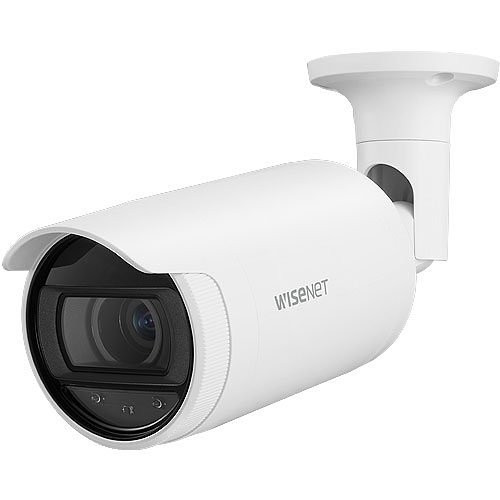
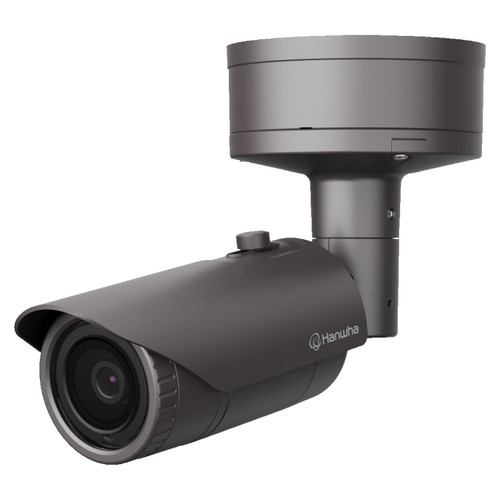
Both the Hanwha ANO-L6082R and XNO-6020R are 2MP outdoor wired bullet IP cameras powered by PoE, making them a legitimate cross-shop for installers specifying fixed perimeter coverage. The L6082R differentiates with a 3.1x motorized varifocal lens, while the XNO-6020R counters with a wider feature set including audio I/O, alarm I/O, IK10 vandal resistance, higher WDR, and a dual-slot SD card bay. This comparison examines imaging, installation environment, and integration trade-offs strictly from the provided specifications.
In This Guide
How do the imaging specs compare?
Both cameras share a 1/2.8" 2MP CMOS sensor delivering 1920×1080 resolution. The L6082R uses a 3.3–10.3mm (3.1x) motorized varifocal lens with DC auto iris at F1.6 (wide) to F3.3 (tele), providing horizontal fields of view from 106° (wide) down to approximately 30° (tele) and DORI Detect distances of 29.4m wide to 140.4m tele. The XNO-6020R uses a fixed 4mm lens at a faster F1.4 aperture, delivering a fixed H: 88.6° / V: 47.5° field of view with no remote zoom capability. The fixed lens cannot be repositioned remotely, but the faster F1.4 aperture means it admits more light at the sensor plane.
On low-light performance, the XNO-6020R specifies 0.015 lux in color mode versus the L6082R's 0.03 lux color, both reaching 0 lux in IR mode. The XNO-6020R also specifies a maximum frame rate of 60fps versus the L6082R's 30fps, making it better suited to fast-moving subjects. WDR is rated at 150dB on the XNO-6020R compared to 120dB on the L6082R, a meaningful 30dB advantage in high-contrast scenes. Both cameras include IR illumination rated at 30m (98.43ft) and Auto ICR day/night switching.
What about installation and environment?
The L6082R is rated IP66 (dust-tight, protected against powerful water jets) and carries no listed IK impact rating. The XNO-6020R is rated IP67/IP66/NEMA 4X and IK10, making it both submersion-rated and vandal-resistant to IK10 impact levels — a significant advantage in exposed or public-access locations. The XNO-6020R body is aluminum (dark grey, 1,220g / 2.69 lb) versus the L6082R's plastic housing (white, 390g / 0.86 lb). Operating temperature range is identical at −30°C to +55°C for both cameras, though the XNO-6020R's storage temperature range extends lower to −50°C versus −30°C for the L6082R.
Both cameras are Class 3 PoE (IEEE 802.3af). Maximum draw differs: the XNO-6020R draws up to 9.7W via PoE, versus 7.0W for the L6082R — both within 802.3af's 15.4W budget but relevant when sizing switch port budgets. The XNO-6020R also accepts 12VDC as an alternate power input (max 8.8W), which the L6082R does not list. Dimensions favor the XNO-6020R in diameter (Ø70mm vs Ø78mm) but the XNO-6020R is longer (296mm vs 262mm) and substantially heavier; mounting hardware and backbox requirements should be verified accordingly. The L6082R lists a compatible backbox (SBV-A14B); no equivalent is listed for the XNO-6020R in the provided specs.
Which fits your VMS and analytics better?
Both cameras support ONVIF Profile S/G/T and Hanwha's SUNAPI HTTP API. The XNO-6020R additionally lists the Wisenet Open Platform for third-party app deployment — not mentioned in the L6082R specs. Streaming concurrency differs markedly: the XNO-6020R supports up to 20 unicast users and 10 simultaneous stream profiles, versus 6 unicast users and 3 profiles on the L6082R. The XNO-6020R's edge storage is dual-slot Micro SD/SDHC/SDXC up to 512GB total; the L6082R provides a single slot capped at 32GB. RAM is 1,024MB on the XNO-6020R versus 512MB on the L6082R, which supports its broader concurrent processing workload.
Analytics depth also diverges substantially. The L6082R offers motion detection, tampering, virtual area (intrusion/enter/exit), and virtual line (crossing/direction). The XNO-6020R adds defocus detection, fog detection, face detection, digital auto tracking, appear/disappear, loitering, audio detection, sound classification, people counting, queue management, and heatmap — a significantly richer on-camera intelligence suite. The XNO-6020R also includes one alarm input and one alarm output, plus audio in (mic/line selectable) and audio out, enabling integration with external sensors and intercoms. The L6082R lists no alarm I/O and no audio capability in the provided specifications. Privacy masking on the XNO-6020R supports 32 polygonal zones with color/mosaic options versus 6 rectangular zones on the L6082R.
Which should you choose: the L6082R or the XNO-6020R?
Our take: The XNO-6020R is the stronger choice when the deployment demands vandal resistance, richer analytics, or audio integration. Its IK10-rated aluminum housing, 150dB WDR (versus 120dB), 60fps maximum frame rate (versus 30fps), and broader analytic suite — including people counting, face detection, loitering, and audio classification — position it for high-traffic or adversarial environments where the L6082R's plastic IP66-only body would be insufficient. The XNO-6020R's dual SD slot (512GB) and 20-user concurrent unicast capacity also suit larger recording deployments. Conversely, the L6082R is the appropriate choice when remote optical zoom is required: its 3.1x motorized varifocal lens spans 3.3–10.3mm and delivers DORI Identify coverage out to 14m at tele, a capability the XNO-6020R's fixed 4mm lens cannot replicate. For installations on standard 802.3af switches where zoom flexibility and lower draw (7W vs 9.7W) matter and vandal rating is not a priority, the L6082R is the practical selection. Both carry a 3-year warranty.
Side-by-Side Comparison
Spec-for-spec, from manufacturer data.
| Specification | Hanwha L6082R | Hanwha XNO-6020R |
|---|---|---|
| Resolution | 2MP (1920×1080) | 2MP |
| Image Sensor | 1/2.8" CMOS | 1/2.8" 2MP CMOS |
| Lens / Focal Length | 3.3–10.3mm varifocal (3.1x), DC auto iris | 4mm fixed focal |
| Max Aperture | F1.6 (wide) / F3.3 (tele) | F1.4 |
| Horizontal Field of View | 106° (wide) / ~30° (tele) | 88.6° |
| Min Illumination (Color / IR) | 0.03 lux color / 0 lux IR | 0.015 lux color / 0 lux IR |
| IR Range | 30m (98.43ft) | 30m (98.43ft) |
| Wide Dynamic Range | 120dB | 150dB |
| Max Frame Rate | 30fps | 60fps |
| Video Compression | H.265 / H.264 / MJPEG | H.265 / H.264 / MJPEG |
| IP Rating | IP66 | IP67 / IP66 / NEMA 4X |
| IK / Impact Rating | — | IK10 |
| Operating Temperature | −30°C to +55°C | −30°C to +55°C |
| Power Input / PoE Class | PoE 802.3af Class 3 / Max 7.0W | PoE 802.3af Class 3 / Max 9.7W; 12VDC / Max 8.8W |
| Edge Storage | Single Micro SD/SDHC up to 32GB | Dual Micro SD/SDHC/SDXC up to 512GB |
| Audio I/O | — | Audio in (mic/line) / Audio out |
| Alarm I/O | — | 1 input / 1 output |
| On-Camera Analytics | Motion, tampering, virtual area, virtual line | Motion, tampering, virtual line, face detection, loitering, people counting, queue management, heatmap, fog detection, audio detection, +more |
| Concurrent Unicast Users / Profiles | 6 users / 3 profiles | 20 users / 10 profiles |
| Housing Material / Color | Plastic / White | Aluminum / Dark grey |
| Dimensions | Ø78.0×262.0mm (Ø3.07"×10.31") | Ø70×296mm (Ø2.76"×11.65") |
| Weight | 390g (0.86 lb) | 1,220g (2.69 lb) |
| Warranty | 3 years | 3 years |
Frequently Asked Questions
Which should you choose: the L6082R or the XNO-6020R?
The XNO-6020R is the stronger choice when the deployment demands vandal resistance, richer analytics, or audio integration. Its IK10-rated aluminum housing, 150dB WDR (versus 120dB), 60fps maximum frame rate (versus 30fps), and broader analytic suite — including people counting, face detection, loitering, and audio classification — position it for high-traffic or adversarial environments where the L6082R's plastic IP66-only body would be insufficient. The XNO-6020R's dual SD slot (512GB) and 20-user concurrent unicast capacity also suit larger recording deployments. Conversely, the L6082R is the appropriate choice when remote optical zoom is required: its 3.1x motorized varifocal lens spans 3.3–10.3mm and delivers DORI Identify coverage out to 14m at tele, a capability the XNO-6020R's fixed 4mm lens cannot replicate. For installations on standard 802.3af switches where zoom flexibility and lower draw (7W vs 9.7W) matter and vandal rating is not a priority, the L6082R is the practical selection. Both carry a 3-year warranty.
Is the ANO-L6082R or XNO-6020R better for low-light performance?
Based on the provided specifications, the XNO-6020R has a lower color minimum illumination (0.015 lux versus 0.03 lux on the L6082R) and a faster fixed aperture of F1.4 compared to the L6082R's F1.6 at wide angle. Both cameras reach 0 lux in IR mode with 30m IR range. For color low-light sensitivity, the XNO-6020R has the specified advantage.
Can either camera be used in locations where it might be physically attacked or tampered with?
Only the XNO-6020R carries an IK10 vandal-resistance rating and an aluminum housing per the provided specifications. The ANO-L6082R is rated IP66 with a plastic housing and no listed IK impact rating. For installations in publicly accessible or tamper-prone areas, the XNO-6020R is the specified choice.
Which camera supports on-camera audio recording and external alarm connections?
The XNO-6020R specifies one alarm input, one alarm output, a selectable microphone/line audio input, and a line audio output, along with audio compression (G.711/G.726). The ANO-L6082R does not list any alarm I/O or audio capability in the provided specifications. If your installation requires audio detection, intercoms, or external sensor integration, only the XNO-6020R supports those interfaces as specified.
Get a Second Opinion on Your Camera Choice
Share your site layout, coverage goals, and budget. Our team will validate the camera selection, flag anything we would change, and recommend products that match the use case.