
Hanwha HRX-434 vs Speco Technologies D4WVN6TB: Specification Comparison
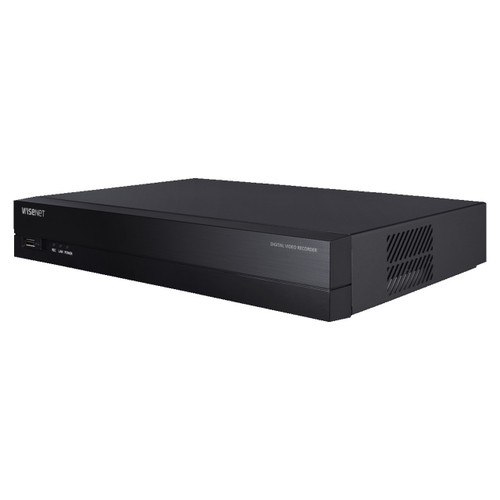
Both the Hanwha HRX-434 and the Speco Technologies D4WVN6TB are 4-channel hybrid DVR recorders targeting installers who need to support analog coax cameras alongside IP channels on a single appliance. The HRX-434 is a rack-mount pentabrid unit supporting AHD, HDTVI, HDCVI, and CVBS signals with up to 6 additional IP channels. The D4WVN6TB is a wall-mount 4K TVI-focused recorder with 6TB onboard storage and TAA/NDAA compliance. Both ship with 6TB storage and H.265 compression, making them direct cross-shop candidates for small-site hybrid deployments.
In This Guide
- Which recorder handles more channels and higher resolution recording?
- How do the storage capacity, physical form factor, and operating environment compare?
- Which unit offers broader integration, remote management, and compliance coverage?
- Which should you choose: the HRX-434 or the D4WVN6TB?
- Side-by-Side Specs
- FAQ
Which recorder handles more channels and higher resolution recording?
The HRX-434 supports 4 analog channels (AHD/HDTVI/HDCVI/CVBS auto-detected on BNC) plus up to 6 additional IP channels via network, for a maximum of 10 concurrent sources. Analog recording tops out at 8MP at 8 fps, 5MP at 12 fps, 4MP at 15 fps, and 2MP at 30 fps. IP channels accept resolutions from 8MP down to CIF. Recording bandwidth is capped at 30 Mbps; simultaneous 6-channel playback reaches 32 Mbps.
The D4WVN6TB is specified as a 4-channel 4K TVI recorder. Its datasheet confirms H.265 and H.264 compression and ONVIF compatibility, but channel-by-channel resolution limits, per-channel frame rates, recording bandwidth figures, and IP channel expansion capacity are not provided in the available specifications. The product title references 4K TVI, indicating support for 4K (nominally 8MP) TVI signals on analog inputs, but no numeric fps or Mbps ceiling is stated.
For buyers who need confirmed numeric bandwidth guarantees or IP channel expansion beyond 4 analog ports, the HRX-434 provides fully published figures (30 Mbps record, 32 Mbps playback, 10 total sources). The D4WVN6TB's 4K TVI claim is noted but cannot be numerically verified from the available spec data.
How do the storage capacity, physical form factor, and operating environment compare?
Both units ship with 6TB of storage. The HRX-434 uses a single internal SATA slot with a 6TB maximum — no expansion slot is available. Its rack-mount chassis measures 300 × 47 × 208.7 mm (1U profile) and weighs approximately 1.5 kg without HDD. It is rated for 0°C to +40°C operating temperature and 20–85% RH, draws up to 22W at DC 12V, and carries UL, CE, FCC, and KC certifications.
The D4WVN6TB ships in a wall-mount enclosure measuring 17.5 × 15.5 × 4.8 inches and weighing 8.0 lbs. Storage capacity is listed as 6TB. Operating temperature range, humidity tolerance, input voltage, and power consumption figures are not provided in the available specifications. The unit holds TAA and NDAA Section 889 compliance certifications, which the HRX-434 does not list.
Form factor is the clearest differentiator here: the HRX-434 fits a standard 1U rack shelf while the D4WVN6TB mounts directly to a wall, making it better suited to retrofit closets or spaces without rack infrastructure. The HRX-434's published thermal and power specs give integrators the data needed for rack power-budgeting; equivalent figures are absent for the D4WVN6TB.
Which unit offers broader integration, remote management, and compliance coverage?
The HRX-434 publishes an extensive network protocol stack: TCP/IP, UDP/IP, RTP, RTSP, NTP, HTTP, DHCP, PPPoE, SMTP, ICMP, IGMP, ARP, DNS, DDNS (Wisenet), uPnP, HTTPS, SNMP, and ONVIF Profile-S. Remote management is supported via Wisenet Webviewer, Smart Viewer, Wisenet Mobile (iOS/Android), SSM CMS, and SDK/CGI. The unit supports up to 10 live unicast remote users and 20 multicast users simultaneously. Security features include IP address filtering, user access logging, 802.1x authentication, ID/PW encryption, recording encryption, transmission encryption, backup encryption, and device certificates tied to the Hanwha Techwin Root CA. Coaxial control covers CVBS (Pelco-C), AHD, CVI, and TVI. RS-485 PTZ control supports Samsung-T, Pelco-D, and Pelco-P protocols.
The D4WVN6TB confirms ONVIF compatibility and H.265/H.264 compression. It lists 'Analytics' as a feature but does not specify which analytic functions are supported. VMS compatibility is noted only as '4K TVI.' No protocol stack, remote user limits, mobile app support, SDK availability, or security feature details are provided in the available specifications. The unit does carry TAA compliance and NDAA Section 889 certification — credentials the HRX-434 does not list — making it eligible for federal, state, and government-funded deployments where those certifications are contractually required.
For commercial integrators building on the Wisenet ecosystem or needing granular remote-access controls, the HRX-434's published protocol depth and multi-tier viewer software are fully documented. For procurement channels that mandate TAA/NDAA compliance, the D4WVN6TB holds certifications the HRX-434 does not.
Which should you choose: the HRX-434 or the D4WVN6TB?
Our take: The HRX-434 is the stronger choice when the deployment requires documented IP channel expansion, a full published protocol stack, or integration into the Wisenet/SUNAPI management ecosystem. Concretely: the HRX-434 supports up to 10 total recording sources (4 analog + 6 IP) versus the D4WVN6TB's 4-channel-only spec; it publishes a 30 Mbps recording and 32 Mbps playback bandwidth ceiling against no equivalent figure for the Speco unit; and it carries a detailed security feature set (802.1x, transmission encryption, device certificates) that is entirely absent from the D4WVN6TB's available documentation. The D4WVN6TB is the appropriate choice when the installation site requires TAA and NDAA Section 889 compliance for government or federally funded procurement, or when rack space is unavailable and a wall-mount enclosure is operationally necessary. Buyers should note that several D4WVN6TB specifications (thermal range, power draw, per-channel fps) are unpublished and should be confirmed directly with Speco prior to quoting.
Side-by-Side Comparison
Spec-for-spec, from manufacturer data.
| Specification | Hanwha HRX-434 | Speco Technologies D4WVN6TB |
|---|---|---|
| Analog Input Channels | 4 (BNC) | 4 (BNC) |
| Analog Signal Types | AHD, HDTVI, HDCVI, CVBS | HDTVI (4K TVI) |
| IP Channel Expansion | Up to 6 additional IP channels (10 total) | — |
| Max Analog Resolution | 8MP | 4K TVI (spec not numerically confirmed) |
| Max Record Bandwidth | 30 Mbps | — |
| Max Playback Bandwidth | 32 Mbps (6CH simultaneous) | — |
| Video Compression | H.265, H.264, MJPEG | H.265, H.264 |
| ONVIF | Yes (Profile-S) | Yes |
| Included Storage | 6TB (single SATA, 6TB max) | 6TB |
| Form Factor | 1U Rack Mount | Wall Mount |
| Dimensions | 300 × 47 × 208.7 mm | 17.5 × 15.5 × 4.8 in |
| Weight | ~1.5 kg (3.30 lb) | 8.0 lbs |
| Power Input / Draw | DC 12V / 22W max | — |
| Operating Temperature | 0°C to +40°C | — |
| TAA / NDAA Compliance | — | TAA and NDAA certified |
| Certifications | UL, CE, FCC, KC | NDAA |
Frequently Asked Questions
Which should you choose: the HRX-434 or the D4WVN6TB?
The HRX-434 is the stronger choice when the deployment requires documented IP channel expansion, a full published protocol stack, or integration into the Wisenet/SUNAPI management ecosystem. Concretely: the HRX-434 supports up to 10 total recording sources (4 analog + 6 IP) versus the D4WVN6TB's 4-channel-only spec; it publishes a 30 Mbps recording and 32 Mbps playback bandwidth ceiling against no equivalent figure for the Speco unit; and it carries a detailed security feature set (802.1x, transmission encryption, device certificates) that is entirely absent from the D4WVN6TB's available documentation. The D4WVN6TB is the appropriate choice when the installation site requires TAA and NDAA Section 889 compliance for government or federally funded procurement, or when rack space is unavailable and a wall-mount enclosure is operationally necessary. Buyers should note that several D4WVN6TB specifications (thermal range, power draw, per-channel fps) are unpublished and should be confirmed directly with Speco prior to quoting.
Can either of these DVRs add IP cameras beyond the analog inputs?
Yes, but only the HRX-434 publishes that capability with confirmed figures: it supports up to 6 additional IP channels (ONVIF or SUNAPI) alongside its 4 analog BNC inputs for a maximum of 10 simultaneous sources at resolutions up to 8MP. The D4WVN6TB's available specifications do not indicate IP channel expansion beyond its 4 TVI inputs.
Which unit is required for a government or federally funded project?
The D4WVN6TB carries both TAA compliance and NDAA Section 889 certification, which are typically mandatory for federal, GSA schedule, and many state/local government contracts. The HRX-434 does not list either certification in its available specifications, so it would not satisfy those procurement requirements without further verification from Hanwha.
Is the HRX-434 or D4WVN6TB a better fit for an installation without a rack cabinet?
The D4WVN6TB is purpose-built as a wall-mount unit (17.5 × 15.5 × 4.8 in, 8.0 lbs) and is the appropriate choice where no rack shelf exists. The HRX-434 is a 1U rack-mount chassis (300 × 47 × 208.7 mm) designed to sit in a standard equipment rack; it is not specified for direct wall mounting.
Get a Second Opinion on Your Camera Choice
Share your site layout, coverage goals, and budget. Our team will validate the camera selection, flag anything we would change, and recommend products that match the use case.