
Hanwha HRX-1634 vs Vivotek ND9442P: Specification Comparison
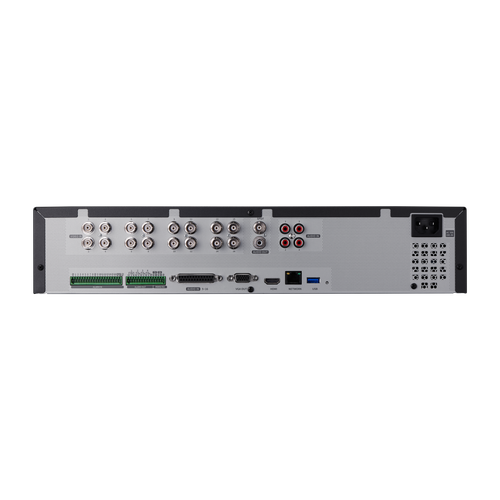
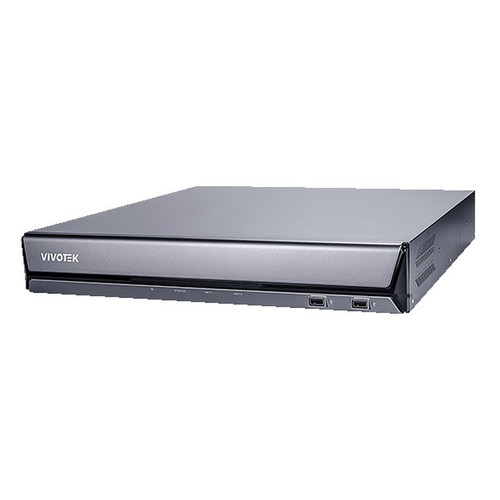
The Hanwha HRX-1634 and Vivotek ND9442P are both 16-channel, 8MP-capable recorders aimed at installers specifying mid-tier surveillance systems. The critical distinction is device type: the HRX-1634 is a pentabrid DVR supporting analog coax inputs (AHD, HDTVI, HDCVI, CVBS) plus up to 18 IP channels, while the ND9442P is a pure IP NVR with built-in PoE+ switching. Both compress in H.265/H.264/MJPEG and output to HDMI and VGA, making them cross-shop candidates for greenfield or mixed-infrastructure projects where the camera type decision drives the recorder choice.
In This Guide
- How do channel capacity, recording throughput, and storage scale differ between the two?
- What are the power delivery, operating environment, and physical build differences?
- How do camera protocol support, analytics, and management software ecosystems compare?
- Which should you choose: the HRX-1634 or the ND9442P?
- Side-by-Side Specs
- FAQ
How do channel capacity, recording throughput, and storage scale differ between the two?
The HRX-1634 supports 16 analog BNC inputs (AHD/HDTVI/HDCVI/CVBS) plus 2 native IP channels expandable to 18 IP total, giving mixed-technology sites a single recorder. Its maximum recording bandwidth is 128 Mbps with a transmission bandwidth cap of 100 Mbps. Storage is limited to two internal SATA bays with a stated maximum of 12 TB (up to 6 TB per drive per spec). There is no RAID support listed in the specifications.
The ND9442P is a pure-IP NVR rated at 192 Mbps recording throughput and 224 Mbps total network input/output across dual Gigabit Ethernet ports. It accommodates four internal 3.5-inch HDD bays and explicitly supports RAID 0, 1, and 5, adding redundancy options the HRX-1634 does not specify. Maximum HDD capacity is not given as a fixed number; Vivotek defers to a recommended HDD list. Playback is capped at 4 simultaneous channels locally versus the HRX-1634's 18-channel simultaneous local playback.
What are the power delivery, operating environment, and physical build differences?
The HRX-1634 draws a maximum of 40 W (with two 6 TB HDDs installed) from AC 100 V input, in a 1U metal chassis measuring 370 × 44 × 320 mm and weighing approximately 4.5 kg. Its operating temperature range is 0 °C to +40 °C and humidity 20–85% RH. Certifications listed are UL, CE, FCC, KC, and UKCA. The unit provides no PoE output; cameras must be separately powered.
The ND9442P is rated at a maximum of 300 W, largely because it integrates PoE+ (802.3at) switching to power connected IP cameras directly—eliminating separate injectors or switches for up to 16 cameras. It operates from 100–240 V AC and across a wider thermal envelope of −10 °C to +55 °C, with humidity tolerance of 0–95%. The chassis is 432 × 421 × 66 mm (a taller 2U footprint) and weighs 4.6 kg without HDDs. Certifications include CE, LVD, FCC, VCCI, C-Tick, UL, CB, BSMI, and BIS.
How do camera protocol support, analytics, and management software ecosystems compare?
The HRX-1634 supports ONVIF Profile S and Hanwha's proprietary SUNAPI (Wisenet) for IP cameras, plus coaxial control via CVBS (Pelco-C), AHD, CVI, and TVI for analog heads. Remote management runs through SSM, SmartViewer, Wisenet Mobile, Wisenet Viewer, and a web viewer. Security features include 802.1x authentication, IP filtering, ID/PW and recording encryption, and Hanwha Techwin device certificates. Analytics events (defocus, audio detection, video analytics) are passed through from connected network cameras; no on-box VCA is specified. ARB (Automatic Recovery Backup) is supported.
The ND9442P integrates ONVIF Profile S and runs Vivotek's VAST Security Station (VSS) and Shepherd software, plus VIVOCloud and VORTEX mobile apps. It includes on-board Smart Search II, object search (people, vehicle), scene search (line crossing, intrusion, loitering), and attribute search (gender, age, clothing color, vehicle type and color)—analytics processed locally without a separate server. Trend Micro IoT Security and Cybersecurity Management modules are specified. Fisheye dewarping is supported locally in multiple modes (1O, 1R, 1P, 1O3R, 1O8R, 1P3R). Hardware decoding supports up to 7680 × 2560 and 4K @ 90 fps.
Which should you choose: the HRX-1634 or the ND9442P?
Our take: The ND9442P is the stronger choice when deploying a greenfield all-IP camera system where PoE+ simplicity, RAID storage redundancy, on-board video analytics, and a wider operating temperature range are priorities. Concretely: its 192 Mbps recording throughput exceeds the HRX-1634's 128 Mbps; its four-bay RAID 0/1/5 storage architecture provides redundancy the HRX-1634's dual-bay, no-RAID design cannot match; and its −10 °C to +55 °C thermal range versus the HRX-1634's 0 °C to +40 °C makes it viable in unheated or warmer spaces. The HRX-1634 is the correct specification when the project inherits existing analog coax infrastructure—its pentabrid inputs (AHD, HDTVI, HDCVI, CVBS) accept legacy cameras while simultaneously adding up to 18 IP channels, at 40 W versus the ND9442P's 300 W, and within the Wisenet/SUNAPI ecosystem.
Side-by-Side Comparison
Spec-for-spec, from manufacturer data.
| Specification | Hanwha HRX-1634 | Vivotek ND9442P |
|---|---|---|
| Device Type | Pentabrid DVR (analog + IP) | Pure-IP NVR |
| Max Analog Channels | 16 (BNC, AHD/HDTVI/HDCVI/CVBS) | — |
| Max IP Channels | 2 native / up to 18 configurable | 16 |
| Max Recording Resolution | 8 MP | 8 MP (4K) |
| Recording Throughput | 128 Mbps | 192 Mbps |
| Network Throughput | 100 Mbps (transmission) | 224 Mbps (input/output total) |
| HDD Bays | 2 x SATA (max 12 TB) | 4 x 3.5" internal |
| RAID Support | — | RAID 0, 1, 5 |
| PoE Output | — | PoE+ (802.3at), 16 ports |
| Video Outputs | 1x HDMI, 1x VGA | 1x HDMI, 1x VGA |
| Max Display Resolution | 4K (local) | 3840x2160 (4K) |
| On-board VCA / Analytics | Camera-passthrough events only | Smart Search II, object/scene/attribute search |
| Operating Temperature | 0°C to +40°C | -10°C to +55°C |
| Max Power Draw | 40 W (with 2x 6TB HDDs) | 300 W |
| Alarm Inputs / Outputs | 16 in / 4 out | 16 in / 8 out |
| Certifications | UL, CE, FCC, KC, UKCA | CE, LVD, FCC, VCCI, C-Tick, UL, CB, BSMI, BIS |
Frequently Asked Questions
Which should you choose: the HRX-1634 or the ND9442P?
The ND9442P is the stronger choice when deploying a greenfield all-IP camera system where PoE+ simplicity, RAID storage redundancy, on-board video analytics, and a wider operating temperature range are priorities. Concretely: its 192 Mbps recording throughput exceeds the HRX-1634's 128 Mbps; its four-bay RAID 0/1/5 storage architecture provides redundancy the HRX-1634's dual-bay, no-RAID design cannot match; and its −10 °C to +55 °C thermal range versus the HRX-1634's 0 °C to +40 °C makes it viable in unheated or warmer spaces. The HRX-1634 is the correct specification when the project inherits existing analog coax infrastructure—its pentabrid inputs (AHD, HDTVI, HDCVI, CVBS) accept legacy cameras while simultaneously adding up to 18 IP channels, at 40 W versus the ND9442P's 300 W, and within the Wisenet/SUNAPI ecosystem.
Can the HRX-1634 power IP cameras the way the ND9442P does?
No. The HRX-1634 provides no PoE output; IP cameras connected to it require separate PoE switches or injectors. The ND9442P integrates PoE+ (802.3at) switching, delivering power to connected IP cameras directly over the network cable, which simplifies wiring and reduces rack equipment.
Which unit is better suited to a site with existing analog coax cabling?
The HRX-1634. Its pentabrid inputs natively accept AHD, HDTVI, HDCVI, and CVBS cameras on standard BNC coax, alongside up to 18 IP channels. The ND9442P is a pure-IP NVR with no analog input capability; existing analog cameras would require replacement or analog-to-IP encoders.
Does either recorder support RAID for drive redundancy?
Only the ND9442P specifies RAID support—RAID 0, 1, and 5—across its four internal 3.5-inch HDD bays. The HRX-1634 specifications list two SATA bays with a 12 TB maximum but make no mention of RAID capability.
Get a Second Opinion on Your Camera Choice
Share your site layout, coverage goals, and budget. Our team will validate the camera selection, flag anything we would change, and recommend products that match the use case.