
Hanwha HRX-1634 vs Vivotek ND9425P: Specification Comparison
Both the Hanwha HRX-1634 and the Vivotek ND9425P are 16-channel 8MP-capable recorders targeting professional physical-security installations. The HRX-1634 is a pentabrid DVR that accepts analog coaxial (AHD/TVI/CVI/CVBS) and IP cameras simultaneously, while the ND9425P is a purpose-built IP NVR with integrated PoE+ switching. Installers evaluating these two units are typically deciding between retaining analog infrastructure versus committing fully to IP—a decision with direct implications for cabling, budget, scalability, and long-term platform strategy.
In This Guide
- How do channel capacity, input flexibility, and recording throughput compare between the two units?
- What are the storage architecture, power delivery, and physical installation differences?
- How do camera compatibility, cybersecurity features, and management software ecosystems differ?
- Which should you choose: the HRX-1634 or the ND9425P?
- Side-by-Side Specs
- FAQ
How do channel capacity, input flexibility, and recording throughput compare between the two units?
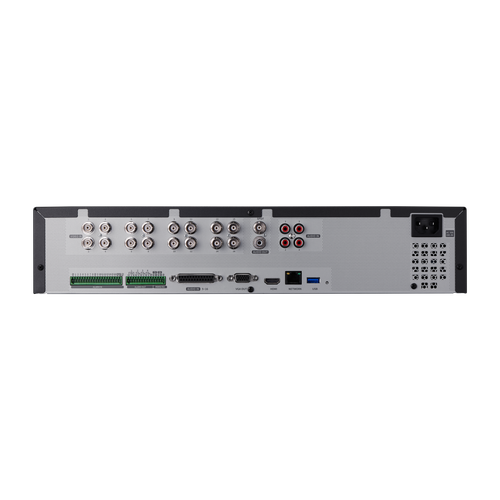
The HRX-1634 supports 16 analog BNC inputs (AHD, HDTVI, HDCVI, NTSC/PAL) plus 2 native IP channels expandable to 18 IP channels, for a blended maximum of 16 analog + 18 IP—though total simultaneous channel count reflects mixed-mode trade-offs per Hanwha's flex-channel rules. Recording bandwidth is specified at 128 Mbps maximum, with transmission bandwidth capped at 100 Mbps. Simultaneous playback reaches 18 channels locally and 18 via CMS, with up to 4 users concurrently (1 local, 3 remote).
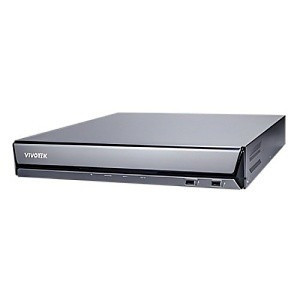
The ND9425P is a fixed 16-channel IP-only NVR with no analog input capability. Its aggregate network throughput is 88 Mbps (input + output combined), and recording throughput is specified at 64 Mbps. Decoding is hardware-accelerated, supporting 3840×2160 at 30 fps on a single channel or 1920×1080 at 120 fps across 4 channels. Playback is limited to 4 simultaneous channels. The ND9425P integrates PoE+ directly, eliminating external switches for camera power.
For throughput, the HRX-1634's 128 Mbps recording bandwidth is double the ND9425P's 64 Mbps, a significant advantage in high-bitrate 4K or multi-stream deployments. However, the ND9425P's hardware decoder and native 4K display pipeline (up to 3840×2160 output) are explicitly specified, while the HRX-1634's 4K output is listed at the display level only, with per-channel record rates topping out at 8 fps for 8MP analog sources.
What are the storage architecture, power delivery, and physical installation differences?
The HRX-1634 provides two internal 3.5-inch SATA bays with a documented maximum of 6 TB per drive (12 TB total). No RAID support is specified in the provided data. Power input is AC 100–240 V with a maximum draw of 40 W when populated with two 6 TB HDDs. Physical dimensions are 370 mm × 44 mm × 320 mm (1U rack form factor, 4.5 kg with one 4 TB HDD). Three USB ports are included (2× USB 2.0 front, 1× USB 3.0 rear).
The ND9425P also has two internal 3.5-inch HDD bays and explicitly supports RAID 0 and RAID 1—a meaningful differentiator for installations requiring redundancy or striped performance. Maximum HDD capacity per drive is not stated in the provided specs; Vivotek defers to a recommended HDD list on their website. Power input is 100–240 V AC with a maximum draw of 255 W—substantially higher due to the integrated PoE+ budget for up to 16 cameras. Dimensions are 366 mm × 320.3 mm × 46 mm at 2.5 kg (without HDD). USB includes one USB 3.0 (front) and one USB 2.0 (rear).
The PoE+ integration in the ND9425P is both an advantage and the primary driver of its 255 W maximum draw versus the HRX-1634's 40 W. Sites already running separate PoE switches gain nothing from the ND9425P's internal PoE, but greenfield IP deployments simplify wiring considerably. RAID support in the ND9425P is an explicit spec; it is absent from the HRX-1634's provided specifications.
How do camera compatibility, cybersecurity features, and management software ecosystems differ?
The HRX-1634 integrates with Hanwha's SUNAPI/Wisenet ecosystem natively, with ONVIF Profile S for third-party IP cameras. Coaxial control supports CVBS (Pelco-C), AHD, CVI, and TVI. Network protocols are extensive: TCP/IP, UDP, RTP, RTSP, NTP, HTTP, DHCP, PPPoE, SMTP, ICMP, IGMP, ARP, DNS, DDNS, UPnP, HTTPS, SNMP, and ONVIF Profile S. Security features include IP address filtering, user access logging, 802.1x authentication, and encryption of ID/PW, recording, transmission, and backup, backed by a Hanwha Techwin Root CA device certificate. Viewer software includes SSM, Webviewer, SmartViewer, Wisenet Mobile, and Wisenet Viewer. Mobile support covers iOS and Android via RTP/RTSP/HTTP/CGI.
The ND9425P supports ONVIF Profile S for camera integration, with no proprietary camera protocol specified in the provided data. Its protocol list includes IPv4, IPv6, TCP/IP, HTTP, HTTPS, UPnP, RTSP/RTP/RTCP, SMTP, FTP, DHCP, NTP, DNS, DDNS, and IP Filter. Notable differentiators are Trend Micro IoT Security integration, a dedicated Cybersecurity Management feature, and VCA (Video Content Analytics) capabilities including Smart VCA Event, VCA Counting Solution, VCA Event Search, and Crowd Control Solution. Management platforms include Shepherd and VAST 2 software, with iViewer for iOS/Android mobile access and VIVOCloud for remote connectivity.
The HRX-1634's hybrid analog/IP compatibility and deep Wisenet ecosystem integration suit sites with existing coaxial infrastructure or Hanwha camera deployments. The ND9425P's built-in VCA analytics, Trend Micro IoT security hardening, and VAST 2 VMS integration are distinct enterprise-grade features not mentioned in the HRX-1634's specifications. RS-485 PTZ control (Pelco-D/P, Samsung-T) is present only on the HRX-1634. Alarm I/O favors the HRX-1634 at 16 inputs / 4 outputs versus the ND9425P's 4 inputs / 1 output.
Which should you choose: the HRX-1634 or the ND9425P?
Our take: The HRX-1634 is the stronger choice when an installation includes existing analog coaxial infrastructure or requires a high alarm I/O count, while the ND9425P is the stronger choice for greenfield all-IP deployments that benefit from integrated PoE+ camera power and built-in VCA analytics. Three concrete spec deltas define the decision: recording bandwidth (HRX-1634: 128 Mbps vs. ND9425P: 64 Mbps) gives the Hanwha unit a clear edge in high-bitrate mixed-channel environments; RAID 0/1 support is specified for the ND9425P but absent from the HRX-1634's provided specs, a meaningful reliability differentiator for mission-critical IP sites; and alarm I/O is 16 in / 4 out on the HRX-1634 versus 4 in / 1 out on the ND9425P, making the Hanwha unit substantially better suited to access-control or perimeter-alarm integration. Platform qualifier: Wisenet-ecosystem sites or hybrid analog-to-IP migration projects favor the HRX-1634; Vivotek camera-centric or analytics-driven deployments favor the ND9425P.
Side-by-Side Comparison
Spec-for-spec, from manufacturer data.
| Specification | Hanwha HRX-1634 | Vivotek ND9425P |
|---|---|---|
| Product Type | Pentabrid DVR (Analog + IP) | IP NVR (IP only) |
| Analog Inputs | 16× BNC (AHD/TVI/CVI/CVBS) | — |
| IP Camera Channels | 2 native, up to 18 (configurable) | 16 (fixed) |
| Max Recording Bandwidth | 128 Mbps | 64 Mbps |
| Network Throughput (total) | 100 Mbps transmission | 88 Mbps (in + out combined) |
| Video Compression | H.265, H.264, MJPEG | H.265, H.264, MJPEG |
| Max Resolution (record/decode) | 8MP | 3840×2160 (hardware decoded) |
| Display Outputs | 1× HDMI, 1× VGA (up to 4K) | 1× HDMI, 1× VGA (up to 3840×2160) |
| HDD Bays / Max Capacity | 2× SATA, 12 TB (6 TB each) | 2× 3.5-inch internal (max capacity: see Vivotek HDD list) |
| RAID Support | Not specified | RAID 0, 1 |
| Integrated PoE+ | No | Yes (up to 16 channels) |
| Alarm I/O | 16 inputs / 4 outputs | 4 inputs / 1 output |
| Audio I/O | 4 Line in / 1 Line out (RCA) | 1× 3.5mm in / 1× 3.5mm out |
| Max Power Consumption | 40 W (with 2× 6TB HDD) | 255 W (with PoE load) |
| Cybersecurity / VCA Features | 802.1x, encryption, Hanwha Root CA | Trend Micro IoT Security, VCA analytics, Crowd Control |
| Operating Temperature | 0°C to +40°C | 0°C to +40°C |
| Certifications | UL, CE, FCC, KC, UKCA | CE, FCC, VCCI, C-Tick, UL, CB, BSMI, BIS |
| ONVIF | Profile S | Profile S |
| Mobile App | Wisenet Mobile (iOS/Android) | iViewer (iOS/Android) |
| Weight (with HDD) | 4.5 kg (1× 4TB HDD) | 2.5 kg (without HDD) |
Frequently Asked Questions
Which should you choose: the HRX-1634 or the ND9425P?
The HRX-1634 is the stronger choice when an installation includes existing analog coaxial infrastructure or requires a high alarm I/O count, while the ND9425P is the stronger choice for greenfield all-IP deployments that benefit from integrated PoE+ camera power and built-in VCA analytics. Three concrete spec deltas define the decision: recording bandwidth (HRX-1634: 128 Mbps vs. ND9425P: 64 Mbps) gives the Hanwha unit a clear edge in high-bitrate mixed-channel environments; RAID 0/1 support is specified for the ND9425P but absent from the HRX-1634's provided specs, a meaningful reliability differentiator for mission-critical IP sites; and alarm I/O is 16 in / 4 out on the HRX-1634 versus 4 in / 1 out on the ND9425P, making the Hanwha unit substantially better suited to access-control or perimeter-alarm integration. Platform qualifier: Wisenet-ecosystem sites or hybrid analog-to-IP migration projects favor the HRX-1634; Vivotek camera-centric or analytics-driven deployments favor the ND9425P.
Can the HRX-1634 or ND9425P work with my existing analog cameras?
Only the HRX-1634 supports analog cameras. It accepts AHD, HDTVI, HDCVI, and NTSC/PAL signals across all 16 BNC inputs via coaxial cable, with coaxial PTZ control (CVBS/AHD/CVI/TVI). The ND9425P is an IP-only NVR; it has no coaxial or analog inputs and requires IP cameras on all 16 channels.
Which unit is better suited to a site that needs camera power delivered from the recorder?
The ND9425P is the correct choice. It includes integrated PoE+ switching for all 16 camera channels, eliminating the need for a separate PoE switch or per-camera power supplies. The HRX-1634 does not provide PoE output; IP cameras connected to it require independent power sources. Note that the ND9425P's maximum power draw reaches 255 W when PoE loads are active, versus 40 W for the HRX-1634.
Which recorder offers stronger built-in analytics and cybersecurity features?
Based on the provided specifications, the ND9425P offers more documented analytics and cybersecurity capabilities. It includes Smart VCA Event detection, VCA Counting Solution, VCA Event Search, Crowd Control Solution, and Trend Micro IoT Security integration with a dedicated Cybersecurity Management feature. The HRX-1634's specified event triggers cover motion detection, tampering, defocus, and audio events from Wisenet/ONVIF cameras, but no equivalent VCA analytics suite or third-party security integration is listed in its provided specifications.
Get a Second Opinion on Your Camera Choice
Share your site layout, coverage goals, and budget. Our team will validate the camera selection, flag anything we would change, and recommend products that match the use case.