
Hanwha HRX-1634 vs Hanwha QRN-1630S: Specification Comparison
Both the Hanwha HRX-1634 and QRN-1630S are 16-channel rack-mount recorders sharing the same physical footprint and Wisenet/ONVIF ecosystem, but they serve fundamentally different camera infrastructures. The HRX-1634 is a pentabrid DVR that accepts analog coaxial cameras (AHD, HDTVI, HDCVI, CVBS) plus up to 18 IP channels, while the QRN-1630S is a pure IP NVR with 16 built-in PoE ports. This comparison covers channel architecture and throughput, storage and power, and software and integration capability.
In This Guide
- Which recorder fits your camera infrastructure—analog coax, IP, or a mix?
- How do the two units compare on storage capacity, recording bandwidth, and power draw?
- Which unit offers stronger software integration, redundancy, and remote management?
- Which should you choose: the HRX-1634 or the QRN-1630S?
- Side-by-Side Specs
- FAQ
Which recorder fits your camera infrastructure—analog coax, IP, or a mix?
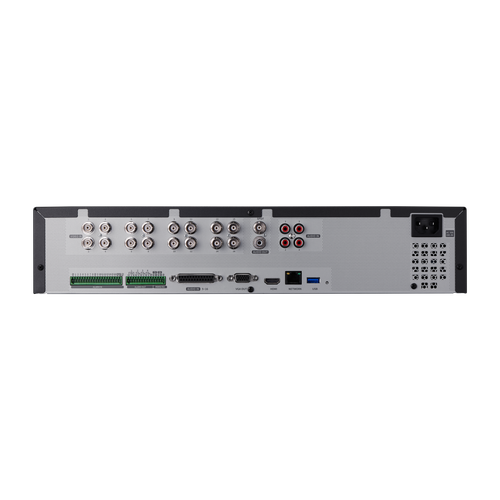
The HRX-1634 is a pentabrid DVR: its 16 BNC inputs accept AHD, HDTVI, HDCVI, and NTSC/PAL analog signals, with a coaxial control bus (CVBS Pelco-C / AHD / CVI / TVI) for PTZ and camera settings over coax. On top of that, it adds 2 dedicated IP channels expandable to 18 total, giving mixed analog-plus-IP sites a single recorder. Analog record rates are signal-type-dependent: up to 8MP at 8fps or 2MP at 30fps per the spec sheet.
The QRN-1630S is a pure IP NVR with 16 PoE RJ-45 ports (10/100 per-port) plus one separate 1Gbps uplink. There are no analog inputs whatsoever. It decodes up to 8MP at 60fps or 1080p at 240fps locally—frame rates the HRX-1634 cannot match on its analog channels. The QRN-1630S also exposes dual HDMI outputs (HDMI1: 4K/30Hz; HDMI2: 1080p/60Hz) supporting clone or expand mode, whereas the HRX-1634 provides one HDMI and one VGA output, both up to 4K resolution but only a single display path for local monitoring plus one BNC spot output.
Buyers retaining existing coax runs should select the HRX-1634; all-IP or greenfield deployments should select the QRN-1630S. There is no analog input on the QRN-1630S and no built-in PoE switch on the HRX-1634.
How do the two units compare on storage capacity, recording bandwidth, and power draw?
Both units use two internal SATA bays and share the same 128Mbps maximum recording bandwidth. The HRX-1634 caps each drive at 6TB (12TB total), while the QRN-1630S supports drives up to 10TB each for a 20TB maximum—a meaningful difference for high-channel, high-resolution deployments that cannot add external storage.
Power consumption diverges significantly. The HRX-1634 draws a maximum of 40W (with two 6TB HDDs installed) from a 12VDC input supplied by an internal AC adapter. The QRN-1630S draws up to 200W (682 BTU) because it integrates a 130W PoE budget powering up to 16 cameras directly; its input is 100–240VAC ±10% at 50/60Hz. If external PoE switches are already in place, the QRN-1630S's power draw is a consideration; if they are not, the consolidated PoE eliminates separate switch costs and cabling.
The HRX-1634 has three USB ports (two USB 2.0 front, one USB 3.0 rear); the QRN-1630S has two USB 2.0 front ports only—a minor but real difference for local backup workflows.
Which unit offers stronger software integration, redundancy, and remote management?
Both recorders run SUNAPI and ONVIF Profile-S, support Wisenet Mobile (iOS/Android), and are compatible with SSM and SmartViewer VMS software. Both offer P2P QR-code setup, 2-way audio, 802.1x authentication, and Hanwha Techwin Root CA device certificates.
The QRN-1630S adds several capabilities absent from the HRX-1634 spec sheet: N+1 failover redundancy (the HRX-1634 lists ARB only), IPv6 support, AAC audio compression (the HRX-1634 is limited to G.711/G.726), signed firmware verification, WAVE VMS compatibility, a 100,000-entry system/event log, and 300 PTZ presets. Its web viewer explicitly supports Windows 10, macOS 11, Chrome, Edge, and Safari. The HRX-1634 spec sheet does not list IPv6, failover, AAC, signed firmware, or WAVE support.
The HRX-1634 includes RS-485 for hardware PTZ controllers (Samsung-T, Pelco-D, Pelco-P) and coaxial PTZ control—features the QRN-1630S does not list, as they are irrelevant to an IP-only recorder. The HRX-1634 also lists SPC-7000/6000/2000 keyboard compatibility explicitly. For sites with legacy PTZ controllers or analog cameras, these analog-side management features matter.
Which should you choose: the HRX-1634 or the QRN-1630S?
Our take: The HRX-1634 is the stronger choice when the site has existing analog coaxial cameras or a mixed analog-plus-IP infrastructure that cannot be fully migrated. It is the only unit of the two that accepts AHD, HDTVI, HDCVI, or CVBS signals across 16 BNC inputs, supports RS-485 hardware PTZ controllers, and draws only 40W maximum—suitable for constrained power environments. However, the QRN-1630S outperforms it on every purely IP metric: 20TB maximum storage (vs. 12TB), 8MP at 60fps decode (vs. 8fps on analog channels), a 130W integrated PoE budget eliminating a separate switch, dual HDMI 4K+1080p output, N+1 failover, IPv6, AAC audio, signed firmware, and WAVE VMS support. For a greenfield all-IP deployment or a fully migrated site, the QRN-1630S is the more capable and future-proof platform.
Side-by-Side Comparison
Spec-for-spec, from manufacturer data.
| Specification | Hanwha HRX-1634 | Hanwha QRN-1630S |
|---|---|---|
| Recorder Type | Pentabrid DVR (analog + IP) | Pure IP NVR |
| Analog Inputs | 16x BNC (AHD, HDTVI, HDCVI, CVBS) | — |
| IP Camera Channels | 2CH standard, up to 18CH | Max. 16CH |
| Built-in PoE Ports | — | 16x RJ-45 (10/100), 130W budget |
| Max Recording Bandwidth | 128 Mbps | 128 Mbps |
| Max Transmission Bandwidth | 100 Mbps | 128 Mbps |
| Max Resolution | 8MP | 8MP |
| Local Decode Frame Rate (8MP) | 8fps (analog spec) | 60fps |
| HDD Bays / Max Capacity | 2x SATA / 12TB (6TB per drive) | 2x SATA / 20TB (10TB per drive) |
| Video Outputs | 1x HDMI + 1x VGA + 1x BNC Spot | 2x HDMI (4K@30Hz + 1080p@60Hz) |
| Audio I/O | 4x Line In / 1x Line Out (RCA) | 16CH network in / 1x RCA out |
| Audio Compression | G.711, G.726 | G.711, G.726, AAC (16/48kHz) |
| Alarm I/O | 16 inputs / 4 output relays | 4 inputs / 2 outputs |
| Failover / Redundancy | ARB only | N+1 Failover + ARB |
| Max Power Draw | 40W (dual 6TB HDDs) | 200W (dual HDD + PoE on) |
| Input Voltage | AC 100V (DC 12V internal) | 100–240 VAC ±10%, 50/60Hz |
Frequently Asked Questions
Which should you choose: the HRX-1634 or the QRN-1630S?
The HRX-1634 is the stronger choice when the site has existing analog coaxial cameras or a mixed analog-plus-IP infrastructure that cannot be fully migrated. It is the only unit of the two that accepts AHD, HDTVI, HDCVI, or CVBS signals across 16 BNC inputs, supports RS-485 hardware PTZ controllers, and draws only 40W maximum—suitable for constrained power environments. However, the QRN-1630S outperforms it on every purely IP metric: 20TB maximum storage (vs. 12TB), 8MP at 60fps decode (vs. 8fps on analog channels), a 130W integrated PoE budget eliminating a separate switch, dual HDMI 4K+1080p output, N+1 failover, IPv6, AAC audio, signed firmware, and WAVE VMS support. For a greenfield all-IP deployment or a fully migrated site, the QRN-1630S is the more capable and future-proof platform.
Can I use the HRX-1634 or QRN-1630S with my existing analog cameras?
Only the HRX-1634 supports analog cameras. Its 16 BNC inputs accept AHD, HDTVI, HDCVI, and NTSC/PAL signals, and it includes coaxial control for compatible PTZ cameras. The QRN-1630S has no analog inputs at all—it is a pure IP NVR. If you have existing coax runs, the HRX-1634 is the only viable option of the two.
Is the HRX-1634 or QRN-1630S better for larger deployments with more storage?
The QRN-1630S supports up to 10TB per drive across two SATA bays for a 20TB maximum. The HRX-1634 is limited to 6TB per drive and 12TB total. For high-resolution, high-channel deployments where local storage volume matters, the QRN-1630S has a clear advantage. Both units share the same 128Mbps maximum recording bandwidth.
Do I need a separate PoE switch if I choose the QRN-1630S?
No. The QRN-1630S has 16 built-in PoE RJ-45 ports with a 130W total PoE budget, plus a separate 1Gbps uplink port. It can power up to 16 IP cameras directly without an external PoE switch. The HRX-1634 has no PoE capability; IP cameras connected to it require their own external PoE switch or injectors.
Get a Second Opinion on Your Camera Choice
Share your site layout, coverage goals, and budget. Our team will validate the camera selection, flag anything we would change, and recommend products that match the use case.