
Hanwha C9022RV vs Pelco SRXF3-8360-ES: Specification Comparison
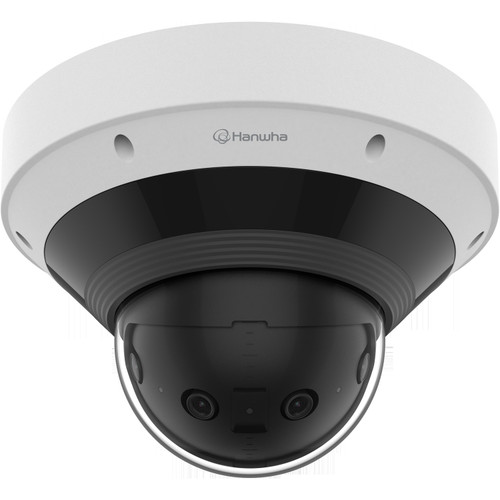
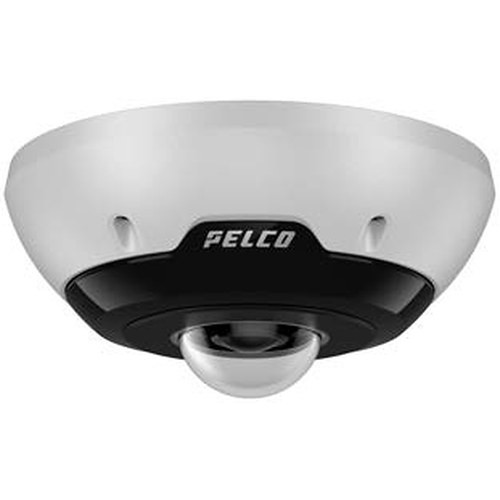
Both the Hanwha PNM-C9022RV and the Pelco SRXF3-8360-ES are 8MP outdoor-rated panoramic IP cameras designed to deliver wide-area situational awareness from a single mounting point. The Hanwha uses four synchronized 2MP sensors stitched into a 209° panoramic dome, while the Pelco uses a single fisheye lens for full 360° coverage. Buyers evaluating wide-area perimeter or lobby coverage will commonly cross-shop these two models on resolution output, IR capability, analytics depth, PoE class, and VMS integration flexibility.
In This Guide
How do the imaging specs compare?
The Hanwha PNM-C9022RV outputs a stitched 5120×1568 (approximately 8MP) panoramic image across four 1/2.8" CMOS sensors, each with a 2.8mm fixed focal length at F2.0, covering 209° horizontal and 60° vertical. It includes built-in WiseIR illuminators rated to 20m (65.6ft) and a minimum illumination of 0.1 lux in color and 0 lux with IR active. WDR is specified at 120dB. The Pelco SRXF3-8360-ES delivers 3264×2448 (approximately 8MP) from a single fisheye sensor using a 2.7mm lens at f/2.5, covering 360°. Minimum illumination is specified at 0.10 lux; no IR illuminator range in meters is stated in the provided specs, and WDR is listed as active up to 83dB.
In practical imaging terms, the Hanwha's 120dB WDR rating exceeds the Pelco's stated 83dB ceiling by a meaningful margin for high-contrast scenes. The Hanwha's built-in IR with a documented 20m range gives it a clear advantage in zero-light environments, while the Pelco's spec sheet does not document a discrete IR throw distance despite listing 'IR; 850nm; Day/Night' in its attributes. The Hanwha's maximum frame rate is 20fps; the Pelco's is 12.5fps at full resolution — a notable difference for motion-sensitive applications. Both cameras carry a max aperture of F2.0/f/2.5 respectively, with the Hanwha's slightly wider aperture marginally favoring low-light collection.
What about installation and environment?
Both cameras are IP66-rated for dust-tight and jet-water resistance, and both carry an IK10 impact rating. The Pelco adds an IP67 rating (temporary immersion), which the Hanwha does not list. Operating temperature ranges are nearly identical: the Hanwha is rated −40°C to +55°C, while the Pelco extends slightly higher to −40°C to +60°C. The Hanwha additionally carries a NEMA 250 Type 4X rating; no equivalent NEMA rating is provided in the Pelco specifications.
Power input differs: the Hanwha PNM-C9022RV requires PoE+ (IEEE 802.3at, Class 4) or 12VDC, with a maximum draw of 24.5W. The Pelco SRXF3-8360-ES is also PoE+ but draws at Class 3, which implies a lower maximum power budget (up to 15.4W under 802.3at Class 3). Installers on switches with per-port Class 3 budgets should confirm Pelco's actual wattage against switch capacity; the Hanwha's 24.5W Class 4 demand requires a switch port with full PoE+ Class 4 headroom. The Hanwha's physical footprint is Ø253×170mm at 2,900g; Pelco dimensions are listed as 153.5×153.5×71.3mm at approximately 1.0kg with wall mount, making the Pelco considerably more compact and lighter.
Which fits your VMS and analytics better?
The Hanwha PNM-C9022RV supports ONVIF Profiles S, G, T, and M, as well as Hanwha's proprietary SUNAPI and Wisenet SDK. Its AI analytics engine supports person and vehicle classification, virtual line (crossing/direction), virtual area (loitering, intrusion, enter/exit), defocus detection, and BestShot. Motion detection supports up to 8 polygonal zones with 8 points each, and privacy masking supports 10 rectangular zones in six colors. The Pelco SRXF3-8360-ES supports ONVIF Profile S and Profile T, with Pelco Smart Analytics covering 8 behaviors; specific behavior names are not enumerated in the provided specifications.
For edge storage, the Hanwha provides dual Micro SD/SDHC/SDXC slots supporting up to 512GB each (1TB total). The Pelco's spec sheet lists microSD storage support but does not specify a capacity ceiling or slot count. The Hanwha supports H.265, H.264 (Main/Baseline/High), and MJPEG compression with WiseStream II/III smart codec; the Pelco's provided specs list H.264 as primary, with H.265 noted in supplemental attributes — no smart codec equivalent is specified. Audio: the Hanwha includes a configurable mic/line input and line output; the Pelco lists 'microphone supported' with no line output stated. Alarm I/O: the Hanwha provides 2 configurable I/O ports; no alarm I/O port count is specified for the Pelco.
Which should you choose: the C9022RV or the SRXF3-8360-ES?
Our take: The PNM-C9022RV is the stronger choice when AI-driven analytics, zero-light IR performance, and deep VMS integration are priorities; the SRXF3-8360-ES is the more appropriate choice when true 360° coverage from a single lens, a smaller physical footprint, and a 5-year warranty are the deciding factors. On measurable spec deltas: the Hanwha's WDR rating of 120dB exceeds the Pelco's 83dB by 37dB — a substantial advantage in high-contrast scenes; the Hanwha's frame rate of 20fps is 60% higher than the Pelco's 12.5fps, relevant for moving-target capture; and the Hanwha offers dual SD slots for up to 1TB on-board storage versus an unspecified capacity on the Pelco. The Pelco counters with a 5-year warranty versus the Hanwha's 3-year, an additional IP67 immersion rating, and a lighter, more compact housing. Platform qualifier: Pelco SRXF3-8360-ES is the natural fit on Pelco VideoXpert or Genetec environments with existing Pelco infrastructure; the Hanwha integrates natively into Wisenet WAVE or any ONVIF Profile M-capable VMS.
Side-by-Side Comparison
Spec-for-spec, from manufacturer data.
| Specification | Hanwha C9022RV | Pelco SRXF3-8360-ES |
|---|---|---|
| Camera Type | Quad-sensor panoramic dome | Single-sensor fisheye dome |
| Max Resolution | 5120×1568 (stitched 8MP) | 3264×2448 (8MP) |
| Field of View | 209° horizontal / 60° vertical | 360° / 180° |
| Image Sensor | 1/2.8" CMOS ×4 | Not specified in provided specs |
| Focal Length / Aperture | 2.8mm fixed ×4 / F2.0 | 2.7mm / f/2.5 |
| Min. Illumination | 0.1 lux color / 0 lux IR | 0.10 lux |
| IR Range | 20m (65.6ft) WiseIR | Not specified (850nm IR noted) |
| Wide Dynamic Range | 120dB | Up to 83dB |
| Max Frame Rate | 20fps | 12.5fps at full resolution |
| Video Compression | H.265 / H.264 / MJPEG | H.264 (H.265 noted in attributes) |
| IP Rating | IP66 / NEMA 4X | IP66 / IP67 |
| Impact Rating | IK10 | IK10 |
| Operating Temperature | −40°C to +55°C | −40°C to +60°C |
| Power Input / PoE Class | PoE+ (802.3at) Class 4 / 12VDC; 24.5W max | PoE+ (802.3at) Class 3 |
| Edge Storage | Dual microSD up to 1TB (512GB×2) | microSD (capacity not specified) |
| Audio | Mic/line in + line out | Microphone supported (line out not specified) |
| Alarm I/O | 2 configurable I/O ports | Not specified in provided specs |
| ONVIF Profiles | S, G, T, M | S, T |
| Dimensions | Ø253×170mm / 2,900g | 153.5×153.5×71.3mm / ~1,001g (with wall mount) |
| Warranty | 3 years | 5 years |
Frequently Asked Questions
Which should you choose: the C9022RV or the SRXF3-8360-ES?
The PNM-C9022RV is the stronger choice when AI-driven analytics, zero-light IR performance, and deep VMS integration are priorities; the SRXF3-8360-ES is the more appropriate choice when true 360° coverage from a single lens, a smaller physical footprint, and a 5-year warranty are the deciding factors. On measurable spec deltas: the Hanwha's WDR rating of 120dB exceeds the Pelco's 83dB by 37dB — a substantial advantage in high-contrast scenes; the Hanwha's frame rate of 20fps is 60% higher than the Pelco's 12.5fps, relevant for moving-target capture; and the Hanwha offers dual SD slots for up to 1TB on-board storage versus an unspecified capacity on the Pelco. The Pelco counters with a 5-year warranty versus the Hanwha's 3-year, an additional IP67 immersion rating, and a lighter, more compact housing. Platform qualifier: Pelco SRXF3-8360-ES is the natural fit on Pelco VideoXpert or Genetec environments with existing Pelco infrastructure; the Hanwha integrates natively into Wisenet WAVE or any ONVIF Profile M-capable VMS.
Is the PNM-C9022RV or the SRXF3-8360-ES better for low-light and zero-light coverage?
Based on provided specifications, the Hanwha PNM-C9022RV has a documented advantage in zero-light conditions: it includes built-in WiseIR illuminators rated to 20m (65.6ft) and a minimum illumination of 0 lux with IR active. The Pelco SRXF3-8360-ES lists a minimum illumination of 0.10 lux and references 850nm IR in its attributes, but no IR throw distance in meters is stated in the provided specifications. If confirmed zero-lux IR range is a requirement, the Hanwha's spec is the only one that explicitly documents it.
Does the SRXF3-8360-ES cover a wider area than the PNM-C9022RV?
By field of view, yes: the Pelco SRXF3-8360-ES delivers a full 360° fisheye panorama from a single lens, covering every horizontal direction with no gap. The Hanwha PNM-C9022RV covers 209° horizontal using four stitched sensors, leaving approximately 151° of horizontal arc uncovered — suitable for wide corridor or perimeter scenes but not full-room 360° coverage. Buyers needing seamless all-around coverage from a ceiling mount should weight the Pelco's geometry accordingly.
Which camera has the longer warranty — the PNM-C9022RV or the SRXF3-8360-ES?
The Pelco SRXF3-8360-ES carries a 5-year warranty per its provided specifications. The Hanwha PNM-C9022RV carries a 3-year warranty. This is a straightforward two-year advantage for the Pelco and may be a meaningful factor in total cost of ownership calculations for large deployments.
Get a Second Opinion on Your Camera Choice
Share your site layout, coverage goals, and budget. Our team will validate the camera selection, flag anything we would change, and recommend products that match the use case.