
Hanwha C9022RV vs Pelco SRXF3-8180-ES: Specification Comparison
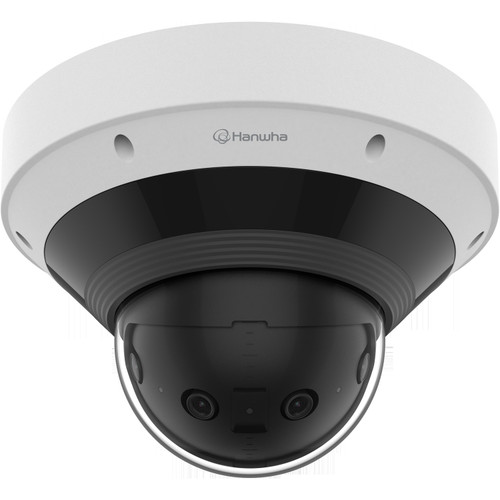
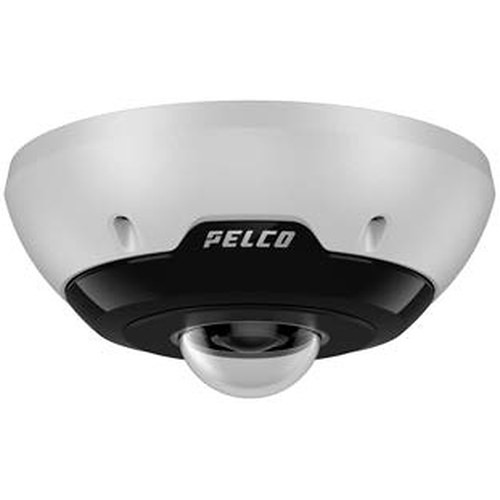
This comparison covers two 8MP fixed outdoor IP cameras designed for wide-area single-camera coverage: the Hanwha PNM-C9022RV, a four-sensor multi-imager panoramic dome delivering 209° horizontal coverage, and the Pelco SRXF3-8180-ES Sarix Fisheye 3, a single-sensor fisheye rated for 180° coverage. Both share outdoor-grade IP66 and IK10 ratings and target applications where installers want maximum scene coverage without PTZ or multiple-camera runs. Buyers comparing these will weigh sensor architecture, frame rate, WDR performance, and VMS integration depth.
In This Guide
How do the imaging specs compare?
The Hanwha PNM-C9022RV uses four discrete 1/2.8" CMOS sensors, each with a 2.8mm f/2.0 fixed lens, producing a composite 5120×1568 panoramic output at up to 20 fps. Its minimum illumination is 0.1 lux color with WiseIR LEDs rated to 20m (65.62ft), dropping to 0 lux in full IR mode. Wide dynamic range is specified at 120dB. The Pelco SRXF3-8180-ES uses a single sensor with a primary specified focal length of 2.7mm f/2.5 (note: the provided spec data also lists 1.4mm in one field — a vendor-side inconsistency; 2.7mm is used here as the series primary value). Primary resolution is 3264×2448 at 12.5 fps full resolution (3840×2160 appears in a secondary field). Minimum illumination is listed at 0.10 lux with 850nm IR LEDs; IR throw distance is not specified in the provided data. WDR is rated up to 83dB.
The Hanwha's 120dB WDR advantage over the Pelco's 83dB is a meaningful 37dB gap for high-contrast lobby, entrance, or loading-dock scenes. The Hanwha's confirmed 20m IR range gives installers a defined coverage number for low-light scene planning; the Pelco's IR throw remains unspecified in the provided data. Frame rate is also materially different: 20 fps on the Hanwha versus 12.5 fps on the Pelco at full resolution, which affects motion clarity on fast-moving subjects. Both cameras share f/2.0-class apertures (Hanwha F2.0, Pelco F2.5), giving the Hanwha a slight light-gathering edge.
What about installation and environment?
Both cameras carry IP66 and IK10 ratings, making them suitable for exposed outdoor installations subject to weather and vandal risk. The Pelco additionally lists IP67 in the provided specs. Operating temperature ranges are nearly identical in the lower bound: both are rated to -40°C. The Hanwha's upper operating limit is +55°C versus the Pelco's +60°C, a minor difference relevant only in extreme heat environments. Storage temperature differs: Hanwha specifies -30°C to +60°C; Pelco specifies -10°C to +70°C.
Power draw separates the two meaningfully. The Hanwha PNM-C9022RV requires PoE+ (802.3at, Class 4) with a 24.5W maximum draw — installers must confirm their switch or midspan ports support Class 4. The Pelco SRXF3-8180-ES is listed as PoE+ (802.3at) but at PoE Class 3, which typically budgets to 15.4W; this lower class may simplify switch selection. Form factor differs substantially: the Hanwha is a large panoramic dome at Ø253×170mm and 2900g; the Pelco is a compact fisheye at 153.5×153.5×71.3mm and approximately 1.0kg with wall mount. The Pelco's smaller footprint and lower weight favor ceiling tile and junction-box installs; the Hanwha's mass requires robust ceiling anchoring. The Pelco spec lists wall, ceiling, pole, pendant, and corner mount options; the Hanwha mount options are not enumerated in the provided data.
Which fits your VMS and analytics better?
ONVIF profile support is broader on the Hanwha: Profile S, G, T, and M are all confirmed. The Pelco supports Profile S and Profile T only — Profile G (edge storage/event) and Profile M (metadata/analytics) are absent from the provided Pelco specs. For VMSes that use Profile G for on-camera recording management or Profile M for standardized analytics metadata, this gap is operationally significant. Both cameras support H.264; the Hanwha explicitly lists H.265 and MJPEG as well. The Pelco spec data includes H.265 in a secondary field but lists H.264 as the primary codec — the inconsistency in the provided data means H.265 support on the Pelco cannot be confirmed with certainty from these specs alone.
Edge storage is dual-slot on the Hanwha (two Micro SD/SDHC/SDXC slots, up to 512GB each, 1TB total), compared to a single microSD slot on the Pelco with no maximum capacity specified in the provided data. On analytics, the Hanwha provides AI-based object detection (person/vehicle classification), virtual line crossing with direction, virtual area loitering/intrusion/enter/exit, and defocus detection. The Pelco lists Pelco Smart Analytics with 8 behaviors, but individual behavior names are not enumerated in the provided specs. Audio: the Hanwha includes a selectable mic-in/line-in input and a line-out output (max 1Vrms); the Pelco lists microphone support but no audio output in the provided data. The Hanwha also specifies 802.1X (EAP-TLS/LEAP/PEAP) and SNMPv3 network security; equivalent Pelco security protocol detail is not provided in the spec data.
Which should you choose: the C9022RV or the SRXF3-8180-ES?
Our take: The PNM-C9022RV is the stronger choice when scene fidelity under variable lighting, dual-redundant edge recording, and deep VMS integration via ONVIF are the primary drivers. Three concrete spec deltas illustrate this: the Hanwha's 120dB WDR outperforms the Pelco's 83dB by 37dB, materially reducing blown highlights in mixed-light entrances; its confirmed 20m IR range gives installers a defined low-light planning number the Pelco spec does not provide; and its 20 fps full-resolution frame rate versus the Pelco's 12.5 fps yields sharper motion capture. The SRXF3-8180-ES has offsetting strengths — a smaller and lighter form factor (1.0kg vs 2.9kg), a broader mount-type menu, IP67 in addition to IP66, a higher upper operating limit (+60°C), a lower PoE class demand (Class 3 vs Class 4), and a two-year longer warranty (5-year vs 3-year). Choose the Pelco where ceiling infrastructure or switch budget constrains power delivery and a compact footprint is non-negotiable.
Side-by-Side Comparison
Spec-for-spec, from manufacturer data.
| Specification | Hanwha C9022RV | Pelco SRXF3-8180-ES |
|---|---|---|
| Resolution | 5120×1568 (max composite); also 3648×1152 / 2560×784 / 1280×392 | 3264×2448 primary (3840×2160 also listed in provided specs — inconsistency noted) |
| Image Sensor | 1/2.8" CMOS × 4 sensors | — |
| Lens / Focal Length | 2.8mm fixed × 4, F2.0 | 2.7mm f/2.5 (1.4mm also listed in provided specs — inconsistency noted) |
| Min Illumination | 0.1 lux color / 0 lux IR | 0.10 lux (day/night with IR) |
| IR Range | 20m (65.62ft) WiseIR | 850nm IR; range not specified in provided data |
| WDR | 120dB | Up to 83dB |
| Max Frame Rate | 20 fps | 12.5 fps at full resolution |
| Video Compression | H.265 / H.264 Main/Baseline/High / MJPEG | H.264 primary (H.265 listed in secondary field — inconsistency noted) |
| IP Rating | IP66 | IP66 / IP67 |
| IK / Impact Rating | IK10 | IK10 |
| Operating Temperature | -40°C to +55°C, 0–95% RH non-condensing | -40°C to +60°C |
| Power / PoE Class | PoE+ IEEE 802.3at Class 4, 12VDC; max 24.5W | PoE+ 802.3at, PoE Class 3 |
| Edge Storage | Dual Micro SD/SDHC/SDXC slots, max 1TB (512GB × 2) | microSD (single slot; max capacity not specified in provided data) |
| Audio | Selectable mic in / line in; line out max 1Vrms | Microphone supported; audio out not specified in provided data |
| Dimensions | Ø253 × 170mm | 153.5 × 153.5 × 71.3mm |
| Weight | 2900g (2.9kg) | ~1.001kg with wall mount (2.21 lb) |
| Warranty | 3-year | 5-year |
Frequently Asked Questions
Which should you choose: the C9022RV or the SRXF3-8180-ES?
The PNM-C9022RV is the stronger choice when scene fidelity under variable lighting, dual-redundant edge recording, and deep VMS integration via ONVIF are the primary drivers. Three concrete spec deltas illustrate this: the Hanwha's 120dB WDR outperforms the Pelco's 83dB by 37dB, materially reducing blown highlights in mixed-light entrances; its confirmed 20m IR range gives installers a defined low-light planning number the Pelco spec does not provide; and its 20 fps full-resolution frame rate versus the Pelco's 12.5 fps yields sharper motion capture. The SRXF3-8180-ES has offsetting strengths — a smaller and lighter form factor (1.0kg vs 2.9kg), a broader mount-type menu, IP67 in addition to IP66, a higher upper operating limit (+60°C), a lower PoE class demand (Class 3 vs Class 4), and a two-year longer warranty (5-year vs 3-year). Choose the Pelco where ceiling infrastructure or switch budget constrains power delivery and a compact footprint is non-negotiable.
Can either camera replace four separate fixed cameras in a parking lot?
The Hanwha PNM-C9022RV is specifically architected for that use case: its four discrete 1/2.8" CMOS sensors composite to a 209° horizontal panorama at 5120×1568 resolution, and each sensor has its own 20m IR LED coverage. The Pelco SRXF3-8180-ES covers 180° via a single fisheye sensor at 3264×2448. Whether either replaces four cameras depends on the lot geometry, required pixel density per foot, and the VMS's dewarping capability, but the Hanwha's multi-sensor architecture is purpose-built for wide-area replacement scenarios.
My switch only has 802.3at PoE+ ports at 15.4W budgeted — will the Pelco or Hanwha work?
The Pelco SRXF3-8180-ES is listed as PoE Class 3, which negotiates within the 15.4W 802.3at budget and should work on those ports. The Hanwha PNM-C9022RV is PoE+ Class 4 with a 24.5W maximum draw; Class 4 requires the switch to allocate up to 30W per port under 802.3at. If your switch caps port delivery at 15.4W, the Hanwha will not receive sufficient power and should instead be powered via its 12VDC input.
The Pelco spec sheet lists two different focal lengths and two different resolutions — which numbers are correct?
The provided Pelco SRXF3-8180-ES spec data contains acknowledged inconsistencies: focal length appears as both 2.7mm and 1.4mm, and resolution appears as both 3264×2448 and 3840×2160 across different fields. This comparison uses the Sarix Fisheye 3 series primary values — 2.7mm focal length and 3264×2448 maximum resolution — as the more conservative and consistently listed figures. For binding specifications, consult the official Pelco product datasheet or your Pelco sales representative before quoting or ordering.
Get a Second Opinion on Your Camera Choice
Share your site layout, coverage goals, and budget. Our team will validate the camera selection, flag anything we would change, and recommend products that match the use case.