
Hanwha C9022RV vs Pelco SRXF3-8180-ERS: Specification Comparison
Both the Hanwha PNM-C9022RV and the Pelco SRXF3-8180-ERS are fixed-lens, outdoor-rated 8MP IP cameras designed for wide-area panoramic coverage without pan/tilt/zoom mechanics. Buyers evaluating either unit are typically seeking a single-camera solution to cover a broad horizontal arc — an entrance, lobby, parking perimeter, or open floor — without deploying multiple fixed-angle cameras. This comparison examines how their imaging architectures, physical installation requirements, and integration profiles differ so installers and IT buyers can match the right unit to their deployment scenario.
In This Guide
How do the imaging specs compare?
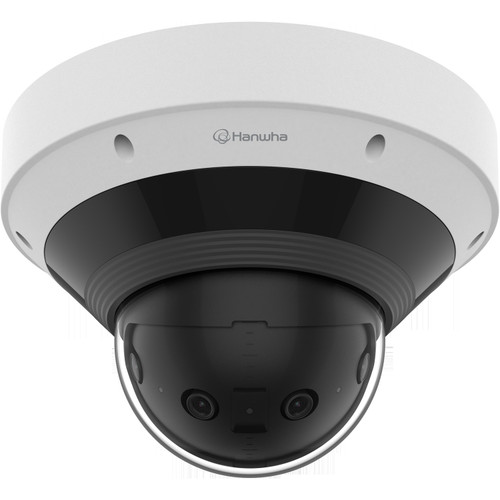
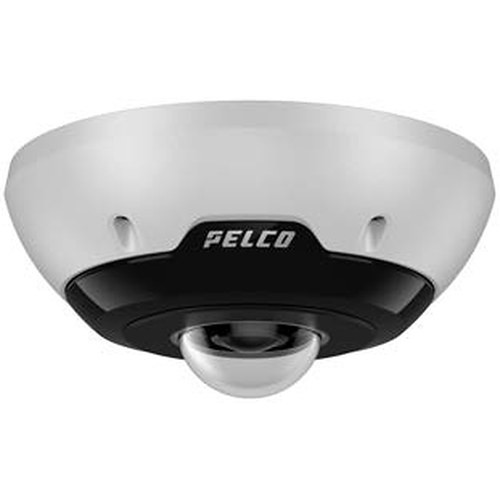
The Hanwha PNM-C9022RV uses four discrete 1/2.8" CMOS sensors, each with a fixed 2.8mm F2.0 lens, stitched together to produce a 209° horizontal by 60° vertical field of view at a maximum stitched resolution of 5120×1568. The Pelco SRXF3-8180-ERS uses a single-sensor fisheye approach with a 2.7mm f/2.5 lens, capturing a 180° hemisphere at a maximum resolution of 3264×2448. The Hanwha's stitched output provides a rectilinear panoramic strip well-suited to corridor and perimeter scenes, while the Pelco's fisheye delivers a hemispherical image that requires de-warping software for usable PTZ-style virtual views.
On frame rate, the Hanwha PNM-C9022RV is specified at 20fps at full stitched resolution, while the Pelco SRXF3-8180-ERS is specified at 12.5fps at full resolution — a meaningful gap for scenes with moving subjects. For low light, the Hanwha lists a minimum illumination of 0.1 lux in color mode and 0 lux with its WiseIR active, with an IR range of 20m (65.6ft). The Pelco specifies integrated 850nm IR illumination covering its 180° field, but its minimum illumination lux figure and IR throw distance are not stated in the provided specifications. The Hanwha's WDR is rated at 120dB; the Pelco lists WDR support but a numeric dB rating is not provided in the supplied specs, with one supplementary field indicating 'Off Upto83dB,' though this appears to be a formatting artifact rather than a confirmed rated spec.
What about installation and environment?
Both cameras carry IP66 and IK10 ratings, making them equivalently rated for outdoor dust ingress, water jet resistance, and vandal resistance. The Pelco SRXF3-8180-ERS additionally lists NEMA 4X certification, which the Hanwha PNM-C9022RV does not — the Hanwha lists NEMA 250 Type 4X, which is functionally similar but a different standard citation. On operating temperature, the Hanwha is rated -40°C to +55°C, while the Pelco is rated -40°C to +60°C, giving the Pelco a 5°C higher upper operating limit. Storage temperature is -30°C to +60°C for the Hanwha; the Pelco's storage temperature is listed as -10°C to +70°C in a supplementary field, though this appears in an irregularly formatted entry and should be verified against the product datasheet before specification.
Power differs: the Hanwha PNM-C9022RV requires PoE+ (IEEE 802.3at, Class 4) or 12VDC and draws up to 24.5W, reflecting its four-sensor architecture. The Pelco SRXF3-8180-ERS is PoE+ (802.3at) Class 3, which draws a maximum of 15.4W — an important distinction when budgeting switch port capacity or midspan injector loads. The Hanwha's physical footprint is Ø253×170mm and 2900g; the Pelco is listed as 6"×6"×2.81" with a weight of approximately 1.001kg (2.21lb) including wall mount, making the Pelco notably lighter and more compact. The Hanwha supports 3/4" conduit and standard US gangboxes; the Pelco lists wall, ceiling, pole, pendant, and corner mounting options, though specific conduit compatibility is not stated in the provided specs.
Which fits your VMS and analytics better?
The Hanwha PNM-C9022RV supports ONVIF Profile S, G, T, and M, as well as Hanwha's proprietary SUNAPI and Wisenet SDK. Its AI-based analytics include person and vehicle object detection, virtual line crossing with direction, and virtual area events (loitering, intrusion, enter, exit), plus defocus detection — all running on-device via an AI engine. It supports up to 8 polygonal motion detection zones and 10 privacy mask zones. Audio is bidirectional: mic/line-in selectable at 2.5VDC with 2KΩ impedance, and a line-out at max 1Vrms. Edge storage is dual micro SD/SDHC/SDXC slots supporting up to 1TB (512GB per slot).
The Pelco SRXF3-8180-ERS supports ONVIF Profile S and Profile T — notably not Profile G or M as listed for the Hanwha. Pelco lists 'Smart Analytics' with 8 configurable behaviors, but specific behavior types (e.g., line crossing, loitering, object classification) are not enumerated in the provided specifications. Audio is noted as 'microphone supported' without further detail on line-in, output, or impedance. Edge storage support (microSD) is listed as a feature but capacity limits and slot count are not specified. The Pelco's compression is listed in a supplementary field as both H.265 and H.264, though the primary spec block lists only H.264 — buyers should confirm H.265 support against the manufacturer datasheet before specifying.
Which should you choose: the C9022RV or the SRXF3-8180-ERS?
Our take: The PNM-C9022RV is the stronger choice when maximum frame rate, documented AI analytics, and dual-slot edge storage are priorities. Its quad-sensor architecture delivers 20fps versus the SRXF3-8180-ERS's 12.5fps, covers a wider 209° arc versus 180°, and carries a documented IR range of 20m with a 0-lux minimum illumination rating — figures the Pelco does not provide in the supplied specs. The Hanwha also offers ONVIF Profile G and M support alongside S and T, adding recording and metadata profile compatibility the Pelco does not list. Conversely, the SRXF3-8180-ERS is lighter (~1kg vs 2.9kg), draws less PoE power (Class 3 vs Class 4), has a higher rated upper operating temperature (+60°C vs +55°C), carries a 5-year warranty versus the Hanwha's 3-year, and adds NEMA 4X certification explicitly. It is the better fit for weight-sensitive mounts, constrained PoE budgets, or sites requiring a longer warranty without extended service contract.
Side-by-Side Comparison
Spec-for-spec, from manufacturer data.
| Specification | Hanwha C9022RV | Pelco SRXF3-8180-ERS |
|---|---|---|
| Camera Type | Multi-sensor panoramic dome (quad 2MP) | Fisheye (single sensor) |
| Max Resolution | 5120×1568 (stitched) | 3264×2448 |
| Image Sensor | 1/2.8" CMOS ×4 | Not specified in provided specs |
| Lens / Focal Length | 2.8mm fixed F2.0 ×4 | 2.7mm f/2.5 |
| Horizontal Field of View | 209° | 180° (360° mode also listed) |
| Max Frame Rate | 20fps | 12.5fps at full resolution |
| Min. Illumination | 0.1 lux color / 0 lux IR | Not specified in provided specs |
| IR Range | 20m (65.6ft) WiseIR | Integrated 850nm IR; range not specified |
| Wide Dynamic Range | 120dB | WDR supported; dB rating not specified |
| Video Compression | H.265, H.264, MJPEG | H.264 (H.265 listed in supplementary field — verify) |
| IP Rating | IP66 | IP66, NEMA 4X |
| IK / Impact Rating | IK10 | IK10 |
| Operating Temperature | -40°C to +55°C | -40°C to +60°C |
| Power Input / PoE Class | PoE+ Class 4 or 12VDC; max 24.5W | PoE+ Class 3 |
| ONVIF Profiles | Profile S, G, T, M | Profile S, T |
| Edge Storage | Dual microSD/SDHC/SDXC up to 1TB (512GB ×2) | microSD supported; capacity not specified |
| Audio | Mic/line-in + line-out (bidirectional) | Microphone supported; output not specified |
| Dimensions | Ø253×170mm (9.96"×6.69") | 6"×6"×2.81" |
| Weight | 2900g (6.39lb) | ~1001g (2.21lb) with wall mount |
| Warranty | 3 years | 5 years |
Frequently Asked Questions
Which should you choose: the C9022RV or the SRXF3-8180-ERS?
The PNM-C9022RV is the stronger choice when maximum frame rate, documented AI analytics, and dual-slot edge storage are priorities. Its quad-sensor architecture delivers 20fps versus the SRXF3-8180-ERS's 12.5fps, covers a wider 209° arc versus 180°, and carries a documented IR range of 20m with a 0-lux minimum illumination rating — figures the Pelco does not provide in the supplied specs. The Hanwha also offers ONVIF Profile G and M support alongside S and T, adding recording and metadata profile compatibility the Pelco does not list. Conversely, the SRXF3-8180-ERS is lighter (~1kg vs 2.9kg), draws less PoE power (Class 3 vs Class 4), has a higher rated upper operating temperature (+60°C vs +55°C), carries a 5-year warranty versus the Hanwha's 3-year, and adds NEMA 4X certification explicitly. It is the better fit for weight-sensitive mounts, constrained PoE budgets, or sites requiring a longer warranty without extended service contract.
Is the PNM-C9022RV or the SRXF3-8180-ERS better for low-light performance?
Based on the provided specifications, the Hanwha PNM-C9022RV has a documented advantage: it lists a minimum illumination of 0.1 lux in color mode and 0 lux with IR active, plus a stated IR range of 20m (65.6ft). The Pelco SRXF3-8180-ERS lists integrated 850nm IR illumination covering its 180° field, but neither a minimum illumination lux figure nor an IR throw distance are provided in the specs supplied for this comparison. Buyers requiring verified low-light numbers for the Pelco should request the manufacturer's datasheet.
Which camera puts less load on my PoE switch — the PNM-C9022RV or the SRXF3-8180-ERS?
The Pelco SRXF3-8180-ERS draws less power: it is PoE+ Class 3, which caps at 15.4W under IEEE 802.3at. The Hanwha PNM-C9022RV is PoE+ Class 4, with a stated maximum draw of 24.5W. If you are deploying multiple cameras off a switch with per-port or total power budgets, the Pelco's lower power class gives more headroom per port. The Hanwha also accepts 12VDC as an alternative power source if PoE budget is a concern.
Does the SRXF3-8180-ERS support the same ONVIF profiles as the PNM-C9022RV?
No. The Hanwha PNM-C9022RV lists ONVIF Profile S, G, T, and M. The Pelco SRXF3-8180-ERS lists ONVIF Profile S and Profile T only — Profile G (recording) and Profile M (metadata/analytics) are not listed in the provided specifications. If your VMS relies on Profile G for ONVIF-native recording control or Profile M for standardized metadata from analytics, verify Pelco's current ONVIF conformance documentation before specifying the SRXF3-8180-ERS.
Get a Second Opinion on Your Camera Choice
Share your site layout, coverage goals, and budget. Our team will validate the camera selection, flag anything we would change, and recommend products that match the use case.