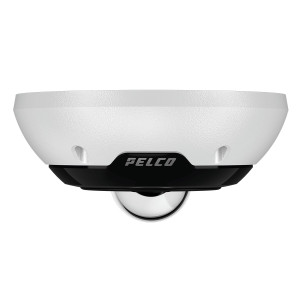
Pelco SRXF3-8180-ERS Sarix Fisheye 3 8MP 180° IR Camera
The Pelco SRXF3-8180-ERS is a fixed fisheye camera designed for perimeter and entrance surveillance where panoramic coverage matters more than per-pixel detail. The 8MP sensor captures a full 180° horizontal field of view with integrated infrared illumination, eliminating the need for external lighting on building facades, canopies, parking areas, and entry points. This approach trades identification-distance for coverage breadth—useful when you need to see what's happening across an entire wall or entrance zone from a single mounting location, not zoom in on a specific face.
Key Features
- 8MP resolution (3264 x 2448 pixel output): Enough density to review events across the full panoramic frame, but expect soft detail at distance. De-warping software recalculates the fisheye image into rectilinear, virtual PTZ, or multi-pane views—useful for extracting actionable alerts from the raw distorted feed.
- 180° field of view with 2.7mm f/2.5 lens: Covers a hemisphere without blind spots. Integrated IR illumination (850nm) extends full-frame night vision across the entire panorama, so outdoor perimeter work doesn't require separate floodlights.
- PoE+ power (Class 3): Draws Class 3 wattage, meaning you can run it from a standard 802.3at switch without negotiation or branch power supplies. Simplifies installation on existing network infrastructure.
- H.264 compression: Mature, widely supported standard. Stores efficiently on 24/7 recorders. MJPEG and proprietary codecs would be more efficient, but H.264 is the safe choice for multi-vendor VMS compatibility.
- Pelco Smart Analytics with 8 configurable behaviors: On-camera detection for intrusion, loitering, or crossing events fires alerts without requiring a separate analytics license. The analytics run across the full panoramic view simultaneously, though accuracy depends on object size within the 180° frame.
- IP66/IP67 ingress protection and IK10 impact rating: Rain, dust, and direct spray won't penetrate. IK10 means it can withstand a 20 joule impact—effectively vandal-resistant for wall-mounted entrance scenarios. Running temperature range −40°C to +60°C handles harsh outdoor climates.
- ONVIF Profile S and Profile T: Guarantees integration with any third-party VMS that claims ONVIF compliance (Milestone, Genetec, Pelco Sarix, etc.). No vendor lock-in.
- microSD card support: Adds local failover storage on the camera itself. Useful for continuous backup during network outages, though microSD is slower than dedicated NVR channels.
- 5-year warranty: Aligns with typical industrial surveillance lifecycle; worth factoring into TCO against cheaper consumer-grade alternatives.
Integration and Compatibility
The SRXF3-8180-ERS integrates as a standard ONVIF Profile S/T device into any VMS that supports panoramic or fisheye views. Many commercial platforms (Milestone XProtect, Genetec Security Center, Pelco Sarix) include de-warping plugins to convert the fisheye stream into rectilinear or virtual PTZ format. If your VMS lacks native de-warping, Pelco supplies software tools to post-process video offline—a minor workflow burden, but one to verify with your integrator before deployment. The camera supports simultaneous H.264 streams at multiple resolutions and frame rates, so you can send full-frame 12.5 fps to the NVR while streaming a lower-bandwidth sub-stream to mobile apps or remote monitoring without duplicating infrastructure.
When to Choose a Different Model
If facial recognition or long-range identification is critical, a narrower lens or higher-megapixel fixed camera is a better fit—180° coverage guarantees soft detail. If you need interior coverage without IR (lower cost, simpler power budget), the SRXF3-8180-ES (non-IR variant) is available. For full 360° panoramic surveillance with integrated IR, step up to the SRXF3-8360-ERS. If you require true 24/7 indoor day/night operation without IR spillover concerns, a standard recessed dome with integrated IR is often cleaner.
Frequently Asked Questions
Q: What frame rate does the SRXF3-8180-ERS support at full 8MP resolution?
A: The camera captures 12.5 fps at full 3264 x 2448 resolution. This is suitable for event review and forensic playback but slower than typical 30 fps streams from standard fixed cameras. For real-time monitoring, many deployments pair the NVR with a lower-resolution sub-stream at 30 fps.
Q: Does the integrated IR illuminate the full 180° field uniformly?
A: IR coverage spans the entire 180° panorama, but intensity varies with distance and angle. Corners and edges will receive less illumination than the center. Always verify night-vision range and coverage in your specific installation geometry.
Q: Can I use the SRXF3-8180-ERS with a VMS that doesn't support ONVIF fisheye de-warping?
A: Yes. The camera streams standard H.264 video that any ONVIF or RTSP-capable VMS will accept. However, you'll see the raw distorted fisheye image in playback. De-warping to rectilinear or virtual PTZ requires either VMS-native support or offline processing with Pelco's software tools.
Q: What's the maximum PoE+ wattage the SRXF3-8180-ERS draws?
A: The camera is rated for Class 3 PoE power (approximately 15.4W maximum). This is well within 802.3at PoE+ budgets and won't require high-power or PoE++ switches for single-camera installations.
Q: Is the SRXF3-8180-ERS NDAA Section 889 compliant?
A: Compliance certification is not stated in available product documentation. If NDAA compliance is a hard requirement, contact the manufacturer or your integrator for a formal attestation.
Q: Does the camera support simultaneous H.264 and H.265 streams?
A: The SRXF3-8180-ERS supports H.264 compression. H.265 support is not listed in the product specifications.
Marty AllisonPerspective based on aggregated IP Security Depot and affiliated engineering team experience.
The SRXF3-8180-ERS is a pragmatic panoramic play for building facades and entrance canopies where you need to know "what happened across this wall" rather than "who was this person." The 8MP sensor and 180° field mean you're distributing resolution across a hemisphere—useful for event overview and coverage continuity, less useful for identification work. The integrated IR (850nm) eliminates the exterior lighting rig, which saves money and complexity but adds a subtle gotcha: IR coverage and beam angle don't follow rectilinear optics the way traditional dome cameras do. Corner illumination will soften noticeably compared to the center frame.
Technical Highlights:
- 12.5 fps at full 8MP: Acceptable for perimeter overview and event review, not real-time action. If you need 30 fps panoramic streaming, you'll be stepping down resolution or accepting lower frame rates at the full 3264 x 2448 output.
- Class 3 PoE+ (≈15.4W typical): Runs cleanly off standard 802.3at switches without negotiation. Paired with microSD failover, this is a solid edge-compute topology for remote sites where NVR traffic is intermittent.
- ONVIF Profile S/T + Pelco Smart Analytics: The camera fires intrusion, loitering, and crossing alerts across the full 180° panorama without needing a separate analytics appliance. Accuracy degrades with object size—a person at the edge of the 180° frame is much smaller than one directly in front, so tune thresholds carefully during commissioning.
- IK10 + IP67: Built for vandalism-resistant mounting on external walls. The full temperature range (−40°C to +60°C) is critical for northern climates where infrared LEDs degrade and lens fogging becomes a real problem. Verify humidity control and lens design if you're deploying in high-condensation zones.
Deployment Considerations:
- Fisheye de-warping introduces latency and processing overhead on the VMS. If your platform doesn't have native fisheye support, plan for offline or client-side de-warping, which breaks real-time alerting workflows.
- 180° coverage with integrated IR creates a "coverage vs. detail" tradeoff. If forensic identification is even a secondary goal, this camera will disappoint. Pair it with a narrow-angle fixed or varifocal unit covering the entrance zone directly if identification is a requirement.
- Mounting angle is critical. A 180° fisheye mounted perpendicular to a wall sees the wall dead-on and wastes half the frame on blind areas. Tilt it slightly (20–30° down) to maximize useful panorama, but confirm sight lines with the systems integrator before installation.
This is your camera for building perimeter overview, warehouse-bay entrance surveillance, or parking-area situational awareness where you prioritize "what happened" over "who did it." Pair it with narrower-angle cameras at entrances and checkpoints if identification matters.
Key Specifications:
Field of View: 180 degrees; 360 degrees
Color: White