
Hanwha ARD-410 vs Speco Technologies D4WVN6TB: Specification Comparison
Both the Hanwha ARD-410 and Speco D4WVN6TB are 4-channel hybrid DVR/pentabrid recorders targeting integrators who need to mix legacy analog cameras with modern IP inputs in a single compact unit. Each ships with 6TB storage and supports H.265/H.264 compression with ONVIF compatibility. The comparison evaluates recording capability and channel flexibility, physical form factor and operating environment, and network integration and management ecosystem — the three axes most relevant to a security integrator selecting a 4-channel DVR for a retrofit or greenfield small-site deployment.
In This Guide
- Which recorder delivers greater channel flexibility and recording performance?
- How do physical design, environmental ratings, and installation constraints differ?
- Which unit offers stronger network integration, compliance, and remote management capabilities?
- Which should you choose: the ARD-410 or the D4WVN6TB?
- Side-by-Side Specs
- FAQ
Which recorder delivers greater channel flexibility and recording performance?
The ARD-410 is a pentabrid unit supporting AHD, TVI, CVI, CVBS, and IP signals across its 4 analog BNC inputs, and it can expand to a maximum of 6 total channels by adding 2 additional IP cameras. Analog recording tops out at 5MP@12fps or 4MP/2MP@15fps per channel, with a maximum recording bandwidth of 30Mbps. The unit supports simultaneous 6-channel playback locally and via CMS.
The D4WVN6TB is specified as a 4-channel 4K TVI DVR. Its specifications confirm H.265 and H.264 compression and ONVIF support, but the provided spec sheet does not state a maximum recording bandwidth, per-channel frame rate ceiling, or whether IP channel expansion is supported. The 4K TVI designation indicates a maximum analog input resolution higher than the ARD-410's 5MP, though no numeric frame rate at 4K is provided.
The ARD-410 offers documented channel expansion (4+2 IP), explicit frame rate specs per resolution tier, and a stated 30Mbps bandwidth ceiling. The D4WVN6TB's recording performance beyond its 4K TVI label is not quantified in the provided specifications.
How do physical design, environmental ratings, and installation constraints differ?
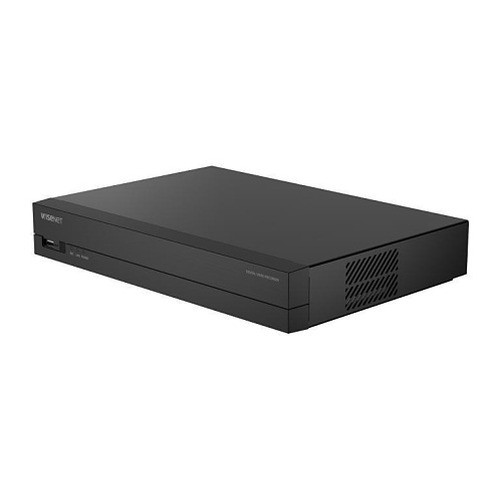
The ARD-410 measures 300 x 47 x 208.7mm and weighs approximately 1.1kg without HDD. It supports wall and rack mounting. Operating temperature is rated 0°C to +40°C with 20–85% RH humidity tolerance. No IP or IK rating is specified. Power input is DC 12V with a maximum draw of 19.2W (with a 6TB HDD installed). The enclosure is black metal with a white housing color noted.
The D4WVN6TB is physically larger at 17.5 x 15.5 x 4.8 inches (approximately 444 x 394 x 122mm) and heavier at 8.0 lbs (approximately 3.6kg). It carries an IP67 ingress protection rating and an IK10 impact resistance rating — specifications the ARD-410 entirely lacks. The D4WVN6TB is also listed with PoE+ (802.3at) support and a broader mount-type list including ceiling, pole, pendant, corner, and rack in addition to wall.
For installations in harsh, wet, or impact-prone environments, the D4WVN6TB's IP67/IK10 ratings are a decisive advantage. For compact rack or wall installations in conditioned IT closets, the ARD-410's smaller footprint and lower weight are practical benefits. Power consumption data is not provided for the D4WVN6TB.
Which unit offers stronger network integration, compliance, and remote management capabilities?
The ARD-410 documents an extensive protocol stack: TCP/IP, UDP/IP, RTP (UDP/TCP), RTSP, NTP, HTTP, DHCP, PPPoE, SMTP, ICMP, IGMP, ARP, DNS, DDNS (Wisenet), uPnP, HTTPS, SNMP, ONVIF Profile-S, and SUNAPI. Remote access supports up to 10 live unicast users and 20 multicast users simultaneously. Security features include IP address filtering, 802.1x authentication, encryption of ID/PW, recording, transmission, and backup, plus a Hanwha Techwin Root CA device certificate. It integrates with Wisenet Viewer, a mobile app (iOS/Android), and supports PTZ control via GUI, web, and mobile. Certifications listed are UL, CE, FCC, and KC.
The D4WVN6TB lists ONVIF support, two-way audio with a built-in microphone, and analytics capability. Critically, it holds TAA and NDAA compliance certification — a mandatory procurement requirement for U.S. federal, state, and many municipal government projects. The ARD-410 does not list TAA or NDAA compliance in the provided specifications. The D4WVN6TB's network protocol stack, remote user limits, and VMS compatibility details beyond '4K TVI' are not specified in the provided data.
For government and federally funded deployments, the D4WVN6TB's NDAA certification is a non-negotiable differentiator. For commercial integrators needing deep protocol support, granular remote-user control, and a full ecosystem (SUNAPI, Wisenet DDNS, ARB redundancy), the ARD-410 provides substantially more documented capability.
Which should you choose: the ARD-410 or the D4WVN6TB?
Our take: The ARD-410 is the stronger choice when the deployment priority is documented multi-signal flexibility, rich remote management, and deep ecosystem integration on a compact, low-power platform. It supports five analog signal types plus 2 additional IP channels (6 total vs. the D4WVN6TB's stated 4), publishes explicit per-resolution frame rates (5MP@12fps, 4MP@15fps), caps bandwidth at 30Mbps, and documents a full protocol stack with 802.1x security and SNMP. The D4WVN6TB is the stronger choice for harsh-environment or government installations: its IP67 and IK10 ratings are entirely absent from the ARD-410's spec sheet, and its TAA/NDAA certification makes it eligible for federal procurement where the ARD-410 is not. Buyers also gain PoE+ (802.3at) output and a built-in microphone on the Speco unit. Choose the ARD-410 for commercial retrofit sites requiring multi-format analog migration; choose the D4WVN6TB for outdoor-adjacent, impact-prone, or government-regulated environments.
Side-by-Side Comparison
Spec-for-spec, from manufacturer data.
| Specification | Hanwha ARD-410 | Speco Technologies D4WVN6TB |
|---|---|---|
| Analog Input Channels | 4CH BNC (AHD/TVI/CVI/CVBS) | 4CH TVI |
| Max Total Channels (with IP) | 6CH (4 analog + 2 IP) | — |
| Max Analog Resolution | 5MP | 4K TVI |
| IP Camera Protocol | ONVIF Profile-S, SUNAPI | ONVIF |
| Max Recording Bandwidth | 30Mbps | — |
| Compression | H.265, H.264, MJPEG | H.265, H.264 |
| Included Storage | Up to 6TB (1x SATA) | 6TB |
| HDD Slots | 1x SATA (max 6TB) | — |
| Local Display Output | 1x HDMI, 1x VGA (up to 4K) | — |
| Audio | 1x Line In / 1x Line Out, 2-Way | Two-way; Built-in mic |
| PoE Output | — | PoE+ (802.3at) |
| IP / IK Rating | — | IP67 / IK10 |
| NDAA / TAA Certified | — | Yes (both) |
| Certifications | UL, CE, FCC, KC | NDAA |
| Dimensions (WxHxD) | 300 x 47 x 208.7mm | 444 x 394 x 122mm (17.5 x 15.5 x 4.8 in) |
| Weight | ~1.1kg (2.4 lb, no HDD) | ~3.6kg (8.0 lb) |
| Max Power | 19.2W (with 6TB HDD) | — |
| Operating Temperature | 0°C to +40°C | — |
| Warranty | — | 3 years |
Frequently Asked Questions
Which should you choose: the ARD-410 or the D4WVN6TB?
The ARD-410 is the stronger choice when the deployment priority is documented multi-signal flexibility, rich remote management, and deep ecosystem integration on a compact, low-power platform. It supports five analog signal types plus 2 additional IP channels (6 total vs. the D4WVN6TB's stated 4), publishes explicit per-resolution frame rates (5MP@12fps, 4MP@15fps), caps bandwidth at 30Mbps, and documents a full protocol stack with 802.1x security and SNMP. The D4WVN6TB is the stronger choice for harsh-environment or government installations: its IP67 and IK10 ratings are entirely absent from the ARD-410's spec sheet, and its TAA/NDAA certification makes it eligible for federal procurement where the ARD-410 is not. Buyers also gain PoE+ (802.3at) output and a built-in microphone on the Speco unit. Choose the ARD-410 for commercial retrofit sites requiring multi-format analog migration; choose the D4WVN6TB for outdoor-adjacent, impact-prone, or government-regulated environments.
Can either recorder mix old analog cameras with newer IP cameras on the same unit?
Yes, the ARD-410 explicitly supports this: it accepts 4 analog channels (AHD, TVI, CVI, or CVBS) plus up to 2 additional IP cameras for a maximum of 6 channels total. The D4WVN6TB is specified as a 4-channel 4K TVI DVR with ONVIF support, but its provided specifications do not document IP channel expansion capability. If mixed analog-plus-IP flexibility is a requirement, the ARD-410's spec sheet provides the clearer, documented answer.
Is either unit approved for government or federally funded security projects?
The D4WVN6TB is listed as both TAA and NDAA certified in its specifications, making it eligible for U.S. federal, GSA, and many state and local government procurements that mandate NDAA Section 889 compliance. The ARD-410's provided specifications do not list TAA or NDAA compliance. For any government-funded deployment with NDAA requirements, the D4WVN6TB is the appropriate choice based on the available spec data.
Which unit is better suited to outdoor or harsh-environment cabinet installations?
The D4WVN6TB carries an IP67 ingress protection rating (dust-tight, immersion-resistant) and an IK10 impact resistance rating. Neither IP nor IK ratings appear anywhere in the ARD-410's specifications. If the recorder will be installed in an outdoor enclosure, a location exposed to moisture or dust, or an area subject to physical impact, the D4WVN6TB's documented environmental ratings make it the appropriate selection. The ARD-410 is rated for 0°C–40°C and 20–85% RH but lacks any IP or IK certification per its provided spec sheet.
Get a Second Opinion on Your Camera Choice
Share your site layout, coverage goals, and budget. Our team will validate the camera selection, flag anything we would change, and recommend products that match the use case.