
Hanwha ARD-410 vs QNAP VS-2204-PRO: Specification Comparison
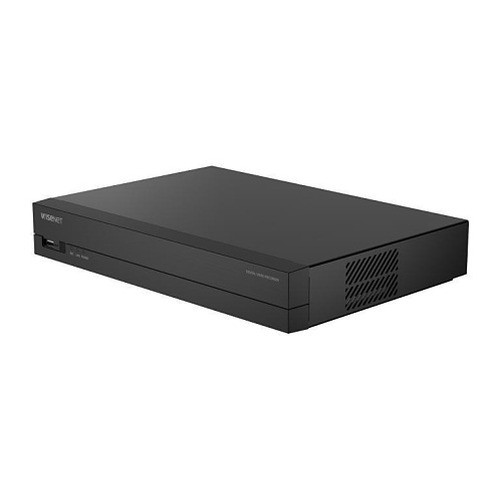
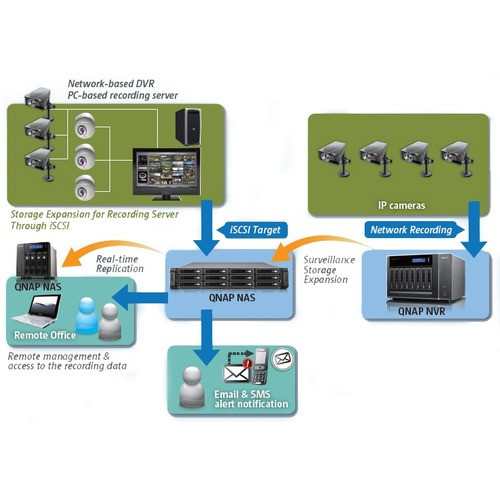
This comparison evaluates two 4-channel standalone video recorders aimed at small commercial and SMB surveillance deployments: the Hanwha ARD-410, a pentabrid hybrid DVR supporting AHD, TVI, CVI, CVBS analog coaxial inputs plus up to 6 IP channels, and the QNAP VS-2204-PRO+, a pure IP NVR built on a dual-core Intel Atom platform with two hot-swappable SATA bays. Both target 4-channel installations but differ fundamentally in camera compatibility, storage architecture, and processing approach.
In This Guide
What camera types and resolutions does each recorder support?
The ARD-410 accepts 4 analog coaxial channels (BNC, 1Vp-p 75Ω) carrying AHD, TVI, CVI, or CVBS signals, plus up to 2 additional IP channels (expandable to a maximum of 6 total channels). Analog recording tops out at 5MP@12fps, 4MP@15fps, or 2MP@15fps. IP camera resolution spans 5MP down to CIF. Compression includes H.265, H.264, and MJPEG.
The VS-2204-PRO+ accepts only IP network cameras — there are no analog coaxial inputs. It supports up to 4 IP channels and records up to 8-megapixel resolution. Compression covers H.264, MPEG-4, M-JPEG, and MxPEG. Recording performance is rated at up to 30fps at D1 or VGA resolution — no per-channel megapixel frame-rate breakdown is specified in the provided specs.
A site running existing analog coaxial cameras (AHD/TVI/CVI/CVBS) can only use the ARD-410. A site committed to IP cameras exclusively can use either, though the VS-2204-PRO+ declares up to 8MP capture while the ARD-410 tops out at 5MP on both analog and IP channels. The ARD-410 also supports H.265 compression; H.265 is not listed in the VS-2204-PRO+ specifications.
How does each unit handle local storage capacity and drive redundancy?
The ARD-410 provides a single internal SATA HDD bay with an explicit 6TB maximum. There is no hot-swap capability and no redundant storage option specified. Total recording bandwidth is capped at 30Mbps. Backup exports to USB in BU, EXE (with embedded player), and AVI formats.
The VS-2204-PRO+ provides two 3.5"/2.5" SATA II/SSD bays, both hot-swappable and lockable. Maximum raw capacity is not capped in the provided specifications and depends on drives installed. Power supply output is 60W; rated power consumption is 25W versus the ARD-410's 19.2W maximum (with a 6TB HDD installed).
For storage resilience the VS-2204-PRO+ has a structural advantage with two hot-swappable bays — drives can be replaced without powering down — versus the ARD-410's single fixed bay. The ARD-410's 6TB ceiling is explicit in its specs; the VS-2204-PRO+'s ceiling is drive-dependent and not stated. RAID configuration options for the VS-2204-PRO+ are not documented in the provided specifications.
What are the remote access, multi-user, and network integration capabilities of each unit?
The ARD-410 carries a single 10/100BASE-T RJ-45 port and supports TCP/IP, UDP/IP, RTP, RTSP, NTP, HTTP, DHCP, PPPoE, SMTP, IGMP, ARP, DNS, DDNS, HTTPS, SNMP, ONVIF Profile-S, and Wisenet SUNAPI. Concurrent remote user limits are explicitly stated: Search 3, Live Unicast 10, Multicast 20. Security features include IP address filtering, 802.1x authentication, and encryption of ID/PW, recordings, transmissions, and backups, backed by Hanwha Techwin Root CA device certificates. Mobile apps (iOS and Android) support live 6-channel and playback 4-channel at 2MP max.
The VS-2204-PRO+ provides 2 x Gigabit RJ-45 Ethernet ports. Remote monitoring display modes extend to 42-channel views, and multi-server aggregation reaches 128 channels. Specific concurrent remote user limits, supported protocols, and security feature details are not provided in the supplied specifications.
The ARD-410 documents concrete concurrency limits and a detailed security framework including 802.1x and encryption. The VS-2204-PRO+ offers dual Gigabit NICs and broader multi-server aggregation (128 channels) but its per-connection limits and security posture cannot be assessed from the provided specs alone.
Which should you choose: the ARD-410 or the VS-2204-PRO?
Our take: The ARD-410 is the stronger choice when the installation includes existing analog coaxial cameras (AHD/TVI/CVI/CVBS) or when a documented, layered cybersecurity framework — 802.1x, encryption at rest and in transit, device certificates — is required, while the VS-2204-PRO+ is preferable for pure-IP deployments that need dual hot-swappable storage bays and dual Gigabit NICs. Three concrete spec deltas: (1) storage — the VS-2204-PRO+ has 2 hot-swappable SATA bays with no stated capacity ceiling versus the ARD-410's single fixed bay capped at 6TB; (2) network — the VS-2204-PRO+ provides 2 x Gigabit Ethernet versus the ARD-410's single 10/100BASE-T port; (3) camera input — the ARD-410 supports 4 analog BNC inputs plus up to 6 IP channels total, while the VS-2204-PRO+ is IP-only with no coaxial inputs. Choose the ARD-410 for hybrid analog-to-IP migration sites on the Wisenet/SUNAPI ecosystem; choose the VS-2204-PRO+ for all-IP sites prioritizing drive redundancy or dual-NIC connectivity.
Side-by-Side Comparison
Spec-for-spec, from manufacturer data.
| Specification | Hanwha ARD-410 | QNAP VS-2204-PRO |
|---|---|---|
| Device Type | Pentabrid Hybrid DVR (Analog + IP) | Pure IP NVR |
| Max Channels | 6 total (4 analog BNC + 2 IP) | 4 IP only |
| Analog Input | 4x BNC (AHD/TVI/CVI/CVBS) | — |
| Max Analog Resolution | 5MP@12fps / 4MP@15fps / 2MP@15fps | — |
| Max IP/Megapixel Resolution | 5MP | 8-megapixel |
| Video Compression | H.265, H.264, MJPEG | H.264, MPEG-4, M-JPEG, MxPEG |
| H.265 Support | Yes | Not specified |
| Storage Bays | 1x SATA (fixed, max 6TB) | 2x SATA/SSD (hot-swappable, lockable) |
| Network Ports | 1x RJ-45 10/100BASE-T | 2x RJ-45 Gigabit Ethernet |
| Video Output | 1x HDMI (up to 3840x2160), 1x VGA | 1x VGA, 1x HDMI (max 1920x1080) |
| USB Ports | 2x USB 2.0 | 5x USB 2.0 |
| Max Concurrent Live Users | Unicast 10, Multicast 20 | Not specified |
| ONVIF Support | Yes (Profile-S) | Not specified in provided specs |
| Mobile App | iOS and Android (live 6ch, playback 4ch) | Not specified in provided specs |
| Operating Temperature | 0°C to +40°C | 0°C to +40°C |
| Power Consumption | Max 19.2W (with 6TB HDD) | 25W |
Frequently Asked Questions
Which should you choose: the ARD-410 or the VS-2204-PRO?
The ARD-410 is the stronger choice when the installation includes existing analog coaxial cameras (AHD/TVI/CVI/CVBS) or when a documented, layered cybersecurity framework — 802.1x, encryption at rest and in transit, device certificates — is required, while the VS-2204-PRO+ is preferable for pure-IP deployments that need dual hot-swappable storage bays and dual Gigabit NICs. Three concrete spec deltas: (1) storage — the VS-2204-PRO+ has 2 hot-swappable SATA bays with no stated capacity ceiling versus the ARD-410's single fixed bay capped at 6TB; (2) network — the VS-2204-PRO+ provides 2 x Gigabit Ethernet versus the ARD-410's single 10/100BASE-T port; (3) camera input — the ARD-410 supports 4 analog BNC inputs plus up to 6 IP channels total, while the VS-2204-PRO+ is IP-only with no coaxial inputs. Choose the ARD-410 for hybrid analog-to-IP migration sites on the Wisenet/SUNAPI ecosystem; choose the VS-2204-PRO+ for all-IP sites prioritizing drive redundancy or dual-NIC connectivity.
Can the QNAP VS-2204-PRO+ record from my existing analog coaxial cameras?
No. The VS-2204-PRO+ accepts only IP network cameras over Ethernet. It has no BNC inputs and no support for AHD, TVI, CVI, or CVBS analog signals. To retain existing analog coaxial cameras, you would need the ARD-410 or a similar hybrid DVR.
Which recorder supports higher on-site storage capacity?
The ARD-410 explicitly caps its single SATA bay at 6TB. The VS-2204-PRO+ has two hot-swappable SATA bays with no stated capacity ceiling in the provided specs, so maximum storage depends on the largest compatible drives installed — potentially exceeding 6TB across two drives. The VS-2204-PRO+ also allows drive replacement without powering down the unit.
Does either unit support ONVIF for third-party IP cameras?
The ARD-410 explicitly lists ONVIF Profile-S support for its IP camera inputs. The VS-2204-PRO+ specs provided do not mention ONVIF compatibility. Buyers requiring ONVIF-certified interoperability with third-party IP cameras should verify QNAP's ONVIF support independently before purchasing the VS-2204-PRO+.
Get a Second Opinion on Your Camera Choice
Share your site layout, coverage goals, and budget. Our team will validate the camera selection, flag anything we would change, and recommend products that match the use case.