
Geovision TBLP880-0010 vs Hanwha C9022RV: Specification Comparison
Both the Geovision 84-TBLP880-0010 and the Hanwha PNM-C9022RV are outdoor-rated, fixed-lens, 8MP panoramic IP cameras designed for wide-area surveillance from a single mounting point. While they share the same nominal resolution and camera type, they differ meaningfully in sensor architecture, power requirements, analytics depth, and environmental ratings. This comparison examines how those differences affect imaging performance, installation constraints, and VMS or analytics integration for installers and IT buyers evaluating either unit.
In This Guide
How do the imaging specs compare?
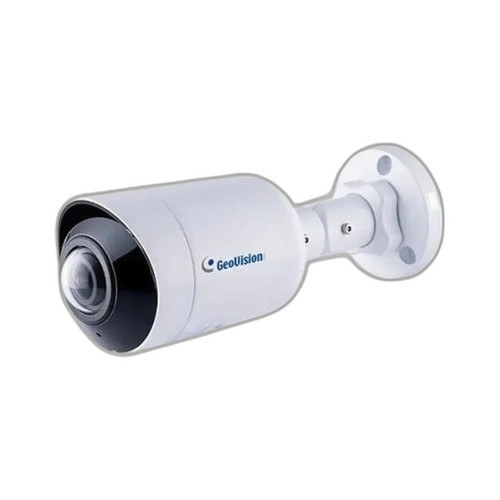
The Geovision TBLP880-0010 uses a single 1/2.7-inch CMOS sensor with a 1.68mm fixed lens at F/2.0, delivering an 8MP image across an approximately 180° horizontal field. IR illumination reaches an estimated 20–30m. WDR is listed as supported but no dB figure is provided in the available specs. Minimum illumination is not specified in the provided data.
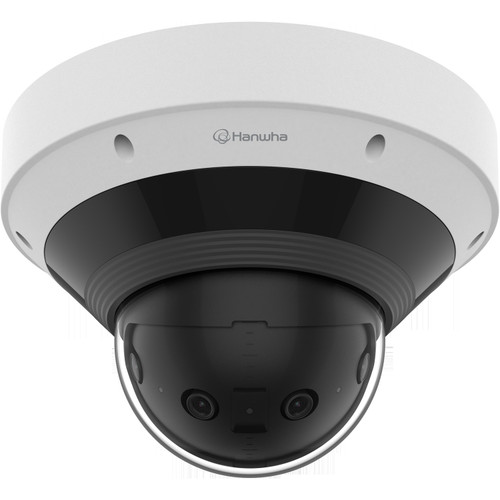
The Hanwha PNM-C9022RV uses four discrete 1/2.8-inch CMOS sensors, each fitted with a 2.8mm fixed lens at F/2.0, stitched together to produce a 5120×1568 pixel output at up to 20fps across a 209° horizontal field. Minimum illumination is 0.1 lux in color and 0 lux in IR mode, with WiseIR illumination rated to 20m (65.6ft). WDR is rated at 120dB with SSDR support, and AI-based WiseNR II and SSNR V provide digital noise reduction. The quad-sensor architecture provides a wider effective field of view and a documented low-light floor that the Geovision spec sheet does not match with equivalent published figures.
What about installation and environment?
The Geovision TBLP880-0010 is a bullet-form-factor camera measuring 137×233×160mm and weighing 1.65kg. It supports wall, pole, corner, and power-box mounting. Power is supplied via PoE 802.3af at approximately 12–13W. No IP or IK rating is provided in the available spec data, and no operating temperature range is listed.
The Hanwha PNM-C9022RV is a dome measuring Ø253×170mm and weighing 2.9kg. It requires PoE+ (IEEE 802.3at, Class 4) with a maximum draw of 24.5W, or 12VDC. It is rated IP66 and IK10, certified to NEMA 4X, and operates from -40°C to +55°C. The higher power requirement means an 802.3af-only switch cannot power this camera without an injector or midspan capable of PoE+.
Which fits your VMS and analytics better?
The Geovision TBLP880-0010 supports ONVIF Profile S and Geovision's own AI deep-learning analytics platform. No ONVIF Profile G, T, or M compliance, no edge storage specification, no audio capability, and no alarm I/O details are provided in the available specs.
The Hanwha PNM-C9022RV supports ONVIF Profile S, G, T, and M, as well as SUNAPI and the Wisenet SDK, giving it broad compatibility with third-party VMS platforms and native Wisenet VMS integration. Edge storage accepts dual microSD/SDHC/SDXC slots up to 512GB each (1TB total). It includes built-in audio in and out, 2 configurable alarm I/O ports, and AI analytics for person/vehicle classification, virtual line crossing, directional detection, loitering, intrusion, enter/exit zone events, and defocus detection. WiseStream II/III with AI engine provides adaptive bitrate reduction.
Which should you choose: the TBLP880-0010 or the C9022RV?
Our take: The Hanwha PNM-C9022RV is the stronger choice when installation conditions demand documented environmental ratings, deeper analytics, and broad VMS interoperability. Three concrete spec deltas support this: first, the PNM-C9022RV carries IP66/IK10/NEMA 4X ratings and a -40°C to +55°C operating range, while the Geovision spec sheet provides no IP, IK, or temperature data; second, the Hanwha's 120dB WDR with a published 0.1 lux color floor contrasts with the Geovision's unquantified WDR and absent illumination spec; third, the PNM-C9022RV supports ONVIF Profiles S/G/T/M plus dual-slot 1TB edge storage and alarm I/O, versus the Geovision's Profile S only with no edge storage or I/O listed. The Geovision TBLP880-0010 may suit budget-constrained deployments on 802.3af infrastructure where 180° coverage is sufficient, but buyers requiring verified outdoor ratings, PoE+ availability, or certified AI analytics should specify the PNM-C9022RV.
Side-by-Side Comparison
Spec-for-spec, from manufacturer data.
| Specification | Geovision TBLP880-0010 | Hanwha C9022RV |
|---|---|---|
| Resolution | 8MP (single sensor) | 8MP stitched / 5120×1568 (quad sensor) |
| Image Sensor | 1/2.7" CMOS (x1) | 1/2.8" CMOS (x4) |
| Lens / Focal Length | 1.68mm fixed, F/2.0 | 2.8mm fixed x4, F/2.0 |
| Horizontal Field of View | ~180° | 209° |
| Min. Illumination | — | 0.1 lux color / 0 lux IR |
| IR Range | ~20–30m (estimated) | 20m / 65.6ft (WiseIR) |
| WDR | WDR (dB not specified) | 120dB WDR + SSDR |
| Max Frame Rate | — | 20fps |
| Video Compression | H.265 | H.265 / H.264 / MJPEG |
| IP Rating | — | IP66 / NEMA 4X |
| IK / Impact Rating | — | IK10 |
| Operating Temperature | — | -40°C to +55°C |
| Power Input / PoE Class | PoE 802.3af (~12–13W) | PoE+ 802.3at Class 4 (max 24.5W) / 12VDC |
| Edge Storage | — | Dual microSD/SDHC/SDXC, max 1TB (512GB x2) |
| Audio | — | Audio in (mic/line) + audio out (line) |
| Alarm I/O | — | 2 configurable I/O ports |
| ONVIF Profiles | Profile S | Profile S / G / T / M |
| Analytics | AI Deep-Learning (Geovision) | AI person/vehicle, virtual line/area, loitering, intrusion, defocus |
| Dimensions | 137x233x160mm (5.4"x9.17"x6.3") | Ø253x170mm (9.96"x6.69") |
| Weight | 1.65kg (3.64lb) | 2.9kg (6.39lb) |
| Warranty | — | 3 years |
Frequently Asked Questions
Which should you choose: the TBLP880-0010 or the C9022RV?
The Hanwha PNM-C9022RV is the stronger choice when installation conditions demand documented environmental ratings, deeper analytics, and broad VMS interoperability. Three concrete spec deltas support this: first, the PNM-C9022RV carries IP66/IK10/NEMA 4X ratings and a -40°C to +55°C operating range, while the Geovision spec sheet provides no IP, IK, or temperature data; second, the Hanwha's 120dB WDR with a published 0.1 lux color floor contrasts with the Geovision's unquantified WDR and absent illumination spec; third, the PNM-C9022RV supports ONVIF Profiles S/G/T/M plus dual-slot 1TB edge storage and alarm I/O, versus the Geovision's Profile S only with no edge storage or I/O listed. The Geovision TBLP880-0010 may suit budget-constrained deployments on 802.3af infrastructure where 180° coverage is sufficient, but buyers requiring verified outdoor ratings, PoE+ availability, or certified AI analytics should specify the PNM-C9022RV.
Is the TBLP880-0010 or PNM-C9022RV better for low-light performance?
The Hanwha PNM-C9022RV has a published minimum illumination of 0.1 lux in color and 0 lux in IR mode with WiseIR illumination to 20m. The Geovision TBLP880-0010 spec sheet does not include a minimum illumination figure, so a direct numeric comparison cannot be made from the available data.
Can I power either camera from a standard 802.3af PoE switch?
The Geovision TBLP880-0010 is powered by 802.3af PoE at approximately 12–13W and will work on any standard PoE switch. The Hanwha PNM-C9022RV requires PoE+ (802.3at, Class 4) with a maximum draw of 24.5W, or a 12VDC supply; it cannot be reliably powered by an 802.3af-only port.
Which camera offers better VMS flexibility and edge analytics?
The Hanwha PNM-C9022RV supports ONVIF Profiles S, G, T, and M plus SUNAPI and Wisenet SDK, AI person/vehicle detection, virtual line and area analytics, dual-slot microSD edge storage up to 1TB, and alarm I/O. The Geovision TBLP880-0010 lists ONVIF Profile S and AI deep-learning analytics, but no edge storage, audio, or alarm I/O details are provided in the available specs.
Get a Second Opinion on Your Camera Choice
Share your site layout, coverage goals, and budget. Our team will validate the camera selection, flag anything we would change, and recommend products that match the use case.