
Geovision BX2600 vs Geovision BX2700V-3D010: Specification Comparison
The Geovision GV-BX2600 and GV-BX2700V-3D010 are both 2 MP box-form-factor IP cameras from Geovision, aimed at indoor or controlled-environment installations where integrators choose their own lens and mount. Both are PoE-powered and ONVIF-compliant, making them direct cross-shop candidates for a buyer selecting a 2 MP box camera for a new or mixed-brand deployment. The comparison centers on imaging fidelity, lens flexibility, compression efficiency, analytics capability, and VMS integration depth.

In This Guide
How do the imaging specs compare?
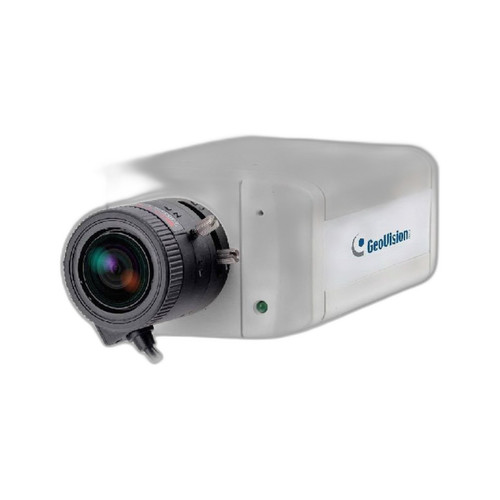
Both cameras deliver 2 MP resolution. The GV-BX2600 ships with a varifocal 3–10.5mm lens included, giving installers an immediate 3.5× optical zoom range for on-site field-of-view adjustment without sourcing a separate optic. Its WDR implementation is listed as WDR Pro. The GV-BX2700V-3D010 ships body-only with CS-mount and M12 mount compatibility, so the installer selects and sources the lens separately; this provides maximum optic flexibility but adds procurement steps. Its WDR is listed generically as WDR, without the 'Pro' qualifier present on the BX2600.
For low-light performance, the BX2700V-3D010 carries a 'Super Low Lux' minimum-illumination rating. The BX2600 spec set does not include a minimum-illumination figure or low-lux claim, so a direct lux-value comparison cannot be made from the provided data. Neither model lists an IR illumination range, so IR distance is not a differentiator available from these specs.
What about installation and environment?
Both cameras are powered exclusively via PoE and share a box form factor, so cabling and mounting footprint requirements are broadly similar. The GV-BX2600 is categorized under cable type IPCAM, while the BX2700V-3D010 is categorized IPPTZCam — a category label difference that reflects catalog classification rather than PTZ mechanical capability, as both are fixed box cameras per their type descriptions.
The BX2700V-3D010 specifies CS-mount and M12 mount compatibility, giving installers a defined mounting interface for lens selection. The BX2600 includes a varifocal lens in the package, removing the lens-mount decision but fixing the installer to that optic family. Neither product's provided specs include IP ingress rating, IK impact rating, or operating temperature range, so environmental suitability cannot be compared from the available data.
Which fits your VMS and analytics better?
Both cameras are ONVIF-compliant. The BX2700V-3D010 specifies ONVIF Profile S/T and additionally lists native compatibility with Geovision GV-System, giving operators running an all-Geovision VMS a verified integration path beyond generic ONVIF. The BX2600 lists ONVIF without specifying a profile tier, so Profile S/T compliance for the BX2600 cannot be confirmed from the provided specs.
The BX2700V-3D010 includes Face Detection as a specified edge analytic. The BX2600 does not list any edge analytics in the provided specs. On compression, the BX2700V-3D010 supports both H.265 and H.264, enabling H.265 bandwidth and storage reduction for compatible recorders. The BX2600 spec set does not list a compression codec, so H.265 support for that model cannot be confirmed. Neither camera lists audio input/output, on-board storage, or alarm I/O in the provided specs.
Which should you choose: the BX2600 or the BX2700V-3D010?
Our take: The BX2700V-3D010 is the stronger choice when storage efficiency, low-light performance, and deeper VMS or analytic integration are priorities. It specifies H.265 compression (absent from BX2600 specs), a Super Low Lux minimum-illumination rating (no equivalent claimed for BX2600), Face Detection edge analytics (not listed for BX2600), and verified ONVIF Profile S/T plus native Geovision GV-System compatibility (BX2600 lists ONVIF without profile detail). The BX2600 holds a practical installation advantage: it ships with a varifocal 3–10.5mm lens included and carries a WDR Pro designation versus the BX2700V-3D010's unqualified WDR, making it a lower-friction, lens-included deployment for sites with moderate lighting complexity. Choose the BX2700V-3D010 for H.265 NVR environments, Geovision-native VMS deployments, or sites needing face-detection analytics; choose the BX2600 where a bundled varifocal lens and WDR Pro are sufficient and simplicity of procurement matters.
Side-by-Side Comparison
Spec-for-spec, from manufacturer data.
| Specification | Geovision BX2600 | Geovision BX2700V-3D010 |
|---|---|---|
| Resolution | 2 MP | 2 MP |
| Form Factor | Box | Box |
| Lens / Focal Length | Varifocal 3–10.5mm (included) | CS-mount / M12 (lens not included) |
| WDR | WDR Pro | WDR |
| Min Illumination | — | Super Low Lux |
| Video Compression | — | H.265; H.264 |
| ONVIF | Yes | Yes (Profile S/T) |
| VMS Compatibility | ONVIF | ONVIF Profile S/T; Geovision GV-System |
| Edge Analytics | — | Face Detection |
| Power | PoE | PoE |
Frequently Asked Questions
Which should you choose: the BX2600 or the BX2700V-3D010?
The BX2700V-3D010 is the stronger choice when storage efficiency, low-light performance, and deeper VMS or analytic integration are priorities. It specifies H.265 compression (absent from BX2600 specs), a Super Low Lux minimum-illumination rating (no equivalent claimed for BX2600), Face Detection edge analytics (not listed for BX2600), and verified ONVIF Profile S/T plus native Geovision GV-System compatibility (BX2600 lists ONVIF without profile detail). The BX2600 holds a practical installation advantage: it ships with a varifocal 3–10.5mm lens included and carries a WDR Pro designation versus the BX2700V-3D010's unqualified WDR, making it a lower-friction, lens-included deployment for sites with moderate lighting complexity. Choose the BX2700V-3D010 for H.265 NVR environments, Geovision-native VMS deployments, or sites needing face-detection analytics; choose the BX2600 where a bundled varifocal lens and WDR Pro are sufficient and simplicity of procurement matters.
Is the BX2600 or BX2700V-3D010 better for low-light conditions?
Based on the provided specs, the BX2700V-3D010 is the only model with a low-light claim — it lists 'Super Low Lux' minimum illumination. The BX2600 does not include a minimum-illumination figure in its specs, so no direct lux comparison can be made. If low-light performance is a deciding factor, the BX2700V-3D010 has the only documented specification supporting it.
Do I need to buy a lens separately for either camera?
Yes — for the BX2700V-3D010. It ships as a body-only unit with CS-mount and M12 mount interfaces, requiring the installer to source a compatible lens. The BX2600 includes a varifocal 3–10.5mm lens in the package, so it is ready to mount and aim without additional optic procurement.
Which camera works better with a Geovision GV-System VMS?
The BX2700V-3D010 explicitly lists Geovision GV-System as a compatible VMS alongside ONVIF Profile S/T. The BX2600 lists ONVIF compatibility but does not specify Geovision GV-System native support or an ONVIF profile tier in the provided specs. For a confirmed, manufacturer-documented integration with GV-System, the BX2700V-3D010 is the better-documented choice.
Get a Second Opinion on Your Camera Choice
Share your site layout, coverage goals, and budget. Our team will validate the camera selection, flag anything we would change, and recommend products that match the use case.