
Digital Watchdog C223W vs Hanwha XNB-6000: Specification Comparison
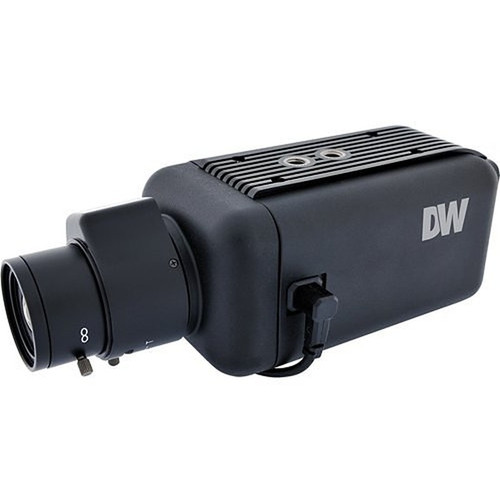
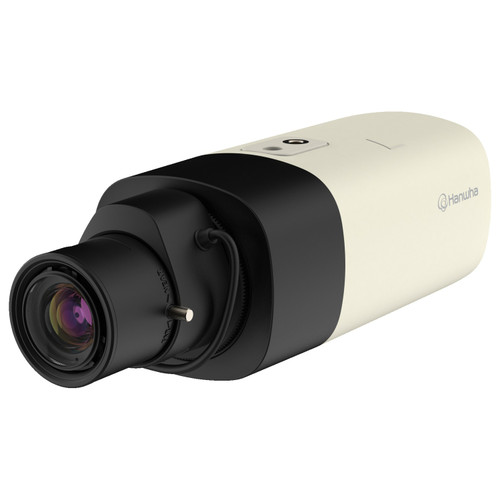
Both the Digital Watchdog DWC-C223W and the Hanwha XNB-6000 are wired, 2MP box-type IP cameras designed for installations requiring interchangeable C/CS-mount lenses. Both carry IP66 ratings and support 12VDC and 24VAC power inputs. This comparison examines how they differ across imaging performance, installation requirements, and VMS/analytics integration — three dimensions that typically drive the final selection decision for integrators specifying a box camera in a supervised, fixed-scene application.
In This Guide
How do the imaging specs compare?
The DWC-C223W uses a 1/3" 2.1MP CMOS sensor with an active pixel array of 1944 × 1092 and achieves a minimum color illumination of 0.20 lux, backed by 100dB True WDR. Its Star-Light sense-up multiplier (Off, ×2–×32) extends low-light color sensitivity without external IR, and it supports Smart DNR™ 3D digital noise reduction, BLC, de-fog, DRC, and a gamma range of 0.45–0.75. Shutter speed spans 1/30 to 1/30,000 sec.
The XNB-6000 uses a larger 1/2.8" CMOS sensor and achieves a minimum color illumination of 0.01 lux — 20× more sensitive than the C223W in color mode — dropping further to 0.001 lux in B/W mode via auto ICR. Its WDR rating is 150dB versus the C223W's 100dB, a 50dB advantage. The XNB-6000 also adds digital image stabilization via a built-in gyro sensor and lens distortion correction (LDC), neither of which is specified for the C223W. Max frame rate is listed at 60fps for the XNB-6000; the C223W lists its frame rate as variable with no numeric maximum stated.
What about installation and environment?
Both cameras are IP66-rated and box-form-factor with C/CS-mount lens compatibility. The DWC-C223W supports 12VDC or 24VAC only (max 2.4W) and has no PoE; the XNB-6000 adds PoE IEEE 802.3af Class 3 (max 7.5W) alongside 12VDC and 24VAC, giving installers cable-run flexibility. The C223W is lighter at 0.70 lb (0.32 kg) versus the XNB-6000's 0.93 lb (0.42 kg), and its footprint (119.7 × 58.8 × 62mm) is more compact than the XNB-6000's 73.1 × 66.6 × 147.8mm body.
Operating temperature ranges differ: the DWC-C223W is rated −20°C to +50°C (−4°F to +122°F), while the XNB-6000 is rated −10°C to +55°C (−14°F to +131°F). The C223W tolerates 10°C lower cold-start temperatures, relevant in unheated enclosures; the XNB-6000 tolerates 5°C higher heat. IK impact rating is not specified for either model. The XNB-6000 provides a micro USB output (1280×720) and CVBS output for installation focus assist; CVBS/analog-out is also present on the C223W (CVBS/960H, HD-Analog, HD-CVI, HD-TVI), making it additionally compatible with hybrid analog-over-coax DVR head-ends — a capability not listed for the XNB-6000.
Which fits your VMS and analytics better?
The XNB-6000 offers substantially broader integration credentials: ONVIF Profile S/G/T, SUNAPI (HTTP API), Wisenet open platform, SNMPv1/v2c/v3, 802.1X authentication (EAP-TLS, EAP-LEAP), HTTPS/SSL, digest authentication, IP address filtering, and user access logging. Its analytics suite includes defocus detection, directional detection, fog detection, face detection, digital auto tracking, appear/disappear, enter/exit, loitering, tampering, virtual line, audio detection, and sound classification. On-board edge storage supports dual micro SD/SDHC/SDXC slots up to 512GB (256GB × 2). Audio is bidirectional: selectable mic-in/line-in/built-in mic plus line out. Video compression covers H.265, H.264 (Main/Baseline/High), and MJPEG with WiseStream II smart codec and up to 10 concurrent streaming profiles.
The DWC-C223W's network integration specifications are not provided in the supplied data — ONVIF compliance, video compression formats, streaming profiles, supported protocols, and security features are all absent from its spec sheet. It offers 16 programmable privacy masks (versus 32 on the XNB-6000), motion detection, and serial PTZ control via Pelco C and Pelco D protocols. No on-board edge storage, audio, or ONVIF profile is listed. Integrators relying on ONVIF-based VMS connectivity, edge analytics, or H.265 bandwidth savings cannot confirm those capabilities from the available C223W specifications.
Which should you choose: the C223W or the XNB-6000?
Our take: The XNB-6000 is the stronger choice when low-light performance, network integration depth, and analytics capability are the deciding criteria. Its 0.001 lux B/W sensitivity is 200× below the C223W's 0.20 lux color floor, its WDR rating is 150dB versus 100dB, and it adds PoE 802.3af Class 3 where the C223W requires a dedicated 12VDC or 24VAC run. The XNB-6000 also ships with confirmed ONVIF Profile S/G/T, H.265 compression, dual-slot edge storage up to 512GB, and a 13-function onboard analytics suite — none of which are specified for the C223W. The C223W warrants consideration when the deployment requires a hybrid analog-over-coax head-end (CVBS/HD-CVI/HD-TVI/HD-Analog output), operation below −10°C, Pelco PTZ serial control from the camera body, or a 5-year warranty versus the XNB-6000's 3-year coverage.
Side-by-Side Comparison
Spec-for-spec, from manufacturer data.
| Specification | Digital Watchdog C223W | Hanwha XNB-6000 |
|---|---|---|
| Resolution | 2.1MP / 1080p (1944 × 1092) | 2MP |
| Image Sensor | 1/3" CMOS | 1/2.8" CMOS |
| Lens Mount | C/CS mount | C mount, CS mount; DC auto iris, P iris, Manual, I-CS |
| Min. Illumination (Color) | 0.20 lux | 0.01 lux |
| Min. Illumination (B/W) | — | 0.001 lux |
| Wide Dynamic Range | 100dB True WDR | 150dB WDR |
| Max Frame Rate | Variable (no numeric max stated) | 60fps |
| Video Compression | Not specified | H.265 / H.264 (Main/Baseline/High) / MJPEG |
| IP Rating | IP66 | IP66 |
| Operating Temperature | −20°C to +50°C (−4°F to +122°F) | −10°C to +55°C (−14°F to +131°F) |
| Power Input / PoE | 12VDC, 24VAC (no PoE) | PoE IEEE 802.3af Class 3, 12VDC, 24VAC |
| Max Power Consumption | 2.4W | 7.5W |
| Edge Storage | — | Dual micro SD/SDHC/SDXC, max 512GB |
| Audio | — | Mic in / Line in / Built-in mic; Line out |
| ONVIF | — | Profile S/G/T |
| Onboard Analytics | Motion detection, 16 privacy masks | 13-function suite incl. directional, loitering, face detection, audio detection |
| Alarm I/O | 1 output | 1 input / 1 output |
| Dimensions (W × H × D) | 119.7 × 58.8 × 62mm (4.71" × 2.31" × 2.44") | 73.1 × 66.6 × 147.8mm (2.88" × 2.62" × 5.82") |
| Weight | 0.32 kg (0.70 lb) | 0.42 kg (0.93 lb) |
| Warranty | 5 years | 3 years |
Frequently Asked Questions
Which should you choose: the C223W or the XNB-6000?
The XNB-6000 is the stronger choice when low-light performance, network integration depth, and analytics capability are the deciding criteria. Its 0.001 lux B/W sensitivity is 200× below the C223W's 0.20 lux color floor, its WDR rating is 150dB versus 100dB, and it adds PoE 802.3af Class 3 where the C223W requires a dedicated 12VDC or 24VAC run. The XNB-6000 also ships with confirmed ONVIF Profile S/G/T, H.265 compression, dual-slot edge storage up to 512GB, and a 13-function onboard analytics suite — none of which are specified for the C223W. The C223W warrants consideration when the deployment requires a hybrid analog-over-coax head-end (CVBS/HD-CVI/HD-TVI/HD-Analog output), operation below −10°C, Pelco PTZ serial control from the camera body, or a 5-year warranty versus the XNB-6000's 3-year coverage.
Is the DWC-C223W or XNB-6000 better for low-light performance?
The XNB-6000 is significantly more capable in low light. Its minimum illumination is 0.001 lux in B/W mode (auto ICR) and 0.01 lux in color, compared to 0.20 lux color for the DWC-C223W. The XNB-6000 also carries a 150dB WDR rating versus 100dB on the C223W, giving it an advantage in high-contrast scenes as well.
Can either camera work with PoE switches to avoid running a separate power cable?
Only the XNB-6000 supports PoE — it is IEEE 802.3af Class 3 compliant. The DWC-C223W requires a dedicated 12VDC or 24VAC power supply; PoE is not listed in its specifications.
Which camera is better suited to a hybrid analog/IP infrastructure?
The DWC-C223W is the better fit for hybrid environments. It outputs CVBS/960H, HD-Analog, HD-CVI, and HD-TVI signals in addition to IP, making it compatible with coax-based DVR and hybrid head-ends. The XNB-6000 provides CVBS and USB outputs only for installation/focus use; full analog signal output over coax is not listed in its specifications.
Get a Second Opinion on Your Camera Choice
Share your site layout, coverage goals, and budget. Our team will validate the camera selection, flag anything we would change, and recommend products that match the use case.