
Comelit 6205W vs ACTi Q950: Specification Comparison
Both the Comelit 6205W and ACTi Q950 are PoE-powered, wall-mountable door station intercoms designed for access control at entry points — products a buyer sourcing a video door station would legitimately cross-shop. The 6205W is a hands-free thermal intercom targeting Comelit-ecosystem residential and commercial deployments, while the Q950 is a 6MP outdoor IP door station with IR night vision and ONVIF compatibility for open-platform VMS integration. This comparison evaluates them across imaging and audio capability, environmental and physical installation fit, and system integration and power.

In This Guide
- How do the imaging technology and audio capabilities differ between the 6205W and Q950?
- Which unit is better suited for outdoor, high-traffic, or harsh-environment installation?
- How do the two units differ in system integration, protocol support, and ecosystem compatibility?
- Which should you choose: the 6205W or the Q950?
- Side-by-Side Specs
- FAQ
How do the imaging technology and audio capabilities differ between the 6205W and Q950?
The Comelit 6205W uses a thermal imaging sensor at 121×121 pixel resolution, enabling occupancy and presence detection in low-light or no-light conditions without relying on visible-light imaging. Its audio implementation is hands-free two-way intercom, with an audio input confirmed in the spec sheet. Video compression is H.264. No megapixel count, lens specification, or optical sensor details are provided in the available specs.
The ACTi Q950 delivers 6MP visible-light video with a 1.65mm wide-angle lens, H.264 compression, and an IR illuminator supplemented by Wide Dynamic Range (WDR) processing for high-contrast scenes. Audio is two-way. Resolution and lens data are explicitly stated; however, IR range distance is listed only as 'IR' with no numeric distance provided in the supplied specs.
These are fundamentally different imaging modalities: the 6205W detects thermal presence at very low resolution, while the Q950 captures high-resolution visible facial detail with IR-assisted night vision. A buyer needing facial recognition quality or high-detail video recording should note the Q950's 6MP advantage; a buyer prioritizing contactless detection in total darkness or privacy-sensitive environments may find the 6205W's thermal approach preferable.
Which unit is better suited for outdoor, high-traffic, or harsh-environment installation?
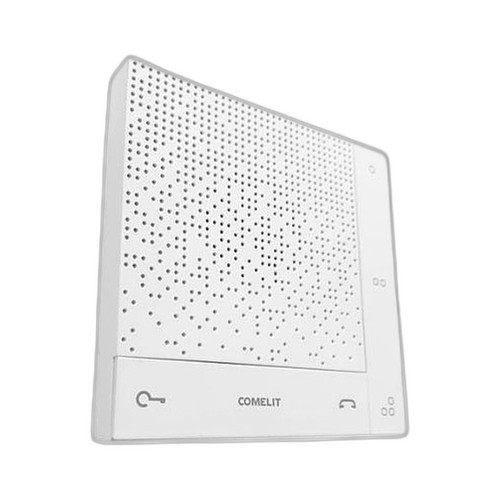
The Comelit 6205W carries an IP30 ingress protection rating, which indicates protection against solid objects greater than 2.5mm but provides no rated protection against water or moisture. It is specified for wall mounting, with published dimensions of 121.2mm × 121.2mm × 25mm (approximately 4.76" × 4.76" × 0.98"). Its housing is white. The IP30 rating makes it unsuitable for direct outdoor exposure to rain or washdown.
The ACTi Q950 carries an IP66 rating, confirming full dust exclusion and protection against powerful water jets. It is described as an outdoor-rated door station and supports wall or post mounting. Housing is also white. No physical dimensions are provided in the available specs for the Q950.
For any outdoor installation — covered or uncovered — the Q950's IP66 rating is the decisive advantage. The 6205W's IP30 rating restricts it to controlled indoor or fully sheltered vestibule environments. Installers specifying an exposed exterior entry point should not substitute the 6205W without additional weatherproofing enclosure.
How do the two units differ in system integration, protocol support, and ecosystem compatibility?
The Comelit 6205W is specified for integration with Comelit Door Entry & Access Control Systems. No ONVIF compliance, VMS compatibility list, or third-party protocol support is stated in the available specifications. Buyers deploying outside the Comelit ecosystem should confirm compatibility independently, as the spec data does not indicate open-protocol support.
The ACTi Q950 is explicitly ONVIF Profile S/T compliant and is listed as compatible with ONVIF-based VMS platforms. This enables integration with the broad range of NVRs and video management software that support ONVIF, including multi-vendor environments. No proprietary ecosystem lock-in is implied by the available specs.
Both units draw power via PoE 802.3af. The Q950 draws approximately 13W; no wattage figure is provided for the 6205W beyond the PoE 802.3af power type designation. For integrators managing PoE switch budgets across large deployments, the Q950's ~13W draw is a known planning figure; the 6205W's power consumption requires datasheet verification.
Which should you choose: the 6205W or the Q950?
Our take: The Q950 is the stronger choice when the installation site is outdoors, requires high-resolution facial-detail video, or must integrate with a non-Comelit VMS platform. Concretely: the Q950 carries IP66 vs the 6205W's IP30, making it the only rated-outdoor option of the two; it delivers 6MP visible resolution vs the 6205W's 121×121 thermal output, a significant delta for identity verification use cases; and it is explicitly ONVIF Profile S/T compliant while the 6205W's integration scope is limited to the Comelit ecosystem per available specs. The 6205W is the better fit for indoor or fully sheltered Comelit-system deployments where hands-free contactless detection, thermal presence sensing, and native Comelit wiring compatibility are the primary requirements — particularly in hygiene-sensitive or privacy-sensitive lobbies where visible-light facial capture is undesirable.
Side-by-Side Comparison
Spec-for-spec, from manufacturer data.
| Specification | Comelit 6205W | ACTi Q950 |
|---|---|---|
| Product Class | Hands-Free Door Entry Phone | Door Station Outdoor Intercom |
| Resolution | 121×121 px (thermal) | 6MP (visible light) |
| Imaging Technology | Thermal | Visible-light with IR |
| IR Night Vision | — | Yes (range not specified in specs) |
| WDR | — | Yes |
| Video Compression | H.264 | H.264 |
| Audio | Two-way hands-free intercom | Two-way |
| IP Rating | IP30 | IP66 |
| Environment | Indoor / sheltered | Outdoor-rated |
| Power | PoE (802.3af) | PoE (802.3af) |
| Power Consumption | — | ~13W |
| Mount Type | Wall | Wall; Post |
| ONVIF Compliance | — | ONVIF Profile S/T |
| Ecosystem / Integration | Comelit Door Entry & Access Control | ONVIF-compatible VMS platforms |
| Housing Color | White | White |
| Warranty | 2-Year | 3-Year |
| Dimensions (mm) | 121.2 × 121.2 × 25 | — |
Frequently Asked Questions
Which should you choose: the 6205W or the Q950?
The Q950 is the stronger choice when the installation site is outdoors, requires high-resolution facial-detail video, or must integrate with a non-Comelit VMS platform. Concretely: the Q950 carries IP66 vs the 6205W's IP30, making it the only rated-outdoor option of the two; it delivers 6MP visible resolution vs the 6205W's 121×121 thermal output, a significant delta for identity verification use cases; and it is explicitly ONVIF Profile S/T compliant while the 6205W's integration scope is limited to the Comelit ecosystem per available specs. The 6205W is the better fit for indoor or fully sheltered Comelit-system deployments where hands-free contactless detection, thermal presence sensing, and native Comelit wiring compatibility are the primary requirements — particularly in hygiene-sensitive or privacy-sensitive lobbies where visible-light facial capture is undesirable.
Can either unit be installed at an exposed exterior door without additional weatherproofing?
Only the ACTi Q950 is rated for direct outdoor exposure — it carries an IP66 rating (dust-tight, protected against powerful water jets). The Comelit 6205W is rated IP30, which provides no water ingress protection and is not suitable for uncovered outdoor installation without a separate weatherproof enclosure.
Will either door station work with my existing non-Comelit NVR or VMS?
The ACTi Q950 is explicitly ONVIF Profile S/T compliant, making it compatible with any VMS or NVR that supports ONVIF. The Comelit 6205W's available specs describe integration only with Comelit Door Entry and Access Control Systems; no ONVIF or third-party VMS compatibility is stated, so buyers should verify with Comelit before deploying it in a mixed-brand environment.
Is the 6205W or Q950 better for after-hours or low-light entry monitoring?
They address low-light differently. The 6205W uses thermal imaging (121×121 resolution) to detect presence regardless of visible light — effective for occupancy detection but not for facial identification. The Q950 uses an IR illuminator combined with WDR and 6MP visible-light capture, providing detailed video in low-light conditions while retaining facial-detail quality. The right choice depends on whether the priority is contactless presence detection (6205W) or identifiable video evidence (Q950); IR distance for the Q950 is listed as 'IR' without a numeric range in the available specs.
More Intercom Comparisons
- Ubiquiti UA-G3-INTERCOM vs SDC IPDSE
- Ubiquiti UA-G3-INTERCOM vs Comelit TP6842
- Ubiquiti UA-G3-INTERCOM vs ACTi Q950
- Axis 03448-001 vs Axis 02892-001
- Comelit TP6842 vs ACTi Q950
- Comelit TP6842 vs Comelit 3460HEV
Intercom Buying Guides
Get a Second Opinion on Your Camera Choice
Share your site layout, coverage goals, and budget. Our team will validate the camera selection, flag anything we would change, and recommend products that match the use case.