
Axis Q1971-E vs Axis Q1972-E: Specification Comparison
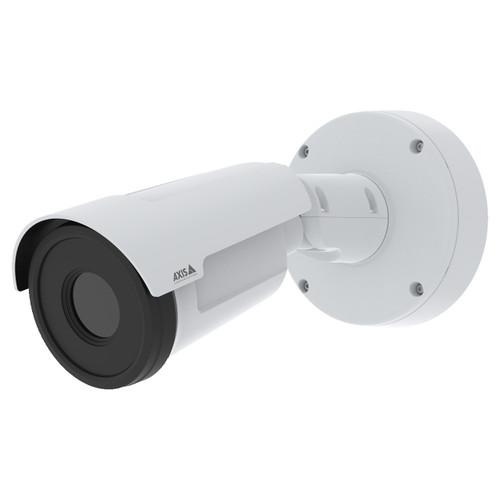
The Axis Q1971-E (SKU 02950-001) and Q1972-E (SKU 03029-001) are both outdoor thermal bullet cameras from Axis's Q19-series, sharing the same housing format, IP66/IK10 ratings, PoE+ Class 3 power, and dual H.265/H.264 compression with Zipstream. The core differentiator is thermal sensor resolution: the Q1971-E delivers QVGA (384×288) imagery while the Q1972-E steps up to VGA (640×480). Both are intended for 24/7 perimeter detection in complete darkness, fog, or smoke, making them direct cross-shop candidates for the same application but at different image-detail budgets.
In This Guide
How do the imaging specs compare?
The Q1971-E uses an uncooled microbolometer sensor at 384×288 pixels with a 17 μm pixel pitch, paired with a 19 mm F1.24 athermalized lens delivering a 19° horizontal × 15° vertical field of view. Thermal sensitivity is specified at <20 mK NETD at 25°C across the 8–14 μm spectral range. Maximum frame rate is 8.3 fps. The Q1972-E uses a VGA uncooled microbolometer at 640×480 pixels paired with a 19 mm F1.0 athermalized lens producing a wider 31° horizontal × 24° vertical field of view. Thermal sensitivity is also specified at <20 mK NETD at 25°C across the same 8–14 μm spectral range. The Q1972-E supports up to 30 fps in one operating mode and 8.3 fps in another, giving it significantly more temporal resolution than the Q1971-E.
Pixel pitch for the Q1972-E sensor is not stated in the provided specs. The Q1971-E's narrower FOV (19° vs 31° horizontal) means it covers a tighter scene at equivalent range, which can aid object discrimination at distance; the Q1972-E's wider FOV covers more area per frame but with the advantage of 2.78× more pixels to resolve detail across that wider scene. Minimum illumination is effectively 0 lux for both, as both rely on passive thermal imaging rather than visible light or active IR illumination. The Q1971-E spec lists image stabilization; the Q1972-E also lists image stabilization, so both share that feature.
What about installation and environment?
Both cameras are rated IP66 and IK10, and both carry NEMA 4X certification per Q1971-E specs (NEMA 4X is not explicitly listed for the Q1972-E in the provided specs). The Q1971-E specifies an operating temperature range of -40°C to 60°C (-40°F to 140°F); operating temperature for the Q1972-E is not stated in the provided specs. Both are powered by PoE+ at Class 3. Both are bullet-form outdoor cameras supporting wall and ceiling mounting; the Q1972-E additionally lists pendant as a supported mount style. Housing color is white for both.
The Q1971-E carries FIPS 140-2 Level 2 certified key storage via Axis Edge Vault, which is relevant for U.S. federal or high-assurance deployments. Axis Edge Vault and FIPS 140-2 are not listed in the Q1972-E specs. Both units list signed firmware, secure boot, and HTTPS encryption as cybersecurity features.
Which fits your VMS and analytics better?
Both cameras include on-board Perimeter Defender and Video Motion Detection (VMD) analytics. VMS compatibility for the Q1971-E is explicitly listed as ONVIF, Axis Camera Station, and Milestone XProtect; the Q1972-E lists ONVIF compliance but does not enumerate specific VMS partners in the provided specs. Both support audio input. Local storage via microSD card is confirmed for both models.
The Q1972-E spec notes support for up to 20 simultaneous H.265/H.264 streams; a comparable multi-stream count is not stated for the Q1971-E. The Q1971-E additionally lists H.264 with Zipstream explicitly; the Q1972-E lists H.265, H.264, and MJPEG. MJPEG is not listed for the Q1971-E in the provided specs. Both cameras list ONVIF Profile compliance, making them broadly compatible with third-party VMS platforms that support the ONVIF standard.
Which should you choose: the Q1971-E or the Q1972-E?
Our take: The Q1972-E is the stronger choice when scene coverage and image detail are the priority: its 640×480 VGA sensor delivers 2.78× more pixels than the Q1971-E's 384×288 QVGA sensor, its lens opens to F1.0 versus F1.24, and it supports up to 30 fps versus the Q1971-E's fixed 8.3 fps maximum. Both cameras match on thermal sensitivity (<20 mK NETD at 25°C), IP66/IK10 weatherproofing, PoE+ Class 3 power, Perimeter Defender analytics, and microSD local storage. The Q1971-E is the stronger choice for deployments requiring FIPS 140-2 Level 2 certified key storage (Axis Edge Vault, confirmed in spec) or verified Milestone XProtect compatibility (explicitly listed), and for applications where a tighter 19° × 15° FOV is tactically preferable to the Q1972-E's wider 31° × 24° view. Operating temperature for the Q1972-E is not stated in the provided specs, so cold-climate suitability should be verified with Axis directly before specifying it in sub-zero environments.
Side-by-Side Comparison
Spec-for-spec, from manufacturer data.
| Specification | Axis Q1971-E | Axis Q1972-E |
|---|---|---|
| Thermal Sensor Resolution | 384×288 (QVGA) | 640×480 (VGA) |
| Sensor Type | Uncooled microbolometer | Uncooled microbolometer |
| Pixel Pitch | 17 μm | — |
| Spectral Range | 8–14 μm | 8–14 μm |
| Thermal Sensitivity (NETD) | <20 mK @ 25°C | <20 mK @ 25°C |
| Lens / Focal Length | 19 mm F1.24 athermalized | 19 mm F1.0 athermalized |
| Field of View (H × V) | 19° × 15° | 31° × 24° |
| Max Frame Rate | 8.3 fps | 30 fps / 8.3 fps |
| Video Compression | H.265; H.264; Zipstream | H.265; H.264; MJPEG |
| Edge Analytics | Perimeter Defender; VMD | Perimeter Defender; VMD |
| IP Rating | IP66 (NEMA 4X) | IP66 |
| IK / Impact Rating | IK10 | IK10 |
| Operating Temperature | -40°C to 60°C | — |
| Power Input / PoE Class | PoE+ Class 3 | PoE+ Class 3 |
| Edge Storage | microSD | microSD |
| Audio | Audio input | Audio input |
| Mount Types | Wall; Ceiling | Wall; Ceiling; Pendant |
| Cybersecurity | Signed firmware; Secure boot; Axis Edge Vault; FIPS 140-2 L2 | Signed firmware; Secure boot; HTTPS |
| VMS Compatibility | ONVIF; Axis Camera Station; Milestone XProtect | ONVIF |
| Warranty | 5 years | 5 years |
Frequently Asked Questions
Which should you choose: the Q1971-E or the Q1972-E?
The Q1972-E is the stronger choice when scene coverage and image detail are the priority: its 640×480 VGA sensor delivers 2.78× more pixels than the Q1971-E's 384×288 QVGA sensor, its lens opens to F1.0 versus F1.24, and it supports up to 30 fps versus the Q1971-E's fixed 8.3 fps maximum. Both cameras match on thermal sensitivity (<20 mK NETD at 25°C), IP66/IK10 weatherproofing, PoE+ Class 3 power, Perimeter Defender analytics, and microSD local storage. The Q1971-E is the stronger choice for deployments requiring FIPS 140-2 Level 2 certified key storage (Axis Edge Vault, confirmed in spec) or verified Milestone XProtect compatibility (explicitly listed), and for applications where a tighter 19° × 15° FOV is tactically preferable to the Q1972-E's wider 31° × 24° view. Operating temperature for the Q1972-E is not stated in the provided specs, so cold-climate suitability should be verified with Axis directly before specifying it in sub-zero environments.
Is the Q1971-E or Q1972-E better for detecting people at long range in complete darkness?
The Q1972-E's VGA 640×480 sensor provides 2.78× more pixels than the Q1971-E's QVGA 384×288 sensor, which generally supports finer object discrimination at equivalent range. Both share the same <20 mK NETD thermal sensitivity and the same 19 mm focal length, so the Q1972-E's higher pixel count is the primary advantage for long-range detection detail. However, the Q1971-E's narrower 19° × 15° field of view concentrates those fewer pixels on a tighter scene, which can partially offset the resolution gap depending on deployment geometry.
Do both cameras work with Milestone XProtect?
Milestone XProtect is explicitly listed as a compatible VMS in the Q1971-E specifications. The Q1972-E lists ONVIF compliance but does not name Milestone XProtect in the provided specs. Because Milestone XProtect supports ONVIF, the Q1972-E should be interoperable in practice, but buyers requiring confirmed factory support should verify Q1972-E compatibility with Axis or Milestone directly before specifying.
Which camera is rated for extreme cold environments?
The Q1971-E specifies an operating temperature range of -40°C to 60°C (-40°F to 140°F). An operating temperature range for the Q1972-E is not stated in the provided specifications. Installers deploying in sub-zero environments should confirm the Q1972-E's cold-temperature rating with Axis before selection.
Get a Second Opinion on Your Camera Choice
Share your site layout, coverage goals, and budget. Our team will validate the camera selection, flag anything we would change, and recommend products that match the use case.