
Axis M3905-R vs Axis P3925-R: Specification Comparison
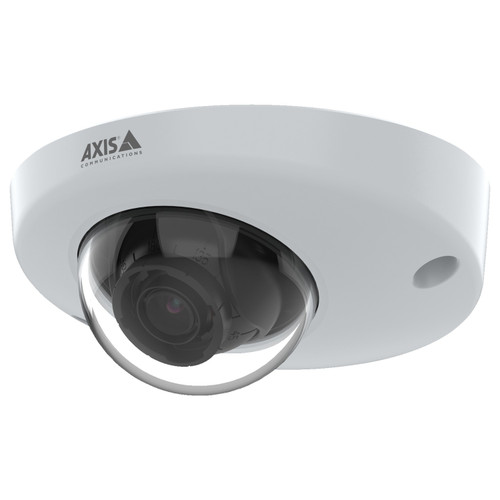
Both the Axis M3905-R (03119-001) and the Axis P3925-R M12 (01933-021, sold as a 10-pack) are 2MP fixed-dome cameras from Axis, rated IP66/IP67 and designed for mobile and vehicle surveillance in harsh environments. The comparison covers imaging performance, installation requirements, and platform integration — the two key differentiators being the connector type (RJ45 vs. M12 vibration-resistant), PoE class draw, and low-light technology (IR-based vs. Lightfinder).
In This Guide
How do the imaging specs compare?
Both cameras deliver 1920×1080 (2MP) resolution with Forensic WDR and H.265/H.264 compression. The M3905-R uses a 3.6mm fixed lens and relies on 940nm invisible IR illumination for low-light performance, with an IR range of 0.3m — a figure consistent with very close-range vehicle interior or cabin use. The P3925-R uses a wider 2.8mm fixed lens at F1.6 aperture and employs Axis Lightfinder technology, achieving 0.06 lux color and 0.01 lux monochrome sensitivity at 30 fps without active IR. No minimum illumination figure is specified for the M3905-R.
The P3925-R's Lightfinder approach with a fast F1.6 aperture is designed to deliver usable color imagery in near-darkness without an IR emitter, whereas the M3905-R's built-in IR is rated for a very short 0.3m range, indicating it is optimized for close-in detail capture rather than distance illumination. The P3925-R also specifies MJPEG as an additional compression option alongside H.265 and H.264; the M3905-R spec lists only H.265 and H.264.
What about installation and environment?
Both cameras carry IP66/IP67 ratings and an operating temperature range of -40°C to 60°C (-40°F to 140°F), making both suitable for outdoor and mobile deployments in extreme conditions. The P3925-R adds an IK10 impact resistance rating; no IK rating is specified for the M3905-R. The P3925-R uses a vibration-resistant M12 female connector — purpose-built for vehicle and rail installations where cable retention under vibration is critical. The M3905-R uses a standard RJ45 connector.
On power, the M3905-R is PoE+ Class 1 (low draw), while the P3925-R is PoE+ Class 5, drawing up to 25.5W maximum — relevant for switch budget planning in fleet deployments. The M3905-R lists Wall and Rack mount types; the P3925-R lists Corner, Column, and Ceiling. The P3925-R is sold as a 10-pack (SKU 01933-021), which is a procurement packaging consideration rather than a per-unit spec difference. Both housings are white.
Which fits your VMS and analytics better?
Both cameras support ONVIF Profile S, Axis Camera Station, and Milestone XProtect. Both support microSD on-board storage; the M3905-R spec explicitly states up to 512GB, while the P3925-R spec notes a microSD slot without specifying a capacity ceiling. Neither camera lists audio (no microphone or speaker spec is present for either model).
Both cameras include HTTPS encryption. The M3905-R additionally specifies Signed Firmware and Secure Boot as distinct cybersecurity features; these are not listed in the P3925-R spec data provided. Neither camera lists edge analytics (e.g., object classification or deep learning) in the provided specs. The M3905-R VMS compatibility list includes Milestone XProtect by name; the P3925-R spec truncates to 'Milestone' without specifying the product line — both are treated as equivalent for practical integration purposes.
Which should you choose: the M3905-R or the P3925-R?
Our take: The P3925-R is the stronger choice for vehicle and mobile fleet deployments where vibration resistance, impact tolerance, and low-light color imaging are priorities: it adds an IK10 impact rating absent from the M3905-R, uses a vibration-resistant M12 connector engineered for rail and in-vehicle cabling, and delivers specified low-light performance of 0.06 lux color / 0.01 lux monochrome via Lightfinder — versus the M3905-R's IR range of only 0.3m with no lux figure published. The M3905-R, by contrast, draws significantly less power at PoE+ Class 1 versus the P3925-R's Class 5 (25.5W max), which matters when powering multiple cameras off a vehicle switch with limited PoE budget. The M3905-R also explicitly documents Signed Firmware and Secure Boot, which may be relevant in security-sensitive deployments. Choose the M3905-R for power-constrained installs with hardened cybersecurity requirements; choose the P3925-R for high-vibration, low-light environments requiring color night imagery and impact-rated hardware.
Side-by-Side Comparison
Spec-for-spec, from manufacturer data.
| Specification | Axis M3905-R | Axis P3925-R |
|---|---|---|
| Resolution | 2MP (1920×1080) | 2MP (1920×1080) |
| Lens / Focal Length | 3.6mm fixed | 2.8mm fixed, F1.6 |
| Low-Light Technology | 940nm invisible IR | Lightfinder (passive) |
| Min Illumination | — | 0.06 lux color; 0.01 lux monochrome @ F1.6, 30 fps |
| IR Range | 0.3m | — |
| Wide Dynamic Range | Forensic WDR | Forensic WDR |
| Max Frame Rate | — | 30 fps |
| Video Compression | H.265; H.264 | H.265; H.264; MJPEG |
| IP Rating | IP66/IP67 | IP66/IP67 |
| IK / Impact Rating | — | IK10 |
| Operating Temperature | -40°C to 60°C | -40°C to 60°C (-40°F to 140°F) |
| Connector Type | RJ45 | M12 female vibration-resistant |
| Power / PoE Class | PoE+ Class 1 | PoE+ Class 5 (25.5W max) |
| Edge Storage | microSD (up to 512GB) | microSD (capacity ceiling not specified) |
| Cybersecurity | HTTPS; Signed Firmware; Secure Boot | HTTPS encryption |
| ONVIF | Profile S | Profile S |
| VMS Compatibility | Axis Camera Station; Milestone XProtect; ONVIF | Axis Camera Station; Milestone; ONVIF |
| Warranty | 5 Year(s) | 5 Year(s) |
Frequently Asked Questions
Which should you choose: the M3905-R or the P3925-R?
The P3925-R is the stronger choice for vehicle and mobile fleet deployments where vibration resistance, impact tolerance, and low-light color imaging are priorities: it adds an IK10 impact rating absent from the M3905-R, uses a vibration-resistant M12 connector engineered for rail and in-vehicle cabling, and delivers specified low-light performance of 0.06 lux color / 0.01 lux monochrome via Lightfinder — versus the M3905-R's IR range of only 0.3m with no lux figure published. The M3905-R, by contrast, draws significantly less power at PoE+ Class 1 versus the P3925-R's Class 5 (25.5W max), which matters when powering multiple cameras off a vehicle switch with limited PoE budget. The M3905-R also explicitly documents Signed Firmware and Secure Boot, which may be relevant in security-sensitive deployments. Choose the M3905-R for power-constrained installs with hardened cybersecurity requirements; choose the P3925-R for high-vibration, low-light environments requiring color night imagery and impact-rated hardware.
Is the M3905-R or P3925-R better for low-light performance?
Based on the provided specs, the P3925-R has a published low-light spec of 0.06 lux color and 0.01 lux monochrome at F1.6 via Lightfinder technology. The M3905-R uses 940nm invisible IR illumination but its IR range is only 0.3m and no minimum lux figure is listed in the spec data. For low-light color imaging at useful distances, the P3925-R's specs are more defined.
Which camera is better suited for in-vehicle or rail installations?
The P3925-R is specifically designed for vehicle and rail use: it features a vibration-resistant M12 female connector (versus the M3905-R's standard RJ45), carries an IK10 impact resistance rating (not specified on the M3905-R), and is sold in a 10-pack for fleet deployment. The M3905-R uses RJ45 and has no IK rating listed, making the P3925-R the more purpose-built option for high-vibration environments.
Does the higher PoE class of the P3925-R matter for switch planning?
Yes. The P3925-R draws PoE+ Class 5 (up to 25.5W), while the M3905-R is PoE+ Class 1 — a substantially lower power draw. When deploying multiple cameras on a vehicle or rail PoE switch with a fixed wattage budget, the M3905-R's lower consumption allows more cameras per switch port budget. For large fleets, this difference should be factored into switch and power-injector specifications.
Get a Second Opinion on Your Camera Choice
Share your site layout, coverage goals, and budget. Our team will validate the camera selection, flag anything we would change, and recommend products that match the use case.