
APC by Schneider Electric SRT3000XLT vs APC by Schneider Electric SRT3000XLW-IEC: Specification Comparison
Both the SRT3000XLT and SRT3000XLW-IEC are APC Smart-UPS On-Line double-conversion tower units rated at 3000 VA / 2700 W — the same power class and topology. The SRT3000XLT targets North American installations with NEMA connectors and a 208 V primary input, while the SRT3000XLW-IEC is configured for international or mixed-voltage environments with IEC outlets and multi-standard input plugs. This comparison examines output connectivity and voltage flexibility, operating environment and physical form factor, and battery / runtime expandability — the three axes that most determine which unit fits a given deployment.
In This Guide
- Which unit offers the right output connections and voltage flexibility for your installation?
- How do the two units compare on operating environment tolerances and physical installation requirements?
- What do the battery specifications, runtime expandability, and management interfaces look like for each model?
- Which should you choose: the SRT3000XLT or the SRT3000XLW-IEC?
- Side-by-Side Specs
- FAQ
Which unit offers the right output connections and voltage flexibility for your installation?
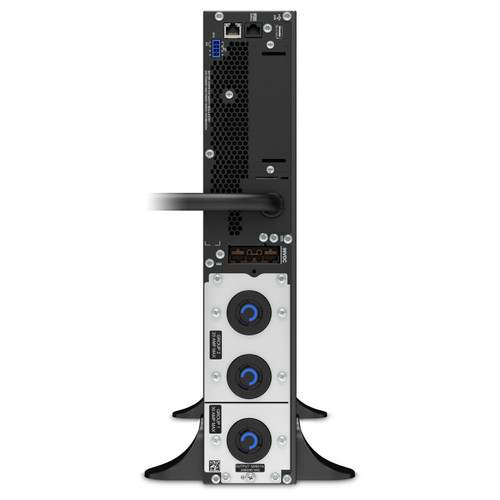
The SRT3000XLT provides NEMA-format outlets: two NEMA L6-20R receptacles and one NEMA L6-30R receptacle, all rated at 208 V primary output with an additional 240 V option. Its input connection is a single NEMA L6-20P plug on a 10 ft (3.05 m) cord. This makes it purpose-built for North American data-center and equipment-room environments that use twist-lock NEMA wiring.
The SRT3000XLW-IEC instead provides ten IEC-format protected output connections: six IEC 320 C13, two IEC jumpers, and two IEC 320 C19 — all battery-backed. Its nominal output covers 208 V and 230 V, configurable to 220 V or 240 V, and its input accepts British BS1363A, IEC-320 C20, and Schuko CEE 7/EU1-16P plugs on an 8.0 ft (2.4 m) cord. The IEC model therefore supports a wider range of international device power supplies and mixed-standard environments out of the box.
Output voltage distortion is specified as less than 2% for both models. Output frequency synchronization to mains is 50/60 Hz ±3 Hz on both. Load crest factor is 3:1 on both. Surge energy rating is stated as 340 joules for the SRT3000XLW-IEC; this figure is not provided in the SRT3000XLT spec sheet.
How do the two units compare on operating environment tolerances and physical installation requirements?
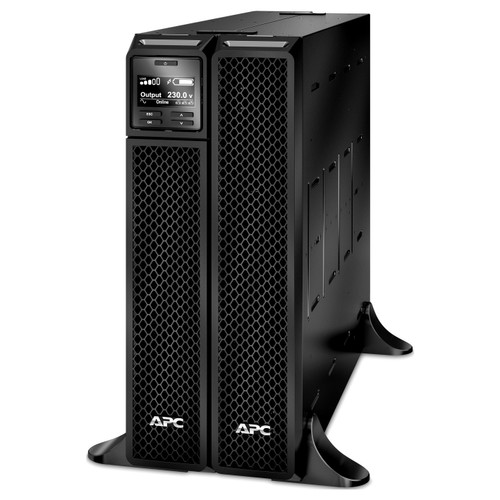
Both units are tower-mounted and finish in black. The SRT3000XLW-IEC provides explicit full dimensions of 17.0 × 3.3 × 25.0 in (43.2 × 8.5 × 63.5 cm) and a package weight of 75 lb. The SRT3000XLT lists only one dimension — 17.01 in (43.2 cm) — and a unit weight of 69.00 lb (31.3 kg); full depth and width are not stated in the provided spec. Both units also support rack mounting with a kit; the SRT3000XLT notes front-facing, lower-preference, vertical rack orientation.
Operating temperature differs: the SRT3000XLW-IEC is rated 32–104 °F (0–40 °C), while the SRT3000XLT does not list an operating temperature range in the provided specs (only a storage range of 5–113 °F / -15–45 °C is given). Storage conditions are comparable: both specify 0–95% non-condensing humidity and a -15–45 °C temperature range.
Operating altitude is 0–10,000 ft (per the SRT3000XLT spec) versus 0–9,843 ft / 0–3,000 m for the SRT3000XLW-IEC — a negligible real-world difference. Acoustic noise is 55 dBA for both. Heat dissipation differs: 773 BTU/h for the SRT3000XLT versus 703 BTU/h for the SRT3000XLW-IEC — a 70 BTU/h gap relevant to HVAC load calculations. Both carry an IP20 protection rating. The SRT3000XLW-IEC lists regulatory approvals including UL 1778, CE, CSA C22.2, ENERGY STAR V1.0 (USA and EU), FCC Part 15 Class A, RoHS, and VDE; the SRT3000XLT spec sheet does not enumerate approvals.
What do the battery specifications, runtime expandability, and management interfaces look like for each model?
Battery chemistry, included module count, typical recharge time, replacement battery, RBC quantity, and runtime extendability are identical between the two models: sealed lead-acid, 1 included module, 3-hour recharge, APCRBC152 replacement, RBC quantity 1, and runtime extendable. Battery life expectancy is 3–5 years on both.
The SRT3000XLT provides additional battery detail: 96 V battery voltage, 165 W charge power, 497 VAh runtime capacity, and a full matrix of optional SRT96BP battery packs scaling from 1 to 10 additional packs (1,491 VAh to 10,437 VAh incremental capacity). The SRT3000XLW-IEC lists one extended run option (APC-Smart-UPS-SRT-3000VA-208-230V-IEC) without detailing the incremental VAh values. Battery voltage and charge power are not stated in the SRT3000XLW-IEC spec.
Management interfaces differ notably. The SRT3000XLW-IEC explicitly lists RJ45 Serial, SmartSlot, and USB interface ports, plus a multi-function LCD status and control console. The SRT3000XLT spec notes 0 power module free slots and 0 power module filled slots, and references 1 free slot, but does not enumerate communication interface types in the provided data. Both units implement internal automatic and manual bypass and provide audible and visible alarms prioritized by severity.
Which should you choose: the SRT3000XLT or the SRT3000XLW-IEC?
Our take: The SRT3000XLW-IEC is the stronger choice when the deployment requires international or mixed-standard power connectivity, broader regulatory compliance, or explicit interface documentation. It provides ten IEC-format battery-backed outlets versus the SRT3000XLT's three NEMA outlets — a significant outlet-count advantage for dense equipment racks — and runs cooler at 703 BTU/h versus 773 BTU/h, reducing HVAC overhead. It also carries a documented approval set (UL, CE, CSA, ENERGY STAR, FCC, VDE, RoHS) not enumerated in the SRT3000XLT spec. Conversely, the SRT3000XLT is the appropriate selection for purely North American NEMA L6 wiring infrastructure, and its spec sheet provides granular battery expansion data (up to 10,437 VAh via SRT96BP packs) that the SRT3000XLW-IEC spec does not match in detail. Both units are rated identically at 3000 VA / 2700 W with double-conversion online topology and sine-wave output.
Side-by-Side Comparison
Spec-for-spec, from manufacturer data.
| Specification | APC by Schneider Electric SRT3000XLT | APC by Schneider Electric SRT3000XLW-IEC |
|---|---|---|
| Rated Power | 2700 W / 3000 VA | 2700 W / 3000 VA |
| UPS Topology | Double Conversion Online | Double Conversion Online |
| Waveform | Sine wave | Sine wave |
| Nominal Input Voltage | 208 V (also 240 V) | 208 V & 230 V (also 220 V & 240 V) |
| Input Connection | NEMA L6-20P | BS1363A, IEC-320 C20, Schuko CEE 7/EU1-16P |
| Cord Length | 10 ft (3.05 m) | 8.0 ft (2.4 m) |
| Nominal Output Voltage | 208 V (also 240 V) | 208 V & 230 V (configurable 220 V or 240 V) |
| Output Connections | (2) NEMA L6-20R, (1) NEMA L6-30R | (6) IEC C13, (2) IEC Jumpers, (2) IEC C19 |
| Bypass Type | Internal Automatic and Manual | Internal Automatic and Manual |
| Heat Dissipation | 773 BTU/h | 703 BTU/h |
| Acoustic Noise | 55 dBA | 55 dBA |
| Operating Altitude | 0–10,000 ft | 0–9,843 ft (0–3,000 m) |
| Battery Type | Sealed lead-acid | Maintenance-free sealed lead-acid |
| Typical Recharge Time | 3 hours | 3 hours |
| Expected Battery Life | 3–5 years | 3–5 years |
| Surge Energy Rating | — | 340 joules |
| Interface Ports | — | RJ45 Serial, SmartSlot, USB |
| Regulatory Approvals | — | UL 1778, CE, CSA, ENERGY STAR V1.0, FCC Part 15 Class A, VDE, RoHS |
| Unit Weight | 69.00 lb (31.3 kg) | 75 lb (package weight) |
| IP Rating | IP20 | IP20 |
Frequently Asked Questions
Which should you choose: the SRT3000XLT or the SRT3000XLW-IEC?
The SRT3000XLW-IEC is the stronger choice when the deployment requires international or mixed-standard power connectivity, broader regulatory compliance, or explicit interface documentation. It provides ten IEC-format battery-backed outlets versus the SRT3000XLT's three NEMA outlets — a significant outlet-count advantage for dense equipment racks — and runs cooler at 703 BTU/h versus 773 BTU/h, reducing HVAC overhead. It also carries a documented approval set (UL, CE, CSA, ENERGY STAR, FCC, VDE, RoHS) not enumerated in the SRT3000XLT spec. Conversely, the SRT3000XLT is the appropriate selection for purely North American NEMA L6 wiring infrastructure, and its spec sheet provides granular battery expansion data (up to 10,437 VAh via SRT96BP packs) that the SRT3000XLW-IEC spec does not match in detail. Both units are rated identically at 3000 VA / 2700 W with double-conversion online topology and sine-wave output.
Can I use the SRT3000XLW-IEC in a North American data center wired for NEMA L6 outlets?
Not without adapters or rewiring. The SRT3000XLW-IEC accepts British BS1363A, IEC-320 C20, and Schuko input plugs and provides IEC 320 C13/C19 output receptacles. It does not include NEMA L6-series connectors. For a NEMA L6-wired North American installation, the SRT3000XLT with its NEMA L6-20P input and NEMA L6-20R/L6-30R outputs is the correct fit.
Is the SRT3000XLT or SRT3000XLW-IEC better for maximizing extended runtime with add-on battery packs?
The SRT3000XLT spec sheet explicitly documents up to 10 additional SRT96BP battery packs, scaling from 1,491 VAh to 10,437 VAh of incremental capacity. The SRT3000XLW-IEC spec lists one named extended-run option without detailing incremental VAh values. If granular, scalable runtime expansion with documented capacity figures is a requirement, the SRT3000XLT provides that data directly; the SRT3000XLW-IEC spec does not.
Which unit generates less heat, and does it matter for my equipment room?
The SRT3000XLW-IEC is specified at 703 BTU/h online thermal dissipation versus 773 BTU/h for the SRT3000XLT — a difference of 70 BTU/h. In a small installation this gap is minor, but in a dense deployment with multiple UPS units it can meaningfully affect cooling load calculations. Both units are otherwise rated identically at 55 dBA acoustic noise and IP20 protection.
More UPS Comparisons
- APC by Schneider Electric SMT3000RMI2U vs Vertiv GXT5-3000LVRT2UXL
- APC by Schneider Electric SMT3000RMI2U vs Panduit U03N11L
- APC by Schneider Electric SMT3000RMI2U vs Panduit U03N12L
- APC by Schneider Electric SMT3000RMI2U vs Panduit U03S12V
- APC by Schneider Electric SMT3000RMI2U vs APC by Schneider Electric SRT3000XLT
- APC by Schneider Electric SMT3000RMI2U vs APC by Schneider Electric SRT3000XLW-IEC
UPS Buying Guides
Get a Second Opinion on Your Camera Choice
Share your site layout, coverage goals, and budget. Our team will validate the camera selection, flag anything we would change, and recommend products that match the use case.