
APC by Schneider Electric SMT3000RM2UCUS vs APC by Schneider Electric SRT3000XLT: Specification Comparison
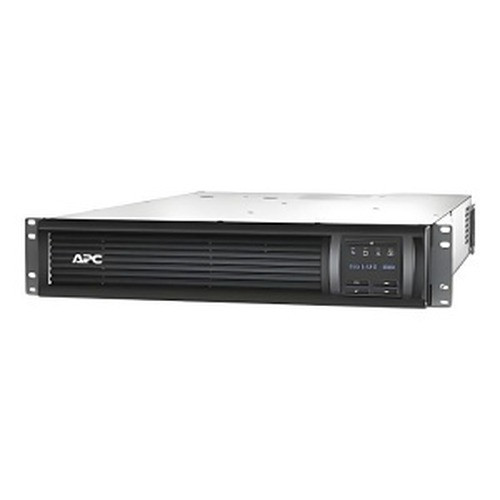
Both the SMT3000RM2UCUS and SRT3000XLT are APC Smart-UPS units rated at 2700 W / 3000 VA, designed to protect IT and network equipment in rack environments. The comparison spans topology, input/output voltage architecture, physical format, and runtime-extension capability — the axes that most determine fit for a given data-center or server-room deployment. Neither unit is an accessory; both are standalone UPS platforms in the same capacity class and are legitimately cross-shopped by installers and IT buyers.
In This Guide
- Which topology delivers cleaner power and how does each unit handle the load?
- Do the input/output voltage and connector types match the facility's power infrastructure?
- How do the units compare for runtime scalability and rack installation?
- Which should you choose: the SMT3000RM2UCUS or the SRT3000XLT?
- Side-by-Side Specs
- FAQ
Which topology delivers cleaner power and how does each unit handle the load?
The SRT3000XLT uses Double Conversion Online topology, meaning the load runs continuously off inverter-synthesized sine-wave power with zero transfer time to battery. Its harmonic distortion is specified at less than 2% and it includes an Internal Bypass (both automatic and manual). The SMT3000RM2UCUS uses Line Interactive topology with a 6 ms typical / 10 ms maximum transfer time and harmonic distortion of less than 5%. Both deliver true sine-wave output, but the SRT3000XLT's double-conversion design provides tighter isolation from input anomalies — important for sensitive servers, storage arrays, or medical/industrial loads where even momentary transients matter. The SMT3000RM2UCUS's line-interactive design is adequate for most standard IT loads and is more power-efficient under normal utility conditions.
Heat dissipation figures reflect the efficiency gap: the SRT3000XLT is specified at 773 Btu/h versus 348 Btu/h for the SMT3000RM2UCUS — the always-converting double-conversion design carries a higher thermal cost. Buyers must factor this into rack and room cooling budgets. The SRT3000XLT also lists a crest factor of 3:1, which is not specified for the SMT3000RM2UCUS.
Do the input/output voltage and connector types match the facility's power infrastructure?
The SMT3000RM2UCUS is a 120 V AC unit throughout. Its input plug is NEMA L5-30P (30 A, 120 V twist-lock), and it provides six NEMA 5-15R output receptacles — the standard North American 15 A outlets found in most office and light data-center environments. Cable length is 8 ft (2.4 m).
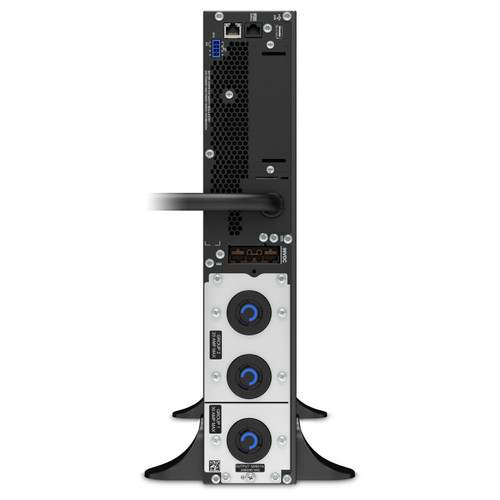
The SRT3000XLT operates at 208 V (with 240 V also supported on both input and output). Its input connector is NEMA L6-20P and outputs are (2) NEMA L6-20R plus (1) NEMA L6-30R — higher-voltage, higher-density connectors common in dedicated data-center circuits and raised-floor environments. The unit is noted as configurable for 208 or 240 V nominal output. Cable length is 10 ft (3.05 m). These two units cannot serve the same outlet type; the voltage architecture is the primary binary selection criterion for most buyers.
How do the units compare for runtime scalability and rack installation?
The SMT3000RM2UCUS ships as a self-contained 2U rack-mount unit (3.4 in H × 17.008 in W × 26.9 in D) weighing 97.62 lb. It occupies a defined 2U footprint with no listed external battery expansion options in the provided specs. Battery charge power is rated at 172 W; typical recharge time is 3 hours. It has 1 free management card slot.
The SRT3000XLT is rack-mounted with kit (not self-contained rack-ready) and mounts vertically; only one dimension is specified (17.01 in / 43.2 cm) in the provided data — height and depth are not listed. It weighs 69.00 lb — approximately 28.6 lb lighter than the SMT3000RM2UCUS despite similar VA rating, reflecting the 208 V design. Critically, the SRT3000XLT supports extensive runtime extension: battery options are documented from 1 to 10 additional SRT96BP packs (491 to 10,437 VAh), and replaceable battery modules are identified (APCRBC152, SRT96RMBPUS). Battery charge power is 165 W rated. The SMT3000RM2UCUS lists no equivalent expansion path in the provided specs.
Which should you choose: the SMT3000RM2UCUS or the SRT3000XLT?
Our take: The SMT3000RM2UCUS is the stronger choice when the facility runs standard 120 V North American circuits and cost-efficient line-interactive protection is sufficient for the load. The SRT3000XLT is the stronger choice for 208/240 V data-center infrastructure requiring zero-transfer-time double-conversion power quality. Three concrete spec deltas drive the decision: (1) topology — Double Conversion Online (SRT3000XLT) vs. Line Interactive with up to 10 ms transfer (SMT3000RM2UCUS); (2) harmonic distortion — less than 2% (SRT3000XLT) vs. less than 5% (SMT3000RM2UCUS); and (3) runtime scalability — the SRT3000XLT supports up to 10 external battery packs (up to 10,437 VAh documented) while no expansion path is specified for the SMT3000RM2UCUS. Choose the SMT3000RM2UCUS for standard office server rooms on 120 V circuits; choose the SRT3000XLT for high-density 208 V data-center racks where runtime extension and topology purity are non-negotiable.
Side-by-Side Comparison
Spec-for-spec, from manufacturer data.
| Specification | APC by Schneider Electric SMT3000RM2UCUS | APC by Schneider Electric SRT3000XLT |
|---|---|---|
| UPS Topology | Line Interactive | Double Conversion Online |
| Rated Power (W) | 2700 W | 2700 W |
| Rated Power (VA) | 2880 VA | 3000 VA |
| Input Voltage | 120 V AC | 208 V / 240 V AC |
| Input Connector | NEMA L5-30P | NEMA L6-20P |
| Output Voltage | 120 V AC | 208 V / 240 V AC (configurable) |
| Output Connectors | 6× NEMA 5-15R | (2) NEMA L6-20R, (1) NEMA L6-30R |
| Transfer Time | 6 ms typical / 10 ms max | 0 ms (double conversion) |
| Harmonic Distortion | < 5% | < 2% |
| Waveform | Sine wave | Sine wave |
| Battery Type | Lead-Acid | Lead-Acid |
| Battery Charge Power | 172 W rated | 165 W rated |
| Typical Recharge Time | 3 h | 3 h |
| Battery Life | 3–5 years | 3–5 years |
| Runtime Extension | Not specified | Up to 10× SRT96BP packs (to 10,437 VAh) |
| Heat Dissipation | 348 Btu/h | 773 Btu/h |
| Acoustic Level | 55 dBA | 55 dBA |
| Mounting | Rack-mount, 2U self-contained | Rack-mount with kit, vertical |
| Weight | 97.62 lb (44.28 kg) | 69.00 lb (31.3 kg) |
| Dimensions (H×W×D) | 3.4 × 17.008 × 26.9 in | 17.01 in (one dimension specified) |
| Cable Length | 8 ft (2.4 m) | 10 ft (3.05 m) |
| Surge Energy Rating | 459 J | — |
| Bypass | Not specified | Internal (automatic and manual) |
| Operating Altitude | 0–10,000 ft | 0–10,000 ft |
| Operating Temperature | 32–104 °F (0–40 °C) | Not specified |
| Relative Humidity (Operating) | 0–95% | 0–95% non-condensing |
| Certifications | cULus, ENERGY STAR V2.0, TAA | Not specified |
| Free Management Slots | 1 | 1 |
| Warranty | 24 months (36 months contractual) | Not specified |
| IP Rating | Not specified | IP20 |
Frequently Asked Questions
Which should you choose: the SMT3000RM2UCUS or the SRT3000XLT?
The SMT3000RM2UCUS is the stronger choice when the facility runs standard 120 V North American circuits and cost-efficient line-interactive protection is sufficient for the load. The SRT3000XLT is the stronger choice for 208/240 V data-center infrastructure requiring zero-transfer-time double-conversion power quality. Three concrete spec deltas drive the decision: (1) topology — Double Conversion Online (SRT3000XLT) vs. Line Interactive with up to 10 ms transfer (SMT3000RM2UCUS); (2) harmonic distortion — less than 2% (SRT3000XLT) vs. less than 5% (SMT3000RM2UCUS); and (3) runtime scalability — the SRT3000XLT supports up to 10 external battery packs (up to 10,437 VAh documented) while no expansion path is specified for the SMT3000RM2UCUS. Choose the SMT3000RM2UCUS for standard office server rooms on 120 V circuits; choose the SRT3000XLT for high-density 208 V data-center racks where runtime extension and topology purity are non-negotiable.
Can I plug the SMT3000RM2UCUS and SRT3000XLT into the same type of outlet?
No. The SMT3000RM2UCUS uses a NEMA L5-30P plug (120 V, 30 A twist-lock) and the SRT3000XLT uses a NEMA L6-20P plug (208/240 V, 20 A twist-lock). They require entirely different facility circuits. Voltage architecture — 120 V versus 208/240 V — is the first filter to apply before comparing any other spec.
Which unit is better if I need to extend runtime for a critical server during long outages?
The SRT3000XLT is the clear choice. Its specs document support for up to 10 SRT96BP external battery packs, scaling runtime capacity from the base 497 VAh to as much as 10,437 VAh. The SMT3000RM2UCUS specs provided do not list any external battery expansion option.
Is the double-conversion topology of the SRT3000XLT worth the extra heat output for a typical IT room?
That depends on load sensitivity and cooling budget. Double conversion eliminates transfer time entirely and holds harmonic distortion below 2%, versus up to 10 ms transfer and less than 5% THD for the line-interactive SMT3000RM2UCUS. However, the SRT3000XLT dissipates 773 Btu/h compared to 348 Btu/h for the SMT3000RM2UCUS — more than double — which is a real cooling cost. For standard servers and network switches, line interactive is generally adequate; for sensitive storage, virtualization hosts, or any load intolerant of micro-interruptions, the double-conversion design is the safer specification.
More UPS Comparisons
- APC by Schneider Electric SMT3000RMI2U vs Vertiv GXT5-3000LVRT2UXL
- APC by Schneider Electric SMT3000RMI2U vs Panduit U03N11L
- APC by Schneider Electric SMT3000RMI2U vs Panduit U03N12L
- APC by Schneider Electric SMT3000RMI2U vs Panduit U03S12V
- APC by Schneider Electric SMT3000RMI2U vs APC by Schneider Electric SRT3000XLT
- APC by Schneider Electric SMT3000RMI2U vs APC by Schneider Electric SRT3000XLW-IEC
UPS Buying Guides
Get a Second Opinion on Your Camera Choice
Share your site layout, coverage goals, and budget. Our team will validate the camera selection, flag anything we would change, and recommend products that match the use case.