
APC by Schneider Electric SMC1500C vs APC by Schneider Electric SMT1500X93: Specification Comparison
Both the SMC1500C and SMT1500X93 are 1440 VA / Line-Interactive tower UPS units from APC by Schneider Electric, designed for small-to-medium IT loads on 120 V North American circuits. Each delivers sine-wave output and eight NEMA outlets, making them natural cross-shop candidates for workstations, network closets, and edge security equipment. The comparison centers on runtime margin (wattage headroom), input voltage tolerance, surge protection, and connectivity—the four axes that most directly affect reliability in the field.
In This Guide
- Which unit delivers more usable runtime and power headroom for the connected load?
- How do the two units compare on input voltage tolerance and surge protection?
- Which model offers better connectivity and management integration options?
- Which should you choose: the SMC1500C or the SMT1500X93?
- Side-by-Side Specs
- FAQ
Which unit delivers more usable runtime and power headroom for the connected load?
The SMT1500X93 is rated at 1000 W output versus the SMC1500C's 900 W, a 100 W (11%) advantage on real power. For a buyer who has profiled a load at, say, 850 W, only the SMT1500X93 can handle it without overloading the UPS. Conversely, a load of 800 W or less fits comfortably within both units. Both share the same 1440 VA apparent-power ceiling and identical sine-wave output waveforms, so waveform quality is not a differentiator. The 100 W gap matters most in dense NVR or server-room builds where rack draw creeps toward the UPS ceiling.
How do the two units compare on input voltage tolerance and surge protection?
Input tolerance is measurably wider on the SMT1500X93: it accepts voltages from 82 V to 144 V before switching to battery, versus the SMC1500C's 85 V–136 V window. The lower floor (82 V vs 85 V) means the SMT1500X93 rides through deeper brownouts on battery less frequently, preserving battery life in electrically noisy environments. The upper ceiling advantage (144 V vs 136 V) likewise prevents unnecessary battery cycling during high-line events. Surge energy rating is marginally higher on the SMT1500X93 at 693 J compared to 680 J on the SMC1500C—a 2% difference that is unlikely to be decisive in practice. Both units include EMI/RFI noise filtering; the SMC1500C explicitly specifies this, while the SMT1500X93 specification does not list it, so that feature cannot be confirmed for the SMT1500X93 from the provided data.
Which model offers better connectivity and management integration options?
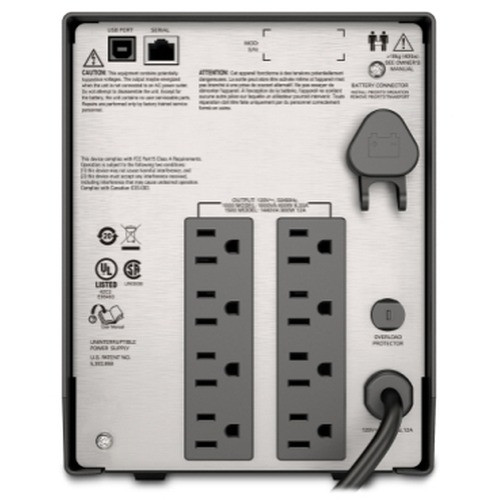
The SMT1500X93 specifies a USB Type-B management port, enabling software-driven shutdown and monitoring via APC's PowerChute ecosystem. The SMC1500C's specification does not list any USB or network port, so USB connectivity cannot be confirmed for it from the provided data. Both units specify 8 NEMA 5-15R AC outlets; the SMC1500C references 'NEMA' outlets in the product title but does not break out outlet type or count in the formal spec fields, whereas the SMT1500X93 explicitly states 8 × NEMA 5-15R and a NEMA 5-15P input plug. For IT environments requiring automated graceful shutdown or integration with a monitoring platform, the SMT1500X93's confirmed USB port is a concrete advantage.
Which should you choose: the SMC1500C or the SMT1500X93?
Our take: The SMT1500X93 is the stronger choice when the connected load exceeds 900 W, when the installation site experiences wide voltage swings, or when USB-based management and graceful shutdown are required. Concretely: it delivers 1000 W versus the SMC1500C's 900 W (+100 W), accepts input as low as 82 V versus 85 V (wider brownout ride-through), and explicitly provides a USB Type-B management port that the SMC1500C does not confirm. The SMC1500C explicitly lists EMI/RFI noise filtering—a feature the SMT1500X93 specification does not confirm—making it potentially preferable in environments with high electrical noise where filtering is a priority. Where loads are consistently below 900 W and management connectivity is handled externally, either unit is technically viable; the SMT1500X93's wider tolerances and confirmed USB port give it the edge for most security and IT infrastructure deployments.
Side-by-Side Comparison
Spec-for-spec, from manufacturer data.
| Specification | APC by Schneider Electric SMC1500C | APC by Schneider Electric SMT1500X93 |
|---|---|---|
| UPS Topology | Line-Interactive | Line-Interactive |
| Output Power Capacity | 1440 VA | 1440 VA |
| Output Power (Watts) | 900 W | 1000 W |
| Waveform | Sine | Sine |
| Input Voltage Min | 85 V | 82 V |
| Input Voltage Max | 136 V | 144 V |
| Input Frequency | 50/60 Hz | 50/60 Hz |
| Output Voltage Min | 110 V | — |
| Output Voltage Max | 127 V | 120 V |
| Output Frequency | 50/60 Hz | 50/60 Hz |
| Surge Energy Rating | 680 J | 693 J |
| Transfer / Response Time | 6–10 ms hold time | 6 ms response time |
| Output Voltage THD | 5% | — |
| EMI/RFI Noise Filtering | Yes | — |
| Noise Level | 45 dB | 45 dB |
| USB Management Port | — | USB Type-B |
| AC Outlets | 8 × NEMA (type not specified in spec fields) | 8 × NEMA 5-15R |
| Input Plug | — | NEMA 5-15P |
| Audible Alarm | Yes | Yes |
Frequently Asked Questions
Which should you choose: the SMC1500C or the SMT1500X93?
The SMT1500X93 is the stronger choice when the connected load exceeds 900 W, when the installation site experiences wide voltage swings, or when USB-based management and graceful shutdown are required. Concretely: it delivers 1000 W versus the SMC1500C's 900 W (+100 W), accepts input as low as 82 V versus 85 V (wider brownout ride-through), and explicitly provides a USB Type-B management port that the SMC1500C does not confirm. The SMC1500C explicitly lists EMI/RFI noise filtering—a feature the SMT1500X93 specification does not confirm—making it potentially preferable in environments with high electrical noise where filtering is a priority. Where loads are consistently below 900 W and management connectivity is handled externally, either unit is technically viable; the SMT1500X93's wider tolerances and confirmed USB port give it the edge for most security and IT infrastructure deployments.
Is the SMC1500C or SMT1500X93 better for powering a high-draw NVR with multiple HDDs?
The SMT1500X93 is the safer choice for high-draw NVRs. Its 1000 W output rating gives 100 W more headroom than the SMC1500C's 900 W. If your NVR, switch, and ancillary gear total more than 900 W, only the SMT1500X93 can support that load within spec.
Which UPS handles brownouts better—the SMC1500C or the SMT1500X93?
The SMT1500X93 tolerates a wider input voltage range (82 V–144 V) versus the SMC1500C (85 V–136 V). In areas prone to brownouts or high-line conditions, the SMT1500X93 will switch to battery less frequently, preserving battery life and providing more stable runtime.
Can I monitor and schedule shutdowns remotely with either of these UPS units?
The SMT1500X93 explicitly specifies a USB Type-B port, which supports APC PowerChute-style software monitoring and graceful shutdown. The SMC1500C's provided specifications do not list a USB or network management port, so that capability cannot be confirmed for it from the available spec data.
More UPS Comparisons
- APC by Schneider Electric SMC1500-2UC vs Vertiv PSA6-1500LVT
- APC by Schneider Electric SMC1500-2UC vs Vertiv PSA6E-1500LVT
- APC by Schneider Electric SMC1500-2UC vs APC by Schneider Electric SMC1500C
- APC by Schneider Electric SMC1500-2UC vs APC by Schneider Electric SMT1500X93
- APC by Schneider Electric SMC1500C vs Vertiv PSA6-1500LVT
- APC by Schneider Electric SMC1500C vs Vertiv PSA6E-1500LVT
UPS Buying Guides
Get a Second Opinion on Your Camera Choice
Share your site layout, coverage goals, and budget. Our team will validate the camera selection, flag anything we would change, and recommend products that match the use case.